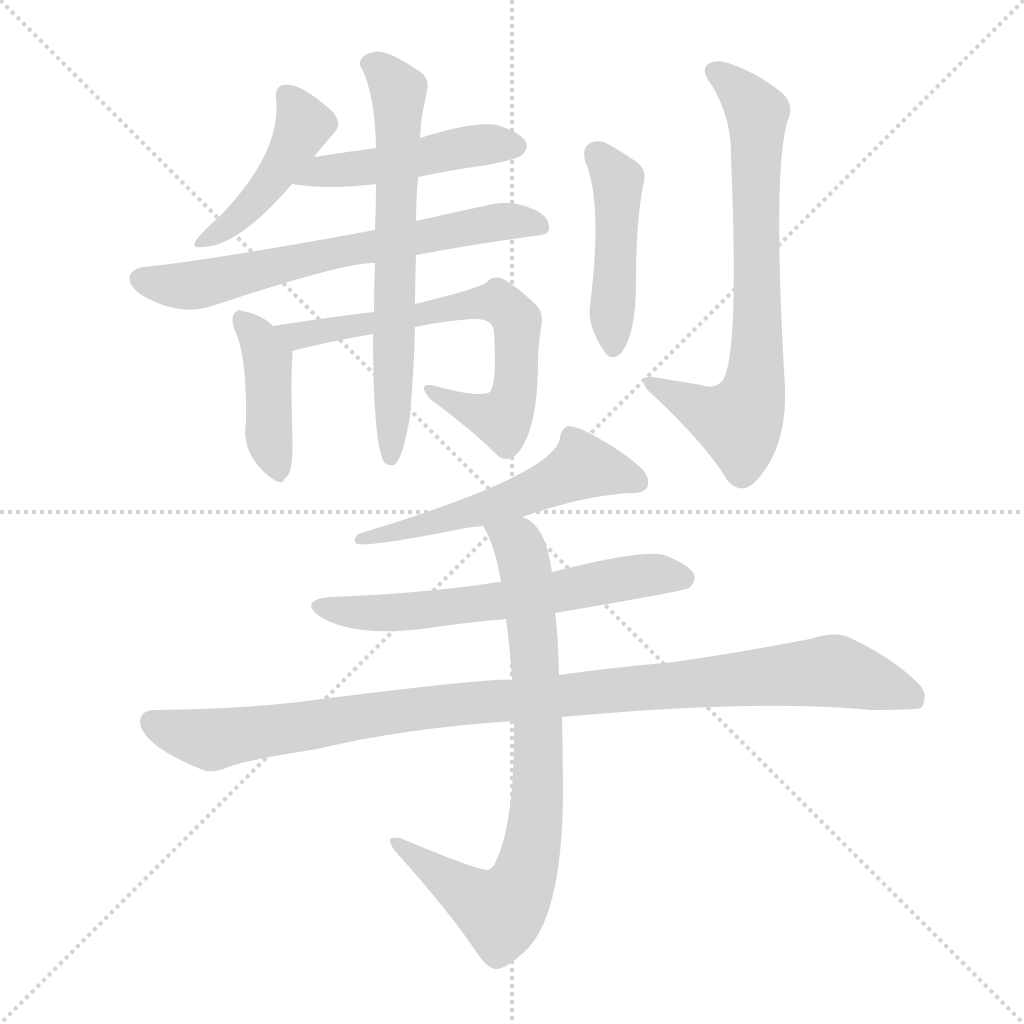
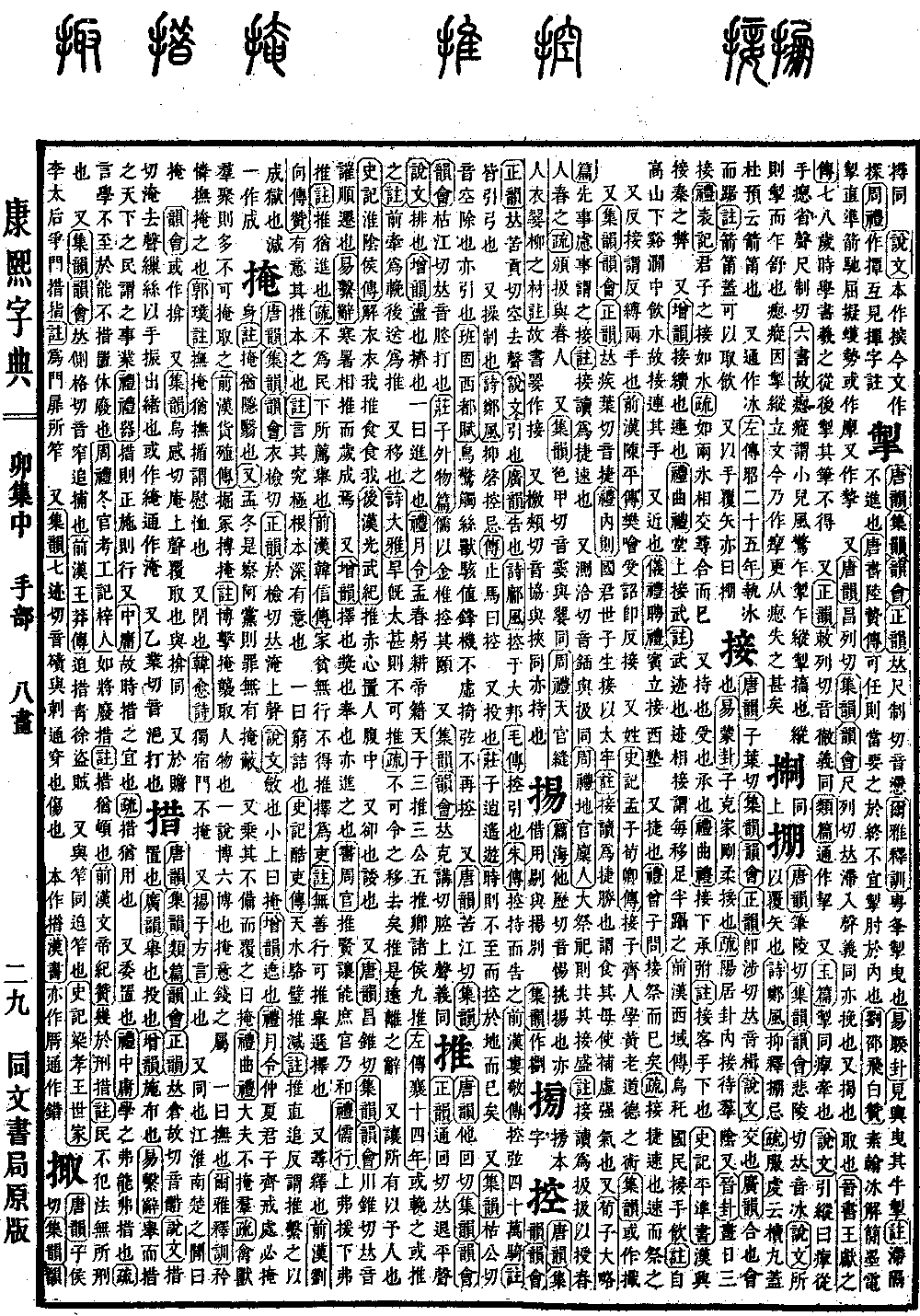
Mao Collection, Middle Volume. Radical: Hand (shǒu). Kangxi strokes: 12. Page 439, Entry 01.
Tang Rhyme (Tangyun), Collection Rhyme (Jiyun), Rhyme Assembly (Yunhui), and Standard Rhymes (Zhengyun) record the pronunciation as chi (fourth tone). The sound is similar to chi (fourth tone).
In Erya, Explanation of Teachings (Erya Shixun), it explains the term pingfeng as the act of pulling or dragging.
In the Book of Changes (Yijing), Hexagram Kui (Kuigua), it is described: Seeing the cart stalled, the ox is being pulled.
Note: Interpreted as being stagnant or obstructed and unable to move forward.
In the History of Tang (Tangshu), Biography of Lu Zhi, it mentions: If one can be appointed, they should be allowed to be responsible until the end; one should not internally restrain or obstruct them.
In Liu Shao, Praise of Flying White (Feibai Zan), it describes: White silk like melting ice, ink marks like a flash of lightning. Straight as a flying arrow, curved like the posture of an inchworm. This character is sometimes written in a variant form. It is also written as zhi (fourth tone).
It is also recorded in Tang Rhyme (Tangyun) as chang (first tone) followed by lie (fourth tone), and in Collection Rhyme (Jiyun) and Rhyme Assembly (Yunhui) as chi (third tone) followed by lie (fourth tone). The pronunciation is similar to zhi (entering tone). The meaning is the same. It also carries the meaning of pulling or dragging.
It also carries the meaning of lifting, raising, or taking.
In the History of Jin (Jinshu), Biography of Wang Xianzhi, it records: When Wang Xianzhi was seven or eight years old, he was practicing calligraphy. Wang Xizhi suddenly pulled his brush from behind, but could not pull it away.
It is also recorded in Standard Rhymes (Zhengyun) as chi (fourth tone) followed by lie (fourth tone). The pronunciation is similar to che (fourth tone). The meaning is the same.
The Categorized Compilation (Leipian) explains that this character is interchangeable with the character qie (fourth tone).
It is also recorded in Jade Chapter (Yupian) that the character che (fourth tone) is the same as the character with the meaning of pulling.
In Explanation of Characters (Shuowen Jiezi), it is explained: Pulling or letting go is called this. The character is formed with the radical for hand, using the character chi (fourth tone) with part omitted as the phonetic component. The pronunciation is chi (fourth tone).
In History of the Six Writings (Liushu Gu), it is explained: The term chizong refers to a child experiencing convulsions due to wind-related illness, twitching and then relaxing. Che refers to the twitching, while zong refers to the sudden stretching after twitching. The term chizong was created based on the states of twitching and stretching, but now it is written as a different character and the radical for illness has been added, which is a serious error.