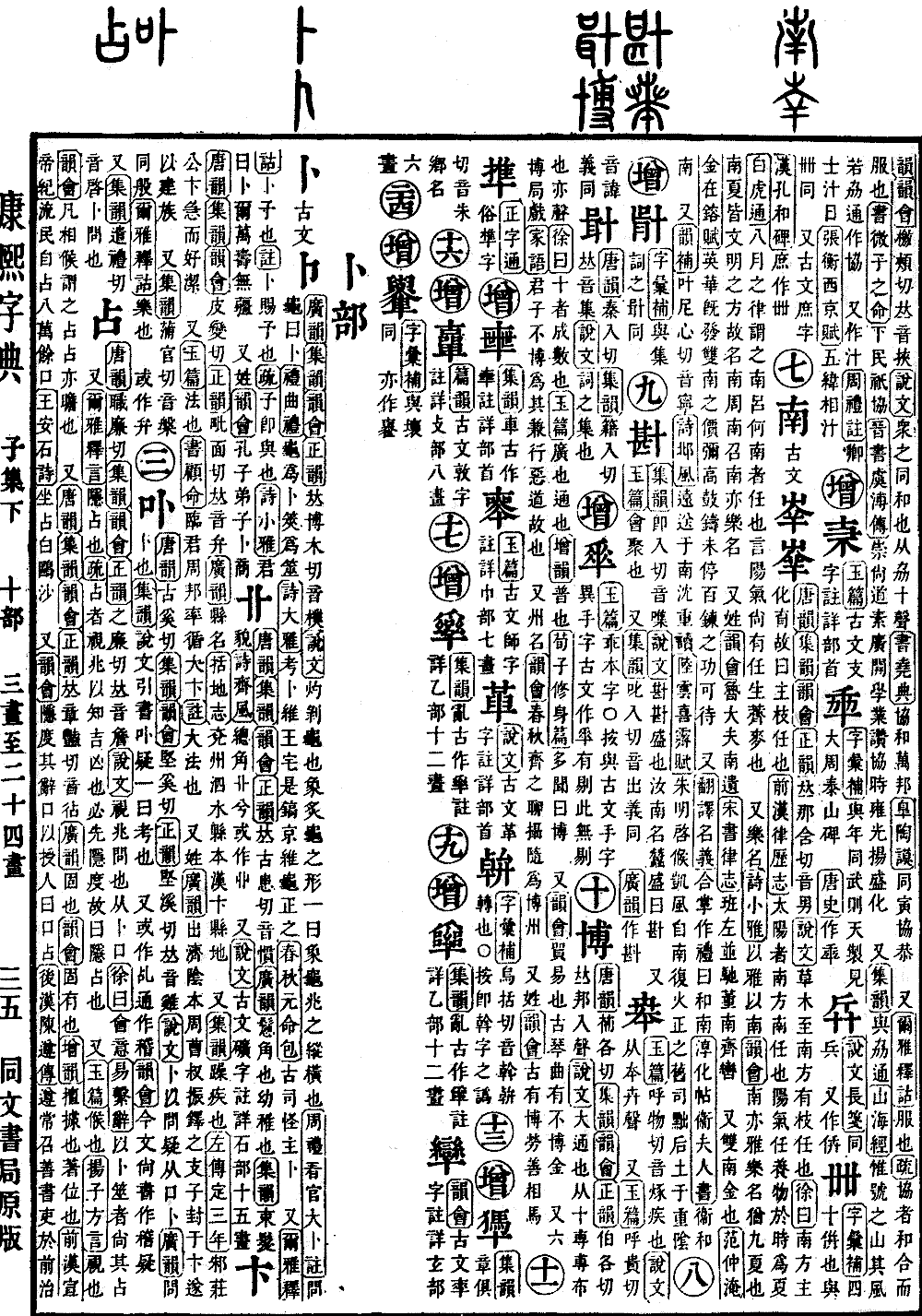
Zi Collection, Page Position: Lower. Radical: Divination (bu). Character: zhan. Kangxi Strokes: 5. Page 157, Entry 30.
According to the Tang Rhymes (Tangyun), the reading is zhi lian qie. According to the Collected Rhymes (Jiyun), the Rhyme Assembly (Yunhui), and the Correct Rhymes (Zhengyun), the reading is zhi lian qie. The sound is the same as the character zhan.
The Explaining Graphs and Analyzing Characters (Shuowen Jiezi) explains this as: observing omens and making inquiries. The character form is composed of the components divination and mouth.
Xu states: This is a compound ideograph.
Those who perform divination value the results of the reading — Classic of Changes (Yi), Great Treatise (Xici).
Also, the Approaching Elegance (Erya), Explaining Words section explains it as hidden divination.
The commentary notes: Divination means observing omens to foresee good or bad fortune. One must first privately speculate, hence it is called hidden divination (yinzhan).
Also, the Jade Chapters (Yupian) explains it as to wait or observe.
The Regional Characters (Fangyan) by Yangzi explains it as to look at.
According to the Rhyme Assembly, any instance of mutual observation is called zhan. Zhan also has the meaning of to gaze at.
Also, according to the Tang Rhymes, Collected Rhymes, Rhyme Assembly, and Correct Rhymes, the reading is zhang yan qie. The sound is the same as the character zhan.
The Expanded Rhymes (Guangyun) explains it as firm or secure.
The Rhyme Assembly explains it as to possess inherently.
The Supplementary Rhymes (Zengyun) explains it as to take possession of something without authorization or to occupy a position.
More than eighty thousand displaced people declared their own household registration — Book of Han (Han Shu), Annals of Emperor Xuan.
Sitting to occupy the sands of the white gulls — Poem by Wang Anshi.
Also, according to the Rhyme Assembly, it refers to privately deliberating on words and dictating them to others, which is called oral dictation (kouzhan).
The Biography of Zhai Zun in the Book of the Later Han (Hou Han Shu) records: Zun often summoned officials skilled in calligraphy to stand before him to handle personal correspondence to thank friends and old acquaintances; leaning on a desk, he orally dictated hundreds of letters, with the degree of closeness for each being different.
Also explained as to possess.
Those who possess even slight merits have mostly been recruited — Han Yu, Encouragement of Learning (Jinxue Jie).
Respectfully narrating the deeds of Jingjie, following his final instructions — Yan Yanzhi, Eulogy for Tao Qian (Tao Qian Lei).
The commentary states: Final instructions (yizhan) refers to a deathbed command.