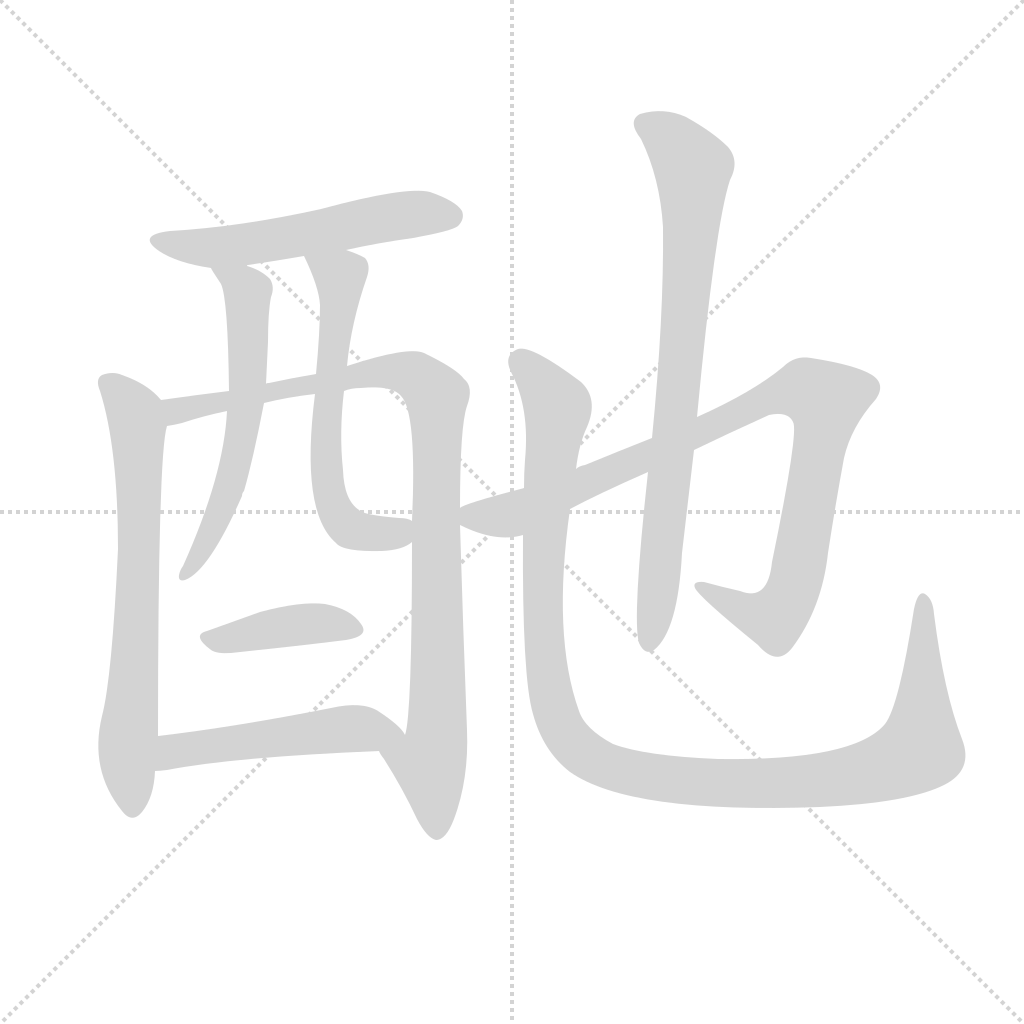
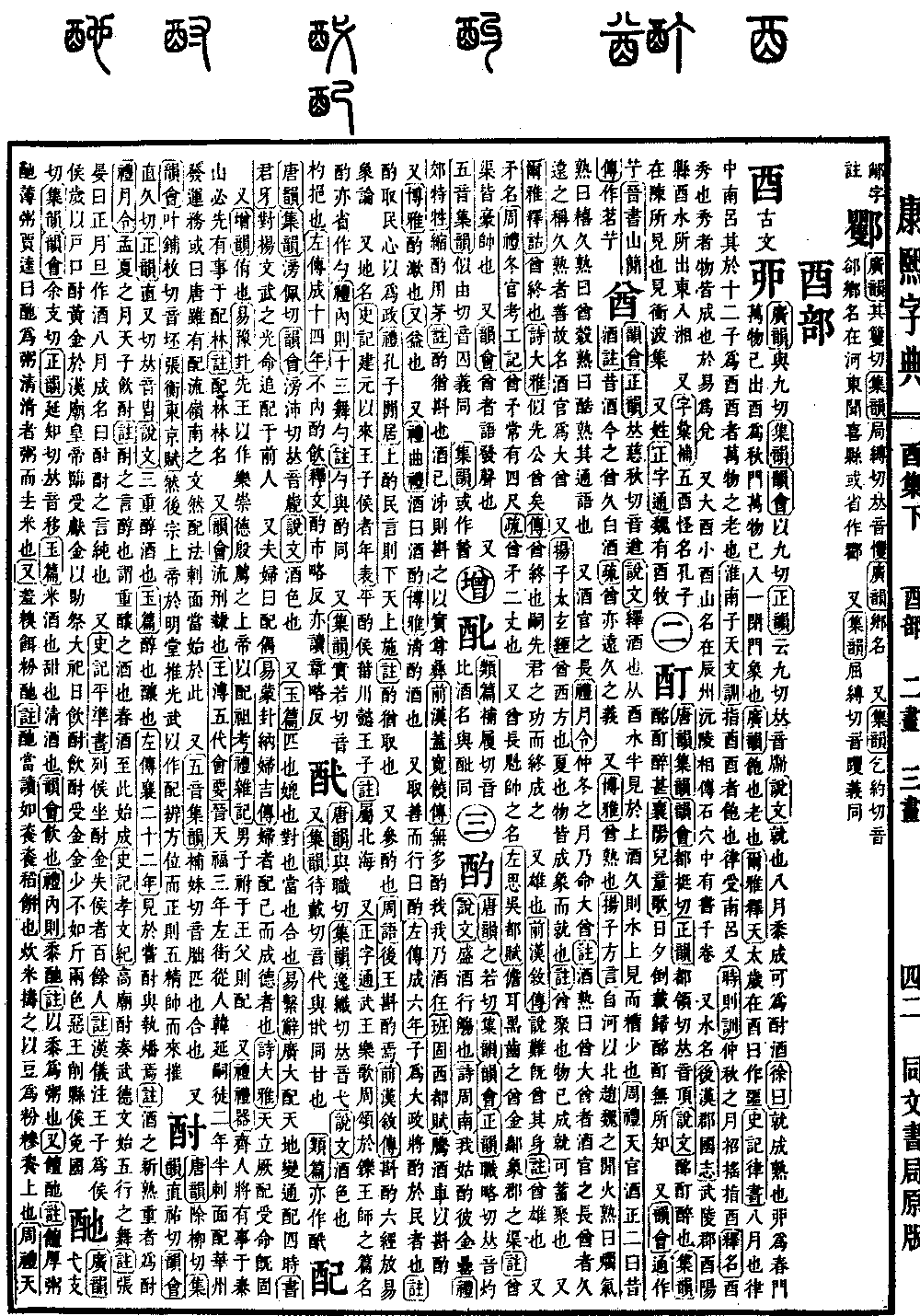
You Collection, Lower Volume
Radical: Wine (yǒu)
Kangxi Strokes: 10
Page 1280, Entry 11
Pronounced yí
Jade Chapter (Yupian): Rice wine. Sweet. Clear wine.
Rhyme Collection (Yunhui): To drink.
Book of Rites (Liji), Inner Principles (Neize): Millet porridge (yí).
Commentary: Made with millet.
Also: Thick porridge and thin porridge.
Commentary: Thick porridge is viscous. Thin porridge (yí) is watery. Jia Kui states: Yí refers to the clear liquid of porridge, meaning porridge water with the grains strained out.
Also: Delicacies, dried parched grain, cakes, and rice cakes (yí).
Commentary: Here, yí should be read as rice cake (cí). Rice cake is steamed and pounded rice with bean flour sprinkled on top.
Rites of Zhou (Zhouli), Offices of Heaven (Tianguan), Administrator of Wines (Jiuzheng): Distinguish the ingredients of the four types of beverages; the fourth is called yí.
Commentary: Yí is modern-day porridge. The Inner Principles (Neize) mentions millet porridge; yí refers to the clear liquid of thin porridge.
Also: Maker of Minced Meats (Hairen): Offerings of bean-filled vessels, porridge-based food and grain porridge.
Commentary: Zheng Sinong says: Porridge-based food is a cake made using yeast. Zheng Kangcheng believes: Yí is rice cake (cí). The Inner Principles states: Wash and soak rice, chop the fat from a wolf's chest, and combine with rice to make a cake.
Correction of Characters (Zhengzitong): Yí is porridge, not a bean-based sacrificial offering. Some say there are two types: the yí in the four and six beverages of the Rites of Zhou (Zhouli) is the same as the beverage-yí in the Inner Principles, which is its original meaning. The porridge-based food in the offerings of bean-filled vessels is the same as the flour-yí in the Inner Principles, which is food prepared with bean flour.
Pronounced yǐ
Same meaning as above.
Explaining Graphs and Analyzing Characters (Shuowen): Millet wine. Another interpretation is sweet. Upon investigation, Explaining Graphs (Shuowen) defines it as millet wine and the Jade Chapter (Yupian) as rice wine, both of which refer to modern-day porridge. Examining the Inner Principles (Neize) and Rites of Zhou (Zhouli) in detail, it is never independently interpreted as wine.
Pronounced zhān
Citing the Record of Rites (Liji): Rice made into yí. Note: The Record of Rites (Liji) explains yí as thick porridge (zhān), not that it is read with the sound of zhān. The Correct Rhymes (Zhengyun) is mistaken.
Sound Collection (Jiyun): Sometimes also written in a variant form.