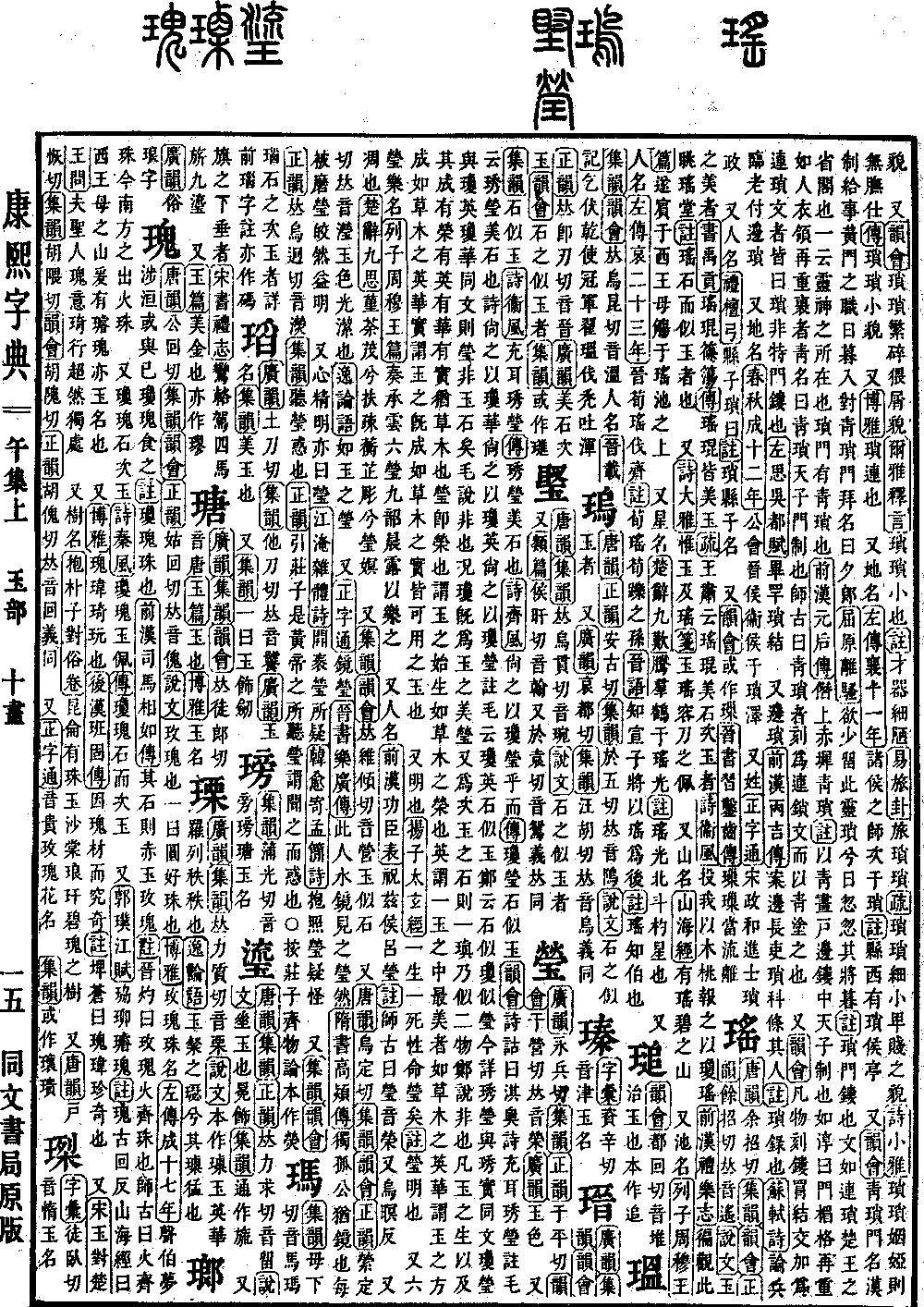
Wu Collection, Upper Volume
Radical: Jade (yù)
Kangxi stroke count: 15
Page 739, Entry 01
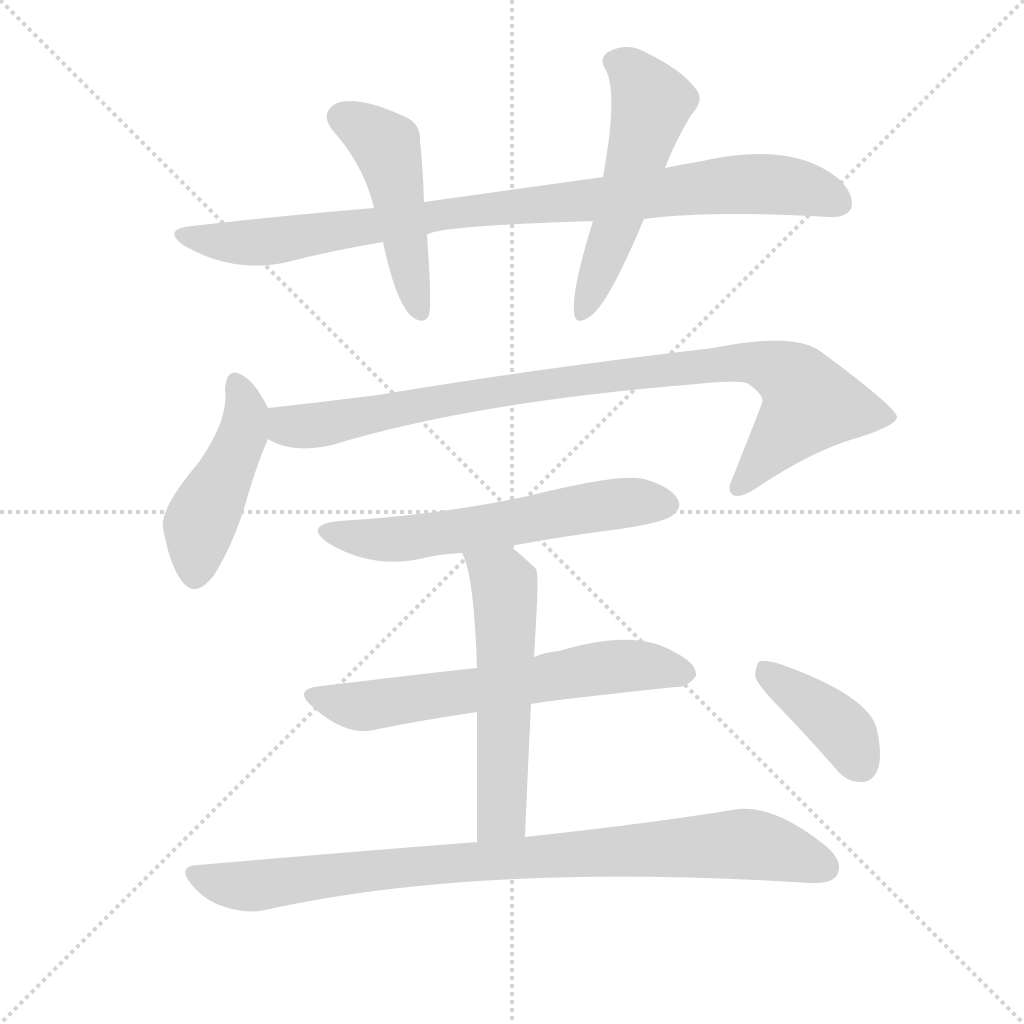
Pronounced ying.
Broad Rhymes (Guangyun): Color of jade.
Collected Rhymes (Jiyun): A stone resembling jade.
Book of Odes (Shijing), Odes of Wei: Ear ornaments of xiu-ying. Commentary: Xiu-ying is a beautiful stone.
Book of Odes (Shijing), Odes of Qi: Adorned with qiong-ying. Commentary: Qiong-ying is a stone resembling jade.
Dictionary of Rhymes (Yunhui): Exegesis on the Odes (Shigu) states: The poem Qi-ao mentions ear ornaments of xiu-ying. The Mao commentary states: Xiu-ying is a beautiful stone. The Book of Odes (Shijing) mentions: adorned with qiong-hua, adorned with qiong-ying, adorned with qiong-ying. The Mao commentary states: Qiong-ying is a stone resembling jade. Zheng Xuan states: A stone resembling qiong, resembling ying. Upon careful examination, xiu-ying and xiu-shi are the same term, and qiong-ying, qiong-ying, and qiong-hua are the same type of term; thus, ying does not refer to a stone. The Mao commentary's view is incorrect. Furthermore, if qiong is a beautiful jade, and ying is defined as a secondary stone resembling jade, it implies a single ear ornament is made of two substances; thus, Zheng Xuan's view is also incorrect. The formation of jade, from inception to completion, includes rong, ying, hua, and shi, much like vegetation. Ying corresponds to rong, referring to the nascent stage of jade, similar to plants blooming. Ying refers to the finest part of a piece of jade, like a plant's flower. Hua refers to jade that has just formed, like a lush plant. Shi refers to fully formed jade, like a plant's fruit. These are all types of jade that can be utilized.
Also refers to brightness.
Yang Xiong's Great Mystery (Taixuanjing): One life and one death, the nature and life are brightened. Commentary: Ying means bright.
Also, Six Ying is the name of a musical piece.
Master Lie (Liezi), Zhou Mu Wang chapter: Performed the pieces Cheng-yun, Six Ying, Jiu-shao, and Chen-lu to provide him with joy.
Also used as a personal name.
History of the Former Han (Qianhan), Table of Meritorious Officials: Marquis of Zhuzi, Lü Ying. Commentary: Yan Shigu says: Ying, pronounced ying. Also pronounced as ying.
Also refers to withering.
Songs of Chu (Chuci), Nine Thoughts: The violet and sow thistle grow dense with spreading branches, the wild ginger and angelica wither, ying-ming.
Also pronounced ying. Refers to jade resembling stone.
Also pronounced ying. Refers to the lustrous and clean color of jade.
Lost Analects (Yi Lunyu): As clean and bright as jade.
Correction of Characters (Zhengzitong): Refers to the brightness of a mirror.
History of Jin (Jinshu), Biography of Yue Guang: This man is like clear water and a mirror; seeing him makes one's mind feel bright.
History of Sui (Suishu), Biography of Gao Jiong: Duke Dugu is like a mirror. Each time it is polished, it becomes even more bright and clear.
Also, inner intelligence is called ying.
Jiang Yan, Miscellaneous Poems: Opened the scroll to clarify doubts.
Han Yu, Poems to Meng: Harboring light, the heart feels confused and strange.
Also pronounced ying.
Collected Rhymes (Jiyun): Ting-ying means to be confused.
Standard Rhymes (Zhengyun): Citing the Master Zhuang (Zhuangzi), this is what the Yellow Emperor felt confused (ting-ying) about; it means to hear something and become confused. Note: The original text of the Zhuangzi, Equalizing Customs (Qiwulun) chapter, was originally written as ying.