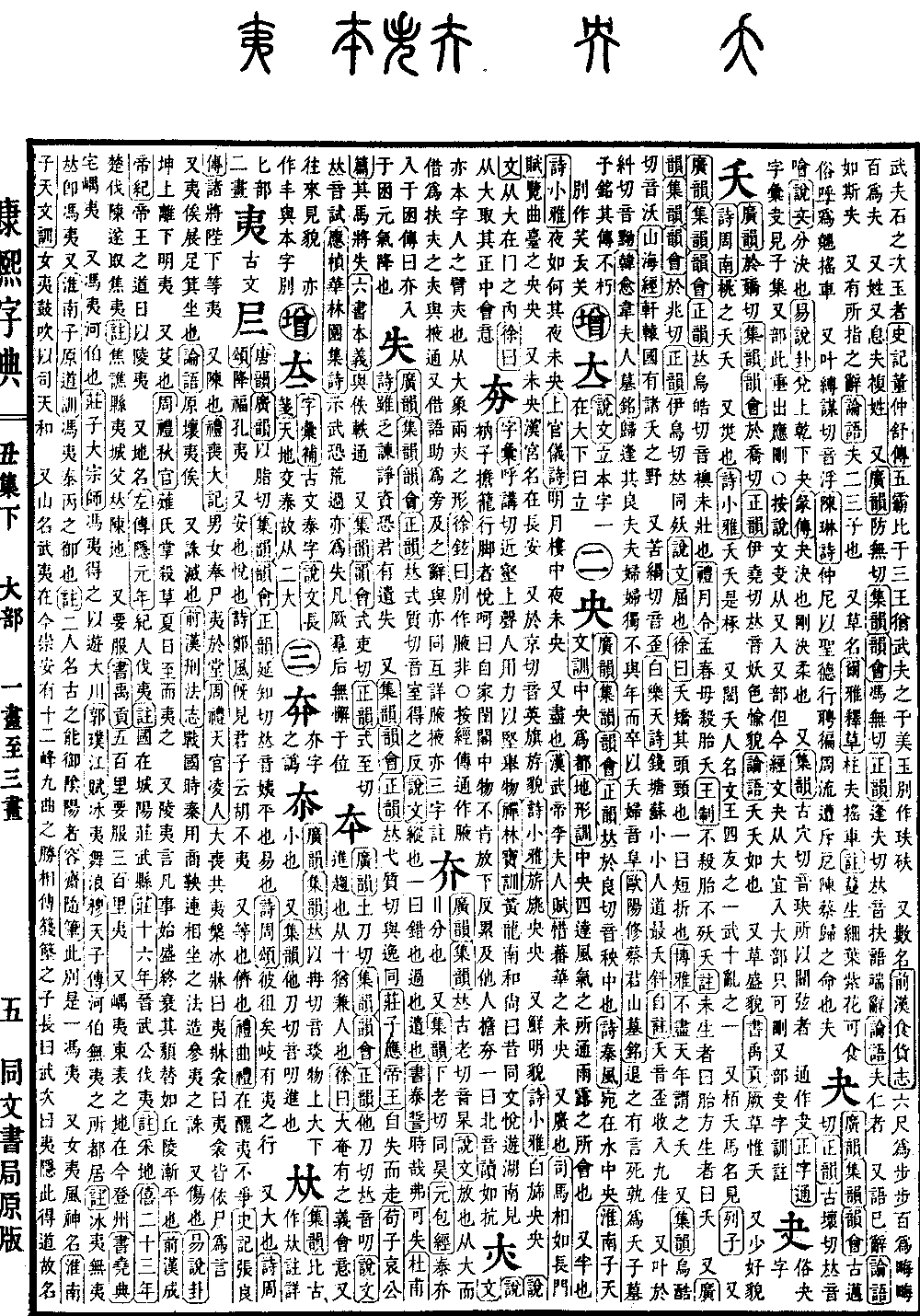
Chou Collection, Lower Volume
Radical: Big (dà)
Page 249, Entry 15
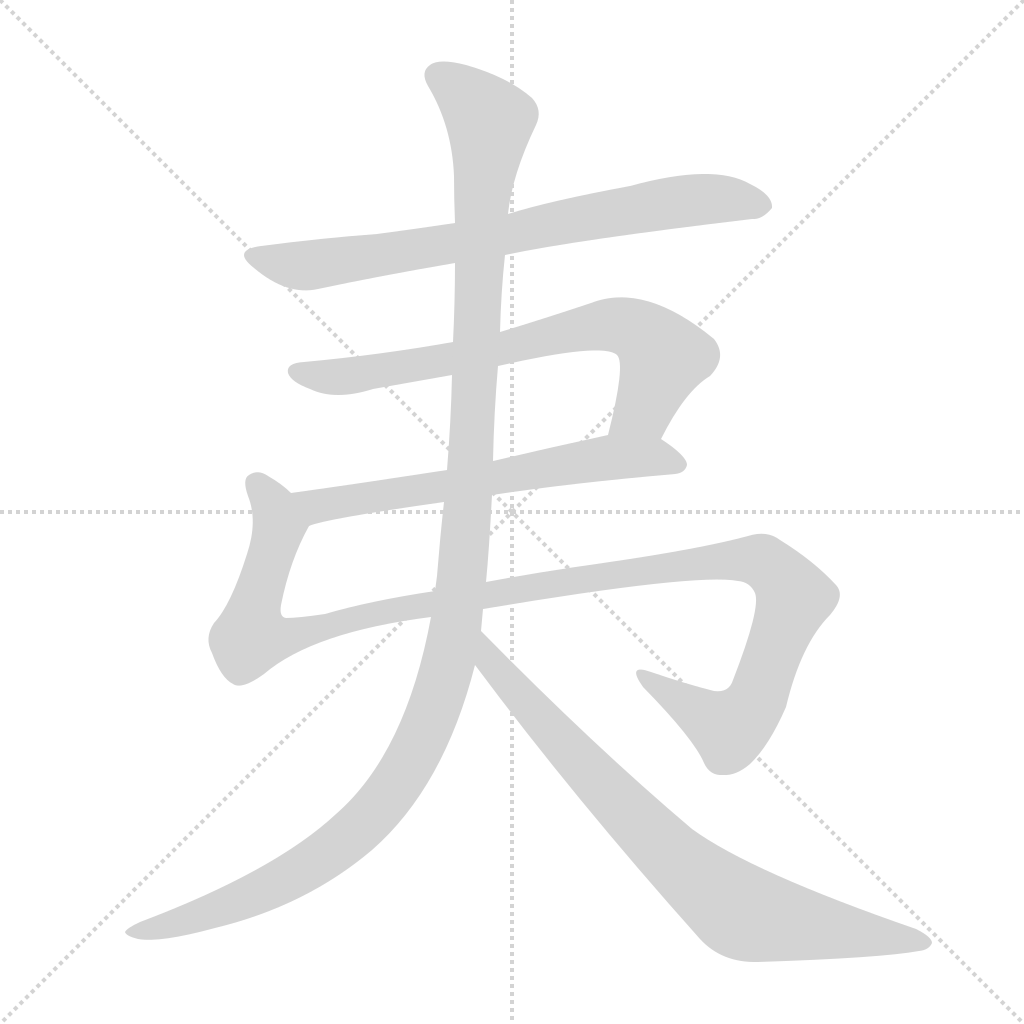
Ancient form. Pronounced yi.
Level, easy. Book of Odes (Shijing): Those who go forth, in Qi there is a level path.
Also, great. Book of Odes (Shijing): Bestowing blessings most greatly.
Also, peaceful, joyful. Book of Odes (Shijing): Having seen the superior man, how could I not be at peace.
Also, equal, peer. Book of Rites (Liji): Among peers in a group, do not contend. Records of the Grand Historian (Shiji): Your Majesty and the various generals are equals.
Also, to spread out. Book of Rites (Liji): Men and women place the corpse spread out in the hall. Book of Rites (Zhouli): During a grand funeral, provide ice for the cooling tray, the bed is called the cooling bed, the quilt is the cooling quilt, all named in relation to the corpse.
Also, to squat with legs splayed. Analects (Lunyu): Yuan Rang sat with legs splayed.
Also, to exterminate. Book of Han (Hanshu): During the Warring States period, Qin used Shang Yang's law of collective responsibility to create the punishment of exterminating three sets of kin.
Also, to wound. Book of Changes (Yijing): Therefore it is followed by The Darkening of the Light (Mingyi).
Also, to mow. Book of Rites (Zhouli): The weed-clearing official is in charge of killing grasses, and at the summer solstice, mows them.
Also, gradual decline, saying that all things start in prosperity and end in decay, like the gradual leveling of a hill. Book of Han (Hanshu): The way of emperors and kings declines day by day.
Also, a place name. Zuo Tradition (Zuozhuan): The people of Ji attacked Yi. Note: The state was in Cheng阳, Zhuangwu County. Zhuang Year 16: Duke Wu of Jin attacked Yi. Note: An appointed territory. Xi Year 23: Chu attacked and then took Jiao and Yi. Note: Jiao is Qiao County, Yi is Chengfu, both are places.
Also, the Ya tribute region. Book of Documents (Shangshu): Five hundred li is the Ya tribute region, three hundred li is the Yi.
Also, Yu Yi, the eastern frontier region, in present-day Dengzhou. Book of Documents (Shangshu): Residing in Yu Yi.
Also, Feng Yi, the Lord of the River. Zhuangzi (Zhuangzi): Feng Yi obtained it and used it to roam the great rivers. Guo Pu (Jiang Fu): Bing Yi leans on the waves. Record of the Son of Heaven (Tianzi Zhuan): The residence of the Lord of the River, Wu Yi. Note: Bing Yi and Wu Yi are just Feng Yi.
Also, Huainanzi (Huainanzi): Feng Yi is the charioteer of Tai Bing. Note: These are the names of two people, ancient experts in managing yin and yang. Rongzhai Random Notes (Rongzhai Suibi): This is a separate Feng Yi.
Also, Nü Yi, the name of a wind deity. Huainanzi (Huainanzi): Nü Yi plays music to preside over the harmony of heaven.
Also, a mountain name. Wuyi Mountain, in present-day Chong'an, has the beauty of twelve peaks and nine bends. Legend says that the sons of Jian Keng, the eldest named Wu and the second named Yi, hid here and attained the Way, hence the name.
Also, a river name. Yi River, emerges between Xiangyang and Kanglang mountains. Commentary on the Water Classic (Shuijing): The Han River passes Yicheng, and the Yi River flows into it.
Also, Chi Yi, a wine vessel. Yang Xiong (Jiu Zhen): Chi Yi is slippery and strange, its belly is as big as a pot. History of Wu and Yue (Wuyue Chunqiu): The King of Wu took the corpse of Zi Xu, stored it in a Chi Yi, and threw it into the river. Records of the Grand Historian (Shiji): Fan Li changed his name and surname to become Chi Yi Zi Pi.
Also, Xin Yi, a flower name. Songs of Chu (Chuci): The Xin Yi lintel and the medicinal chamber.
Also, Liu Yi, a fragrant herb. Qu Yuan (Lisao): Cultivating Liu Yi and Jie Che.
Also, in the system of posthumous titles: To be resolute and uphold governance, to be calm and love tranquility, is called Yi.
Also, a surname. Descendants of Yi Zhongnian, a grand officer of Qi during the Zhou dynasty. Seen in the Comprehensive Genealogy (Tongpu).
Also, a person's name. Bo Yi, an official in charge of rituals under Emperor Shun. Also, the eldest son of the Lord of Guzhu was called Bo Yi.
Also, Upasika. Buddhist texts (Translation of Meaning): The male is called Upasaka, the female is called Upasika, referring to pure men and women.
Also, same as Yi (sacrificial vessel). Mencius (Mengzi): The Book of Odes says: The people hold to the Yi (principle). The original text of the Odes uses Yi (vessel).
Also, rhyming with yi (rising tone). Feng Yan (Xianzhi Fu): Gathering asarum and mixing with wild ginger, tying the wood blossoms with the Xin Yi. Radiant and shining with brilliance, abundant and lush, spreading beauty. Beauty sounds like Mei. Xin Yi is the same as the flower Xin Yi. Originally written as that character. Some say ancient Chi Yi is interchangeable.