Si Collection, Upper Volume
Radical: Water (shuǐ)
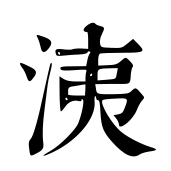
洟
Kangxi strokes: 10
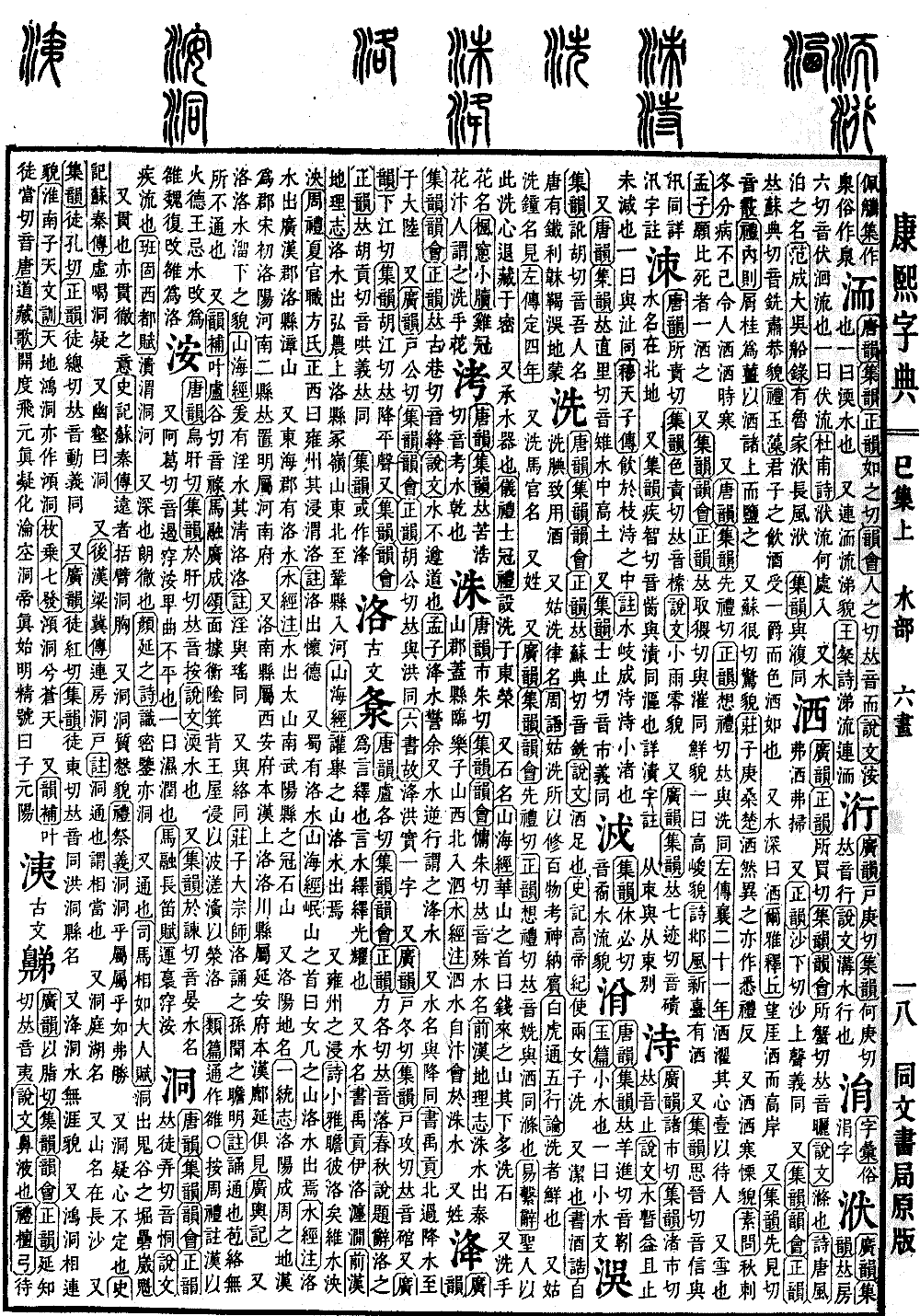
Page 620, Entry 19
Ancient records:
Broad Rhymes (Guangyun): Pronounced yi
Collection of Rhymes (Jiyun), Rhyme Meetings (Yunhui), and Orthodox Rhymes (Zhengyun): Pronounced yi (rising tone)
Readings are identical to the character yi.
Explanations in Analytical Dictionary of Chinese Characters (Shuowen Jiezi): Defined as nasal secretion.
Records in Book of Rites (Liji): When waiting at the ancestral temple, one sheds tears and nasal discharge.
Commentary (Shu): Explains that what flows from the nose is called yi.
There is also a term, marsh-yi, which is the name of a marsh.
Records in Commentary on the Water Classic (Shuijing Zhu): The Fen River extends to the left at Daling County to form the Wu Marsh.
Annals of Lu (Lüshi Chunqiu) refers to this as the Great Land. It is also called the marsh of Ou-yi.
Also, Broad Rhymes (Guangyun) and Collection of Rhymes (Jiyun) provide the pronunciation ti (falling tone). It is identical to the character ti (tears).
Records in Book of Rites (Liji): Do not dare to spit or let nasal discharge flow.
Annotation: Explains that the original text is also sometimes written as ti (tears).
Also, Tang Rhymes (Tangyun) provide the pronunciation ti (rising tone); Collection of Rhymes (Jiyun) provides the pronunciation ti (rising tone). The meaning is the same.
Textual research:
Annals of Lu (Lüshi Chunqiu) refers to it as Great Principle. It is also called the marsh of Wen-yi.
Following the original text carefully, we have amended Principle to Land and Wen to Ou.