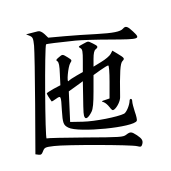
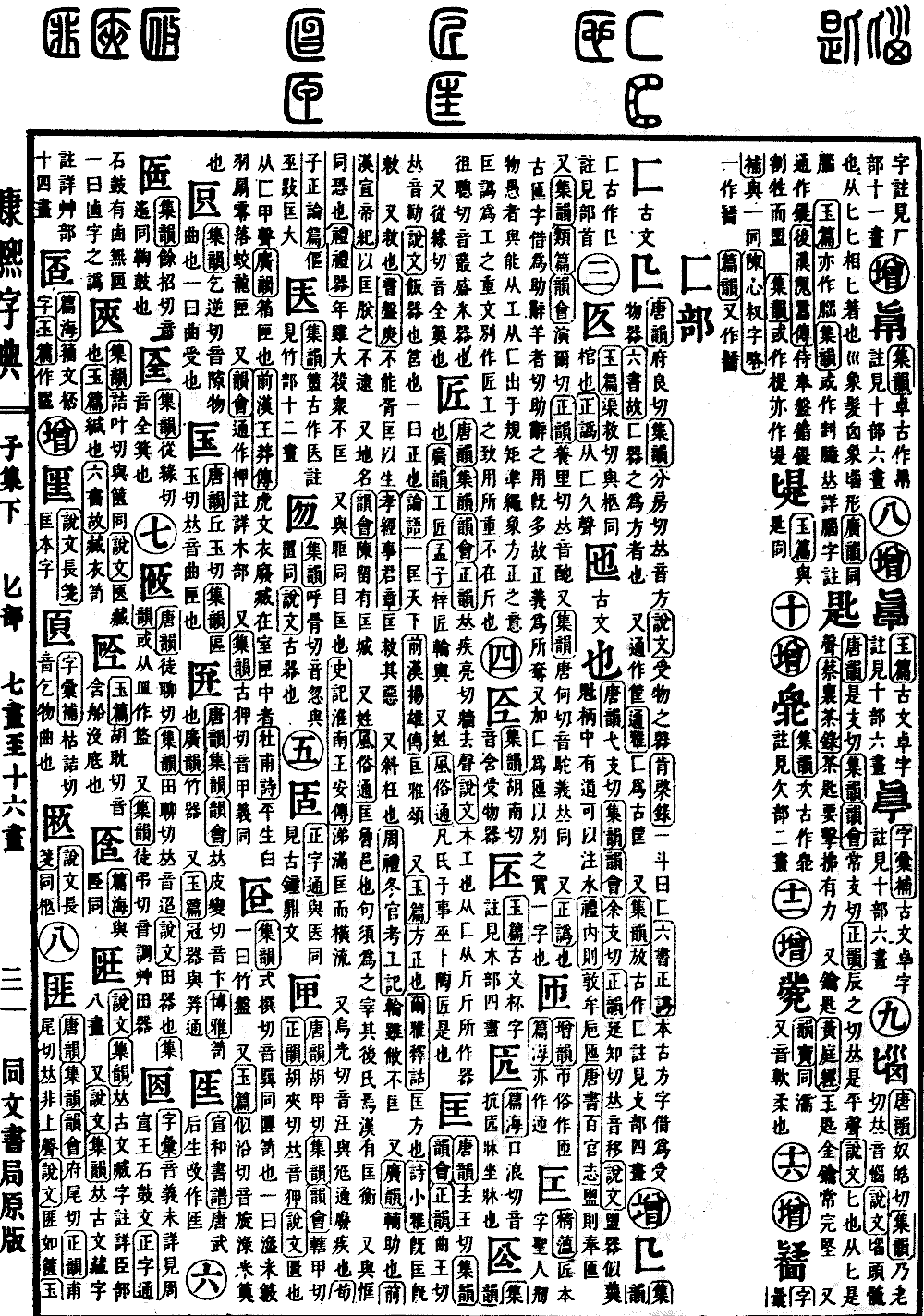
Zi Collection, Page Position: Lower. Radical: Box (fāng). Kangxi Dictionary Strokes: 5 strokes. Page: Page 153, Column 14.
The ancient form of the character pronounced ye was originally the character pronounced yi.
In the Tang Dynasty Rhymes (Tangyun), the pronunciation is indicated by the characters yi and zhi. In the Collected Rhymes (Jiyun) and the Concise Rhymes (Yunhui), it is indicated by yu and zhi. In the Corrected Rhymes (Zhengyun), it is indicated by yan and zhi. It is pronounced the same as yi.
The Explaining Graphs and Analyzing Characters (Shuowen Jiezi) defines this as a vessel used for washing, shaped like a ladle with a channel in the handle for pouring water.
The Book of Rites (Liji) mentions various vessels including platters, bowls, cups, and water pourers. The History of Tang (Tangshu) notes that when performing ritual washing, the water pourer is presented.
In the Collected Rhymes (Jiyun), the Classified Chapters (Leipian), and the Concise Rhymes (Yunhui), the pronunciation is indicated by yan and er. In the Corrected Rhymes (Zhengyun), it is indicated by yang and li. It is pronounced the same as the character yi.
Furthermore, in the Collected Rhymes (Jiyun), the pronunciation is indicated by tang and he, pronounced the same as the character tuo. These various pronunciations share the same meaning.
The Correction of Errors (Zheng'e) points out that the character ye was originally the ancient form of the character yi, but it was later borrowed as a grammatical particle and pronounced as yang and zhe. As its use as a grammatical particle became more frequent, its original meaning was obscured. Consequently, the Box (fang) radical was added to create a new form of the character yi to distinguish it. In reality, the characters ye and yi were originally one and the same.