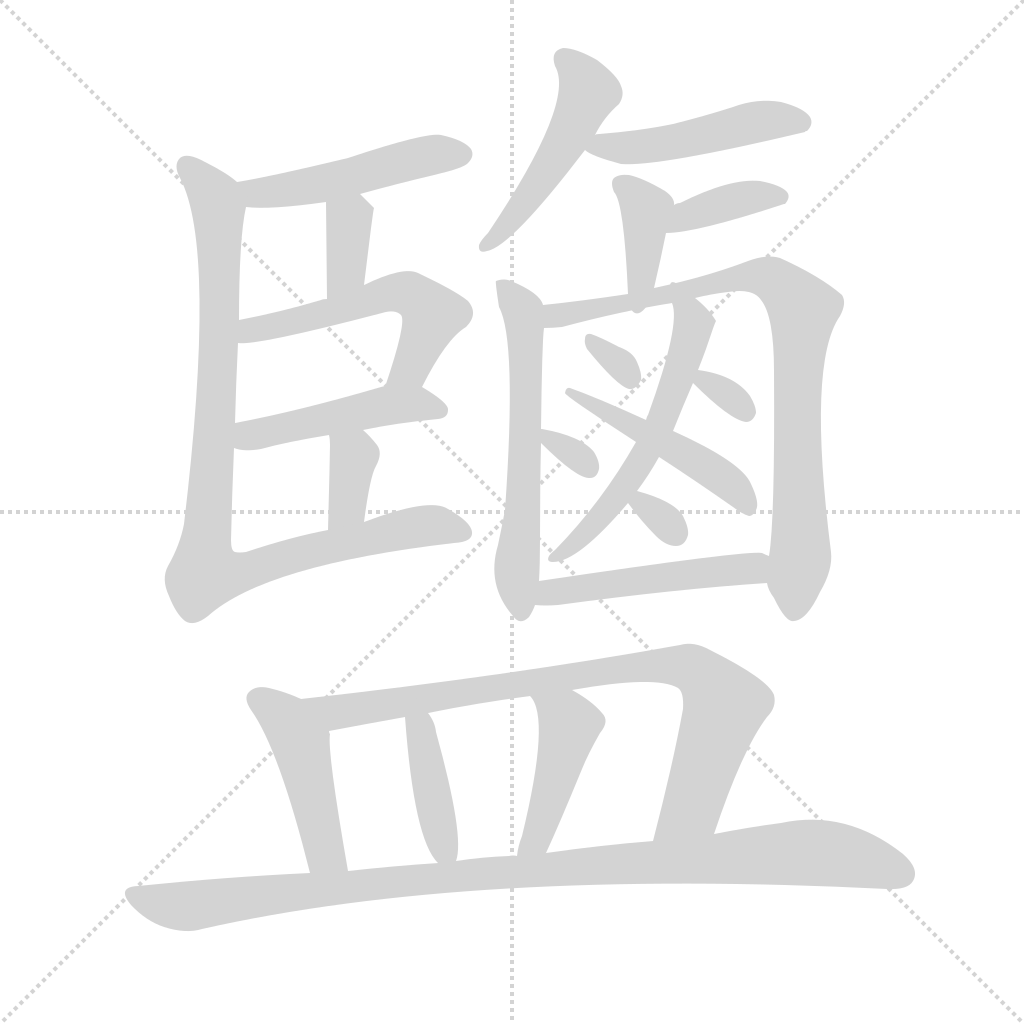
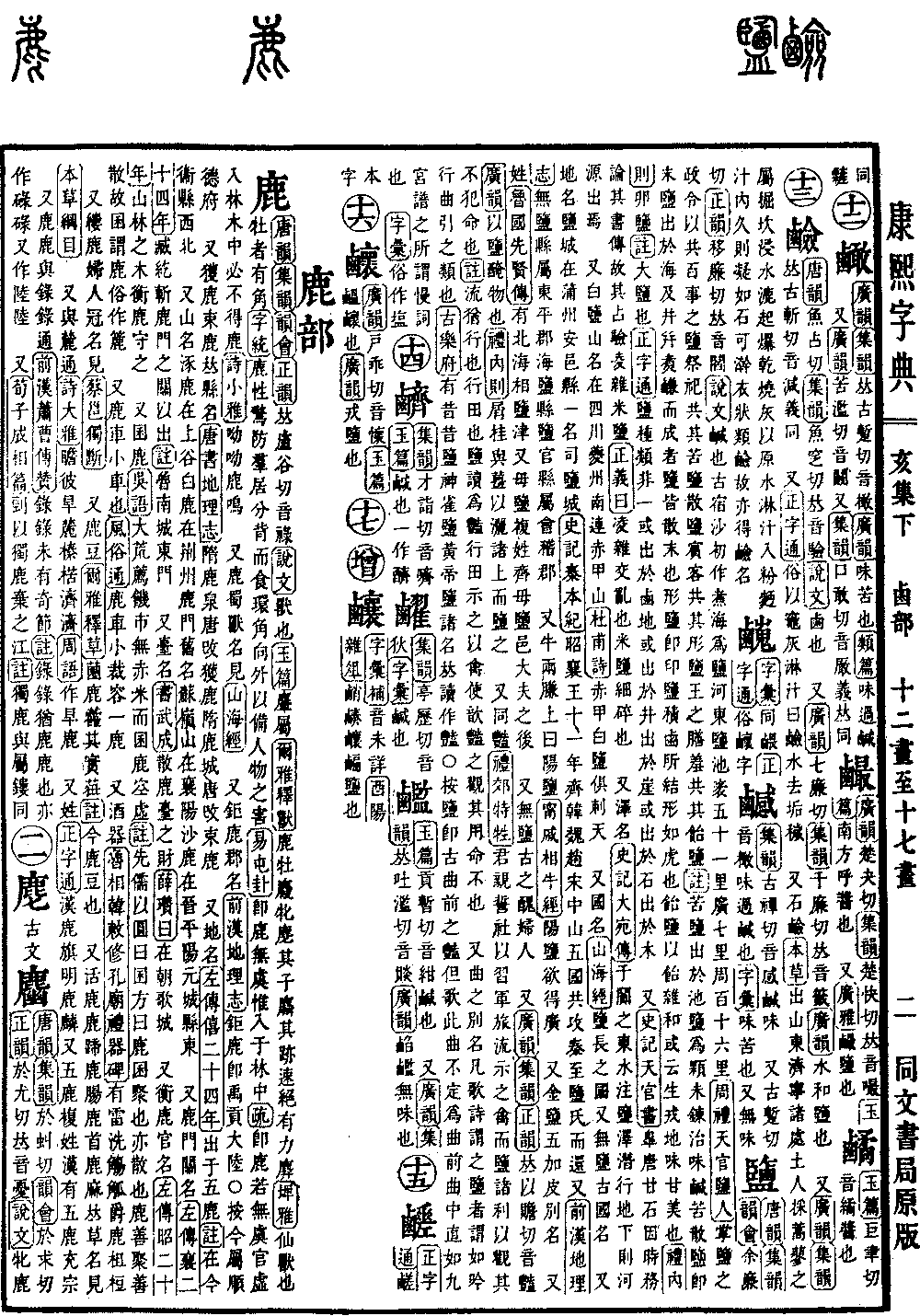
Hai Collection, Lower Volume
Radical: Salt (lǔ)
Kangxi Strokes: 24
Page 1508, Entry 07
Pronounced yan
Shuowen Jiezi (Explanation of Simple and Compound Characters): Salty. In ancient times, Susha first created it by boiling seawater to make salt. The salt lake in Hedong is fifty-one li long and seven li wide, with a circumference of one hundred and sixteen li.
Rites of Zhou (Zhouli), Offices of Heaven, Officer of Salt: In charge of the government orders regarding salt, to supply salt for all matters; for sacrificial rites, provide bitter salt and loose salt; for guests, provide shaped salt and loose salt; for the king’s meals and delicacies, provide sweet salt.
Annotation: Bitter salt comes from the lake; the salt is in particles and unrefined, with a salty and bitter taste. Loose salt is granular salt, which comes from the sea or wells, formed by boiling brine together; such salt is always in loose granules. Shaped salt is stamped salt, formed by the accumulation of brine, shaped like a tiger. Sweet salt is mixed with starch, or some say it comes from the Rong lands, with a sweet and pleasant taste.
Book of Rites (Liji), Inner Chapters: Granular salt.
Annotation: Large salt.
Zhengzitong (Comprehensive Dictionary of Characters): There are many types of salt, some coming from saline lands, some from wells, some from cliffs, some from stone, and some from wood.
Also: Records of the Grand Historian (Shiji), Book of the Celestial Offices: Gaotang and Ganshi relied on current affairs to discuss their historical traditions, so their prognostications were mixed and trivial.
Commentary: Mixed means intertwined and confused. Trivial means small and fragmented.
Also: Name of a marsh.
Records of the Grand Historian (Shiji), Account of Dayuan: East of Yutian, water flows into the salt marsh and travels underground, from which the source of the Yellow River emerges.
Also: White Salt, name of a mountain. Located in Kuizhou, Sichuan, connecting to Red Armor Mountain in the south.
Poetry of Du Fu: Red Armor and White Salt both pierce the sky.
Also: Name of a state.
Classic of Mountains and Seas (Shanhaijing): The state of Yanchang.
Also: Wuyan, name of an ancient state.
Also: Name of a place. Yancheng, located in Anyi County, Puzhou. Also known as Siyancheng.
Records of the Grand Historian (Shiji), Annals of Qin: In the eleventh year of King Zhaoxiang, the five states of Qi, Han, Wei, Zhao, and Song-Zhongshan jointly attacked Qin, returning after reaching Yanshi.
Also: Former Han Dynasty (Qianhan), Geographical Records: Wuyan County, belonging to Dongping Commandery; Haiyan County and Yanguan County, belonging to Kuaiji Commandery.
Also: The area above the flanks of a cow is called yangyan.
Classic of Cattle Judging by Ning Qi: Yangyan should be broad.
Also: A synonym for five-flavor-bark (wujiapi) medicinal liquor.
Also: A surname.
Biographies of Worthies of the State of Lu: There was a Yan Jin who served as Administrator of Beihai.
Also: Wuyan, a compound surname. Descendants of the Magistrate of Wuyan in Qi.
Also: Wuyan, an ancient woman known for her ugliness.
Pronounced yan (falling tone)
Guangyun (Broad Rhymes): To pickle items with salt.
Book of Rites (Liji), Inner Chapters: Shred cinnamon and ginger to sprinkle on top, then salt it.
Also: The same as beauty (yan).
Book of Rites (Liji), Suburban Sacrificial Rituals: The ruler personally swore an oath at the altar of the soil to practice military drills; he displayed the game birds and animals to them, and used these benefits to entice them, to observe whether they would violate orders.
Annotation: To display meant to conduct; conducting the hunt. To salt (yan) is read as beauty (yan), meaning to conduct the hunt and display the game to make them desire it, to see if they follow orders or not.
Also: A type of musical melody. Any songs or poems called yan refer to things like chants, airs, and instrumental preludes.
Old Music Bureau (Guyuefu): Includes titles such as Past Past Yan, Divine Sparrow Yan, and Yellow Emperor Yan. Read as yan. Note: Yan is the ancient prelude to a melody. However, singing such pieces is not fixed to the beginning or middle of a melody, much like the slow verses (mancí) mentioned in the Nine Palaces Scores.
Zihui (Collection of Characters): Commonly written as a variant form.