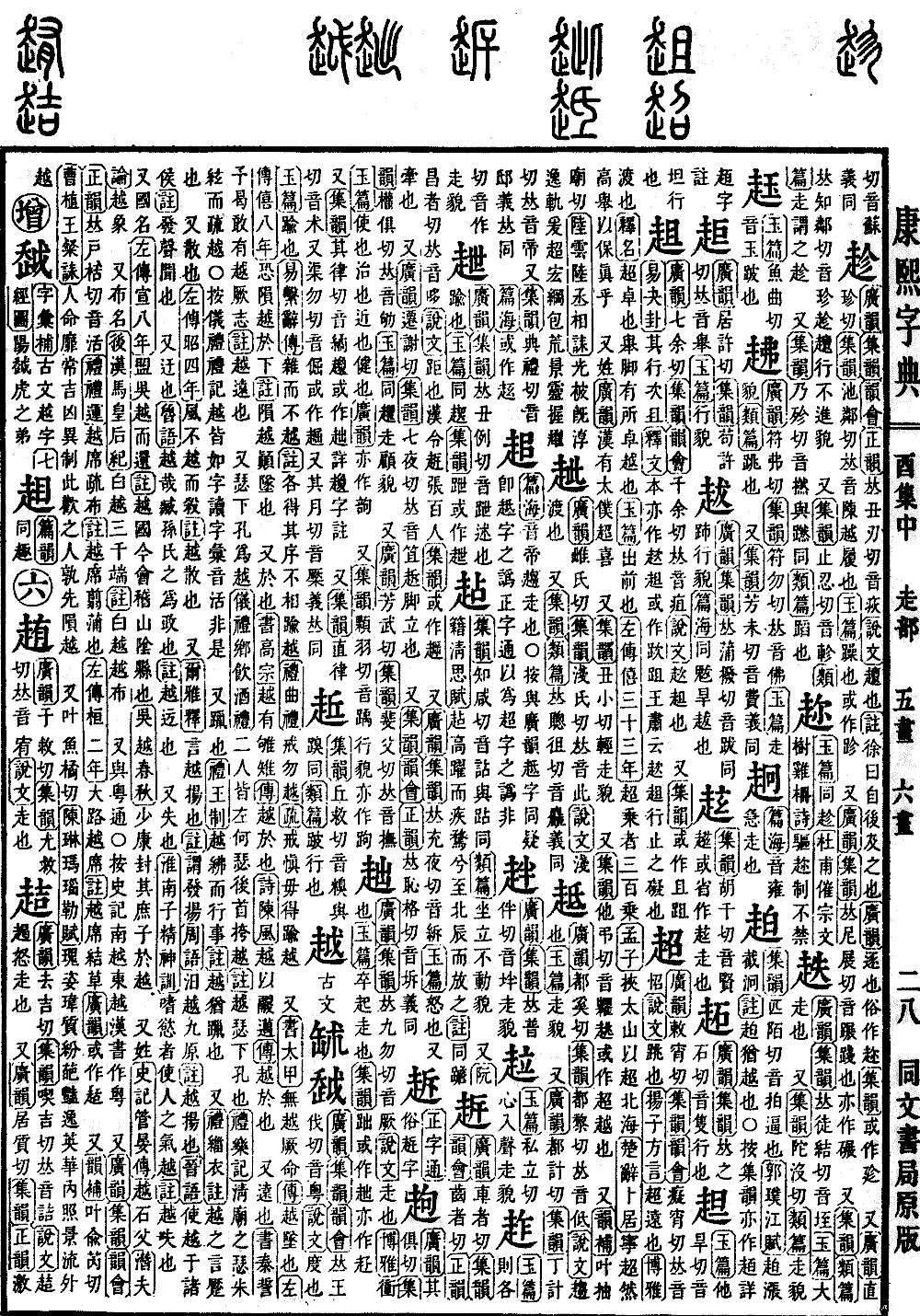
You Collection, Middle Volume
Radical: Walk (zǒu)
Kangxi Dictionary Stroke Count: 12
Page 1216, Entry 28
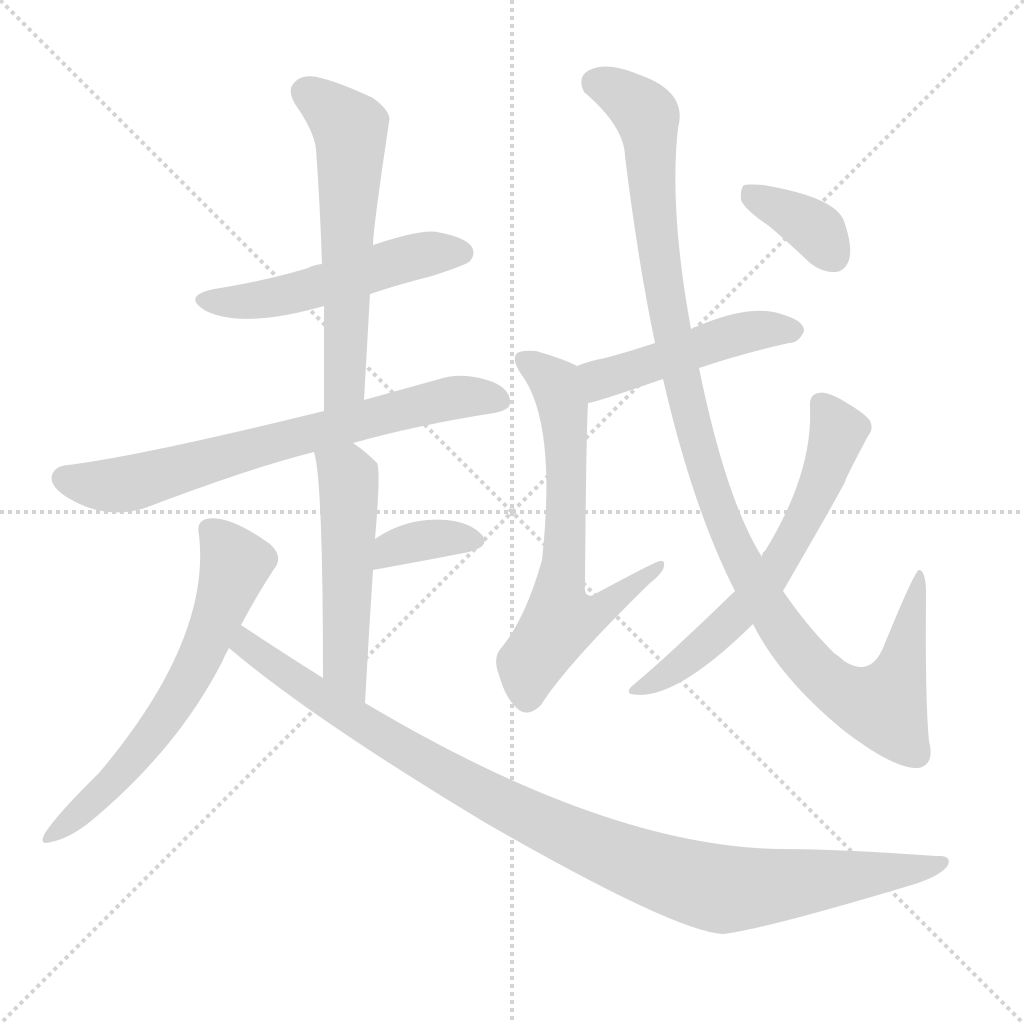
Ancient text. According to Broad Rhymes (Guangyun), Collected Rhymes (Jiyun), and Collection of Rhymes (Yunhui), pronounced yue. According to Explaining Graphs and Analyzing Characters (Shuowen), it means to cross. According to Jade Chapters (Yupian), it means to exceed.
From the Commentary on the Appended Remarks of the Book of Changes (Yijing Xicizhuan): Mixed but not exceeding. Commentary: Each attains its proper order without overstepping or exceeding.
From the Record of Rites (Liji), section on Inner Rules (Quli): Warning not to exceed. Commentary: Be cautious and do not overstep.
Also, from the Book of Documents (Shujing), section on Taijia: Do not exceed his mandate. Commentary: To exceed means to fall.
From the Zuo Tradition (Zuozhuan), 8th year of Duke Xi: Fearing to fall and perish in the depths. Commentary: To fall and perish means to tumble and drop.
Also, it means at or in. From the Book of Documents (Shujing), section on Gaozong: At the time there was a crowing pheasant. Commentary: In this context, it means at.
From the Book of Odes (Shijing), section on Odes of the States (Feng): In this way, proceeding in an orderly fashion. Commentary: In this context, it means at.
Also, it means far. From the Book of Documents (Shujing), section on Great Oath (Taishi): How would I dare to cast my will far away? Commentary: It means far.
Also, the hole beneath a zither is called yue. From the Ceremonial Rites (Yili), section on Village Drinking Ritual (Xiangyinjiuli): Both men carry the zither on their left, holding the tail and the yue. Commentary: Yue refers to the hole beneath the zither.
From the Record of Rites (Liji), section on Record of Music (Yueji): The zither of the Clear Temple has red strings and wide bridges (yue). Note: In the Ceremonial Rites and the Record of Rites, yue should be read as written. The Dictionary of Characters (Zihui) pronounces it huo, which is incorrect.
Also, it means to step over. From the Record of Rites (Liji), section on Royal Regulations (Wangzhi): To step over the funeral rope to perform tasks. Commentary: To step over means to tread across.
Also, from the Commentary on the Black Robes (Ziyi), it means to stumble.
Also, it means to disperse. From the Zuo Tradition (Zuozhuan), 4th year of Duke Zhao: The wind did not disperse and yet killed. Commentary: It means to disperse.
Also, according to the Er Ya (Erya), section on Explaining Words (Shiyan), it means to raise. Commentary: Referring to to manifest or promote.
From the Discourses of Zhou (Zhouyu): To regulate and raise the Nine Regions. Commentary: It means to raise.
From the Discourses of Jin (Jinyu): To make it broadcast among the feudal lords. Commentary: To make it known through sound.
Also, it means circuitous. From the Discourses of Lu (Luyu): How circuitous is the way the Sun clan conducts governance! Commentary: It means roundabout.
Also, it means to lose. From the Huainanzi, section on Spirit Training (Jingshenxun): Addictions cause one's vital energy to be lost. Commentary: It means to lose.
Also, a state name. From the Zuo Tradition (Zuozhuan), 8th year of Duke Xuan: Formed an alliance with Wu and Yue and returned. Commentary: The state of Yue is present-day Shanyin County, Kuaiji Mountain.
From the History of Wu and Yue (Wuyue Chunqiu): Shaokang enfeoffed his son in Yue.
Also, a surname. From the Records of the Grand Historian (Shiji), Biography of Guan and Yan: Yue Shifu. From the Hidden Man's Essays (Qianfulun): Yue Xiang.
Also, a type of cloth. From the History of the Later Han (Hou Hanshu), Annals of Empress Ma: Three thousand rolls of white yue. Commentary: White yue refers to yue cloth.
Also, interchangeable with the character yue (as in Yue/Cantonese). Note: In the Records of the Grand Historian, Nanyue and Dongyue are written as yue in the Book of Han.
Also, according to Broad Rhymes (Guangyun), Collected Rhymes (Jiyun), Collection of Rhymes (Yunhui), and Correct Rhymes (Zhengyun), pronounced huo.
From the Record of Rites (Liji), section on Rites' Evolution (Liyun): Yue mats and coarse cloth. Commentary: Yue mat refers to woven rushes.
From the Zuo Tradition (Zuozhuan), 2nd year of Duke Huan: A grand road and a yue mat. Commentary: A yue mat is made of knotted grass. According to Broad Rhymes, sometimes written in a variant form (ti).
Also, following the Rhyme Supplement (Yunbu), rhyming with yu-rui. From Cao Zhi’s Eulogy for Wang Can (Wang Can Lei): Human life is not constant, and good fortune and calamity follow different paths. Among those who rejoice, who will be the first to fall?
Also, rhyming with yu-ju. From Lin's Rhapsody on the Agate Ornament (Manaole Fu): With precious posture and elegant quality, the flowers spread in colorful abundance. Internal brilliance shining within, the scenery flows and exceeds outward.