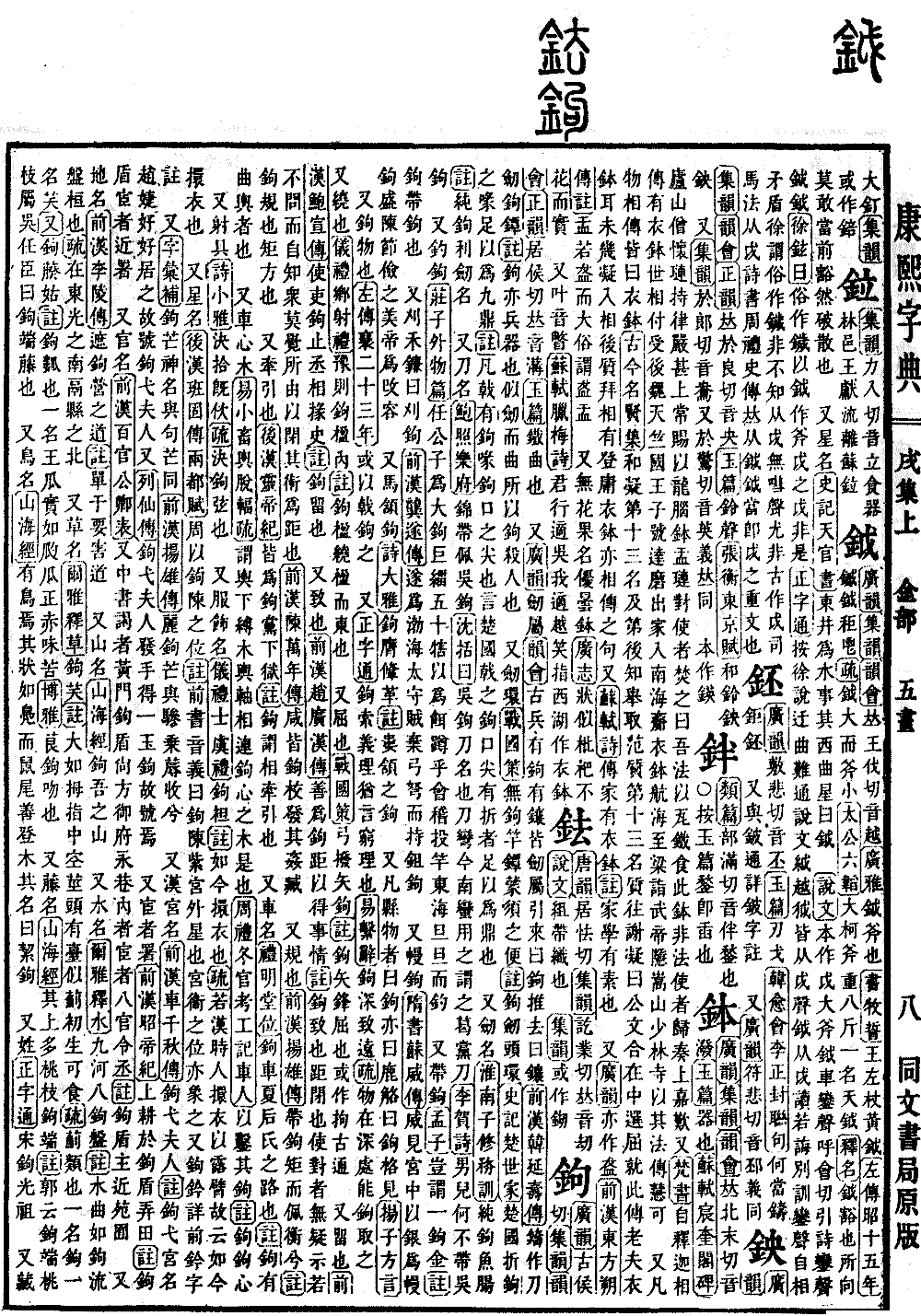
Xu Collection, Upper Volume
Radical: Metal (jīn)
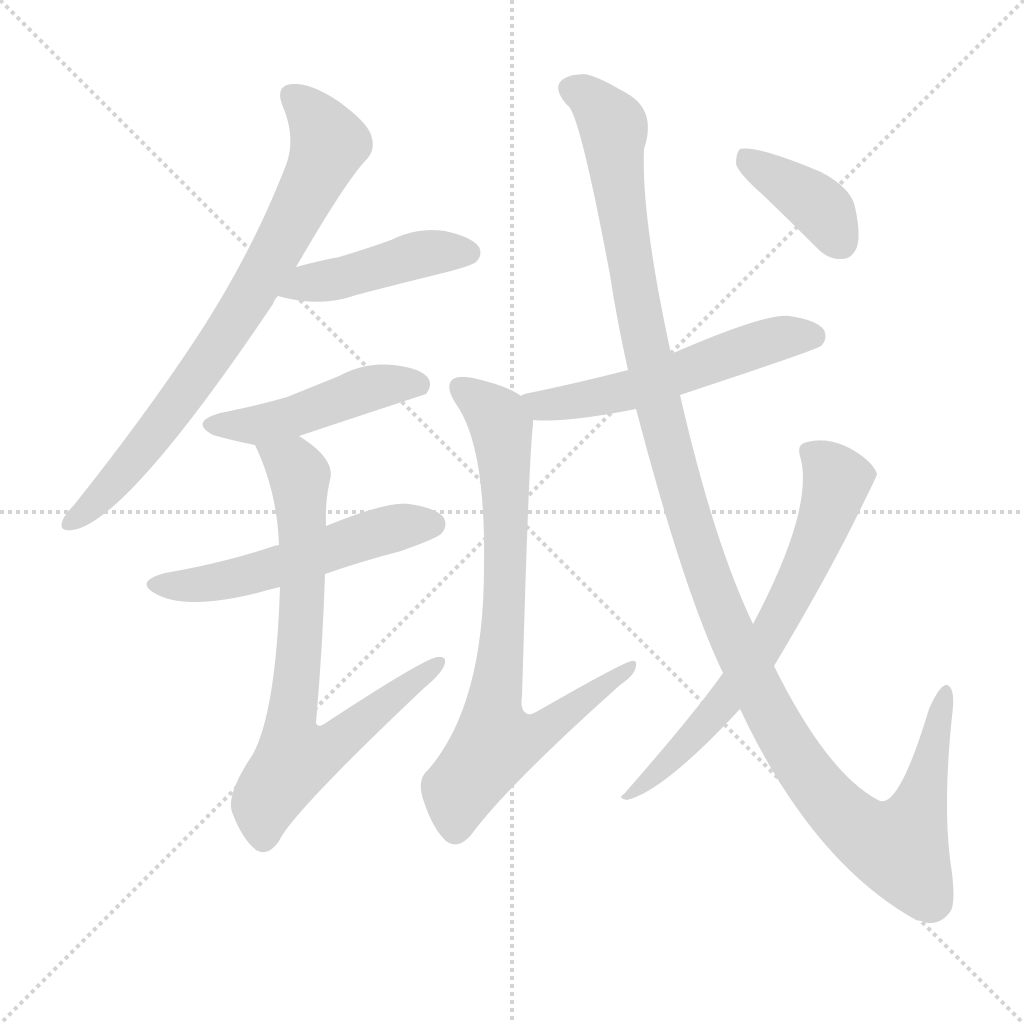
Yue (axe)
Kangxi strokes: 13
Page 1302, Entry 01
Pronounced yue (falling tone).
Guangyun (broad rhymes) and Jiyun (collection of rhymes) and Yunhui (compendium of rhymes) state: Pronounced yue.
Guangya (explanations of words) states: A yue is a small axe.
Book of Documents (Shangshu), Mushi chapter: King Wu of Zhou held a yellow yue in his left hand.
Zuo Tradition (Zuo zhuan), 15th year of Duke Zhao: There were halberds, axes, and black millet wine.
Commentary states: The yue is large and the axe is small.
Taigong Liutao (six secret teachings): A large-handled axe weighs eight pounds.
Also called the heavenly yue.
Shiming (explanation of names): Yue means to open or split. Where it points, no one dares to block it; it splits and scatters with a crash.
Also a star name.
Records of the Grand Historian (Shiji), Treatise on the Celestial Offices: The East Well constellation governs water affairs; the curved stars to its west are called the Yue stars.
Shuowen Jiezi (explanation of writing and analysis of characters): Originally written as yue. It is a large axe, and also refers to the sound of bells on a chariot, pronounced hui (falling tone), citing the Book of Odes (Shijing): The bells ring with a yue-yue sound.
Xu Xuan states: The common form is written as yue. Using the character yue as the axe yue is incorrect.
Zhengzitong (standard character compendium) notes: Xu Xuan's explanation is circuitous and difficult to justify. The Shuowen Jiezi entries for yue (to exceed) and yue (to jump) both derive their sound from the character yue; yue (axe) also derives from yue, yet it is read as hui (falling tone) and additionally interpreted as the sound of bells, which is contradictory. Xu Xuan says the common form is written as yue is incorrect, but he fails to realize that deriving sound from yue does not yield the pronunciation hui, which is even more incorrect. In ancient times it was written as yue. Sima Fa (method of Sima) writes it as yue. The Book of Odes (Shijing), Book of Documents (Shangshu), Rites of Zhou (Zhouli), and historical biographies write it as yue. The character yue should be considered a variant form of yue.