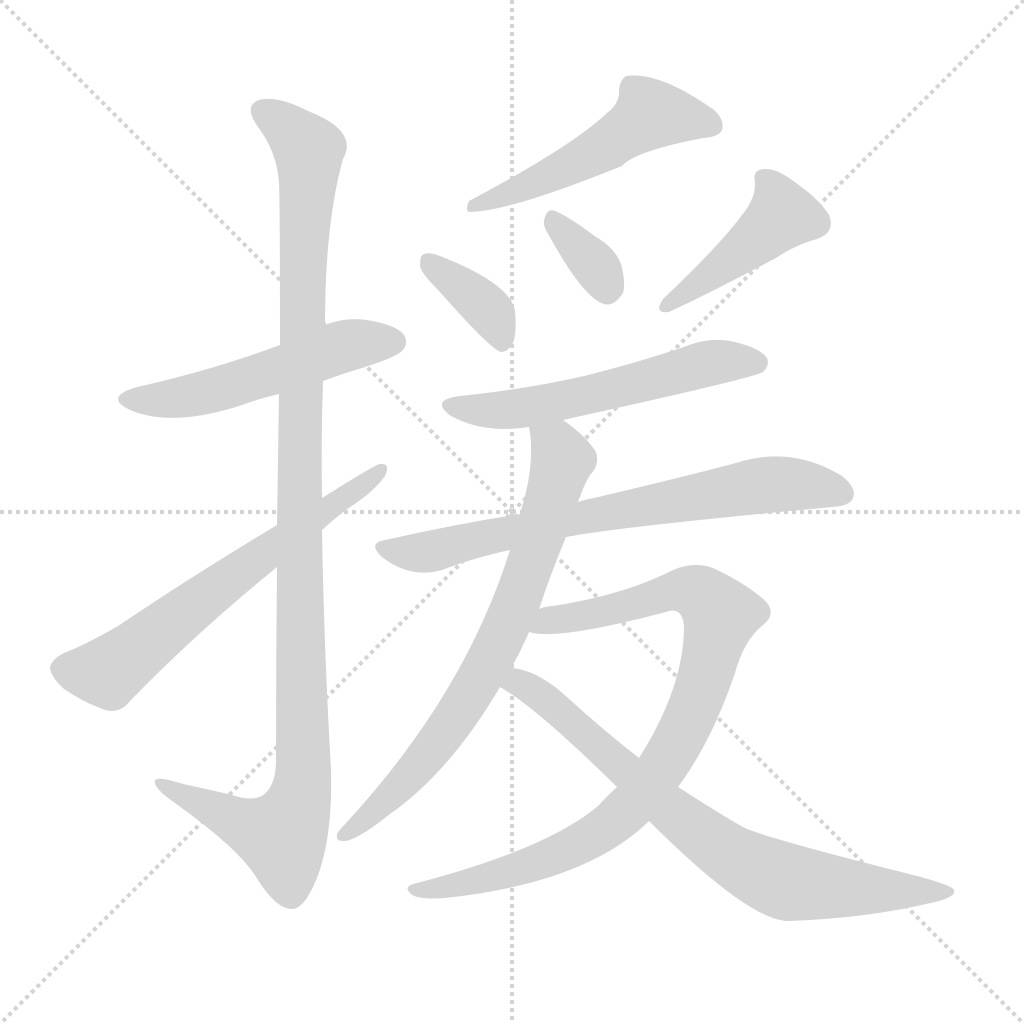
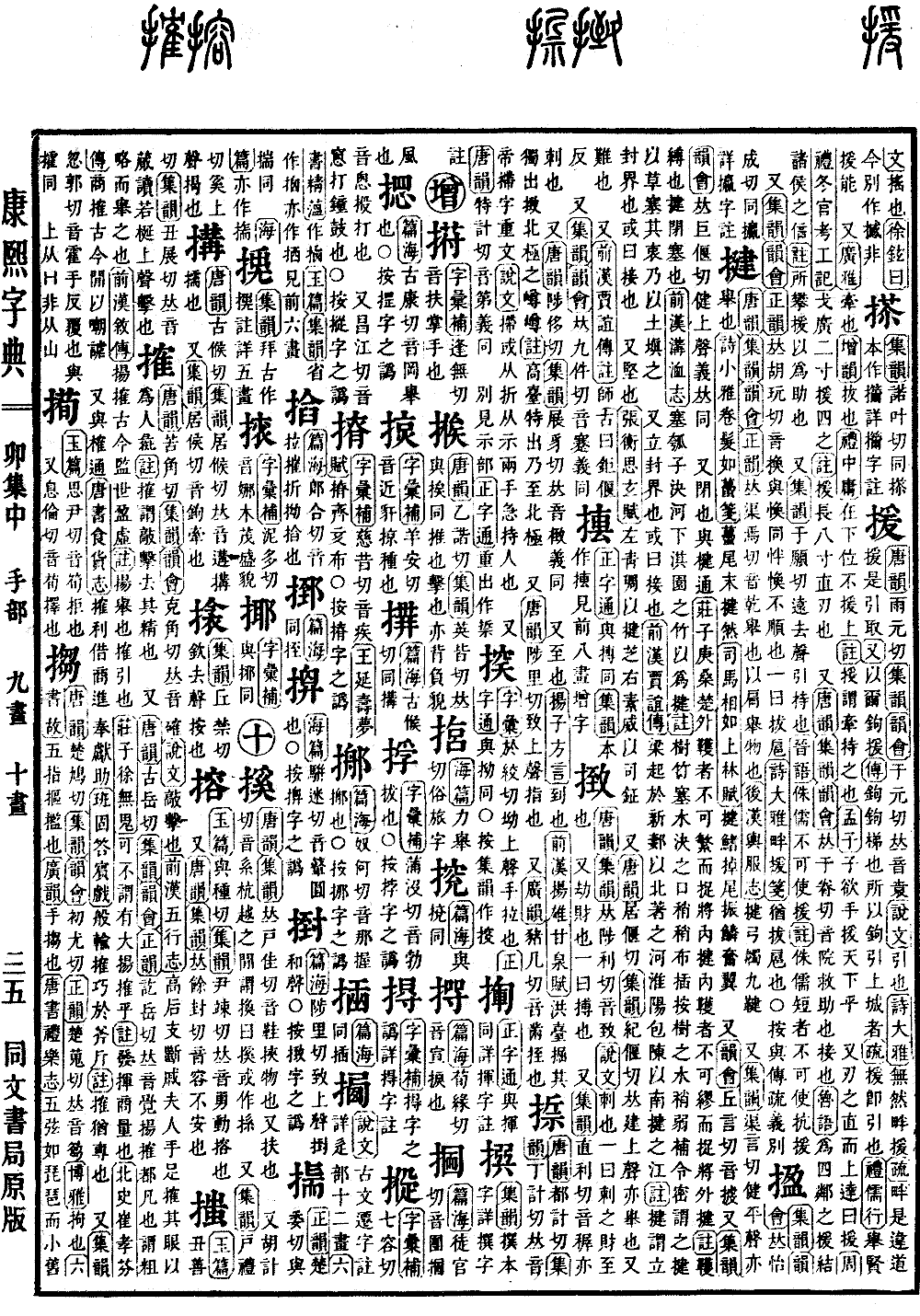
Mao Collection, Middle Volume. Radical: Hand (shǒu). Kangxi strokes: 13. Page 445, Entry 02.
Pronounced yuan. In the Shuowen Jiezi (Explanation of Graphs and Analysis of Characters), it means to pull. In the Book of Odes (Shijing), it is written that one should not act in a way that is rebellious and pulling. The commentary explains that to be rebellious is to violate the path, and to pull is to draw or take. It is also written, use your hooks to pull. The commentary explains that a hook is a hooked ladder, used to hook and pull oneself up a city wall. The commentary further explains that to pull is to draw. In the Book of Rites (Liji), it is written that one should promote the worthy and support the capable.
According to the Guangya (Broadened Dictionary), it also means to lead or pull. According to the Zengyun (Expanded Rhymes), it means to pull out or extract. In the Book of Rites (Liji), specifically the Doctrine of the Mean (Zhongyong), it is written that one in a lower position should not pull on those in higher positions. The commentary explains that to pull means to drag or hold onto. In the Mencius (Mengzi), it is written, do you wish to take hold of the world with your hands?
The straight part of a blade that extends upward is called a yuan. In the Rites of Zhou (Zhouli), specifically the Artificers Record (Kaogongji), it is written that the width of a dagger-axe is two inches, and the yuan is four times that. The commentary explains that the yuan is eight inches long, representing the straight blade.
Also pronounced yuan (falling tone). It means to save, assist, or connect. In the Discourses of Lu (Luyu), it is written to act as a support for the four neighbors and to strengthen the trust of the feudal lords. The commentary explains that this refers to those one grasps for assistance.
Also pronounced yuan (falling tone). To pull or hold. In the Discourses of Jin (Jinyu), it is written that a dwarf should not be asked to act as a support. The commentary explains that a dwarf, being short, cannot be asked to resist or provide support.
Also pronounced huan. The same as the character huan. Refers to a state of being unyielding or contrary. One source defines it as being overbearing or intractable. In the Book of Odes (Shijing), the commentary on the phrase regarding rebellion notes that it also means to be overbearing. Note that this definition differs from the interpretations found in the previous commentaries and sub-commentaries.