Wu Collection, Upper Volume
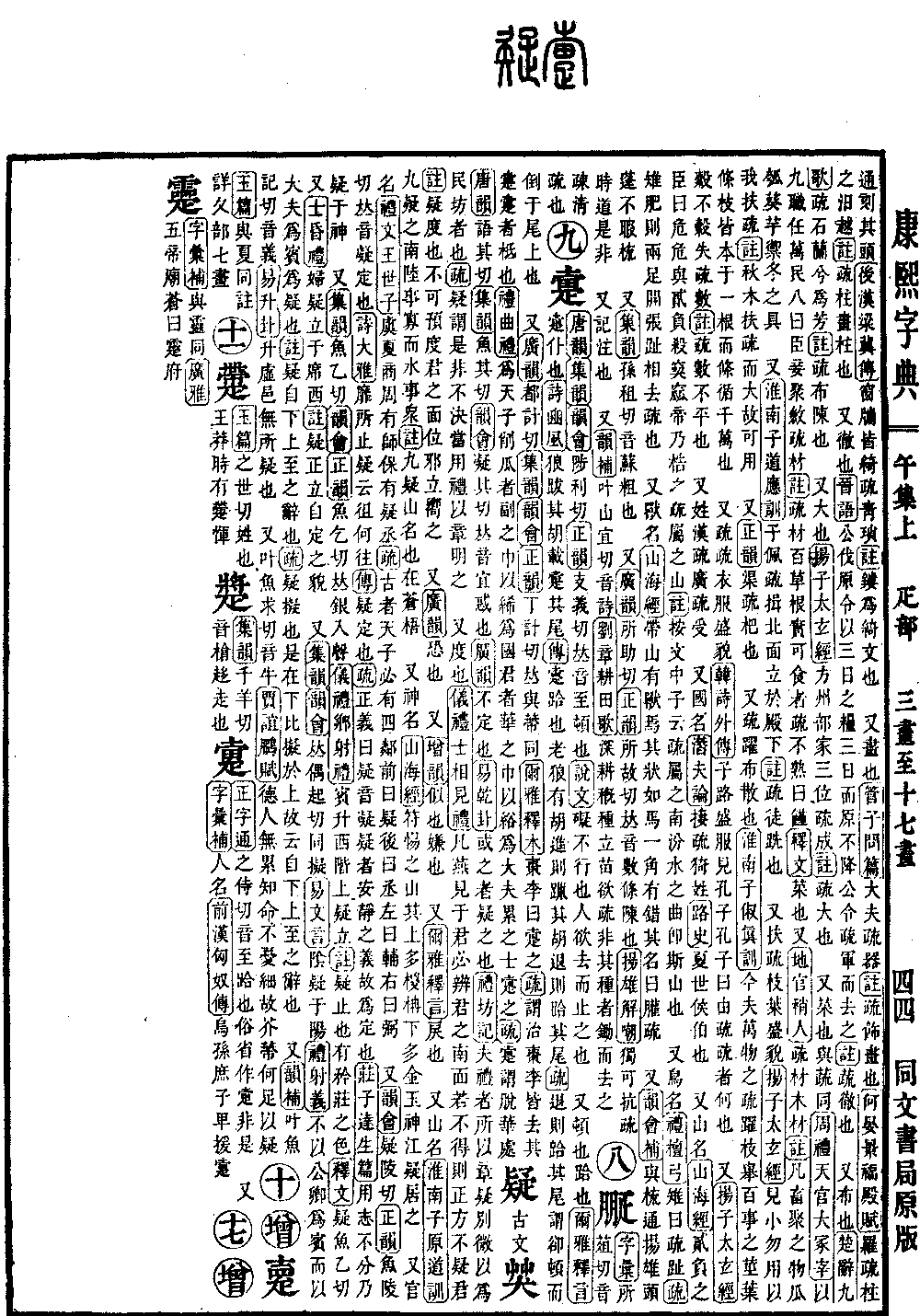
Radical: Bolt (pǐ)
Kangxi Strokes: 14
Page 768, Entry 03
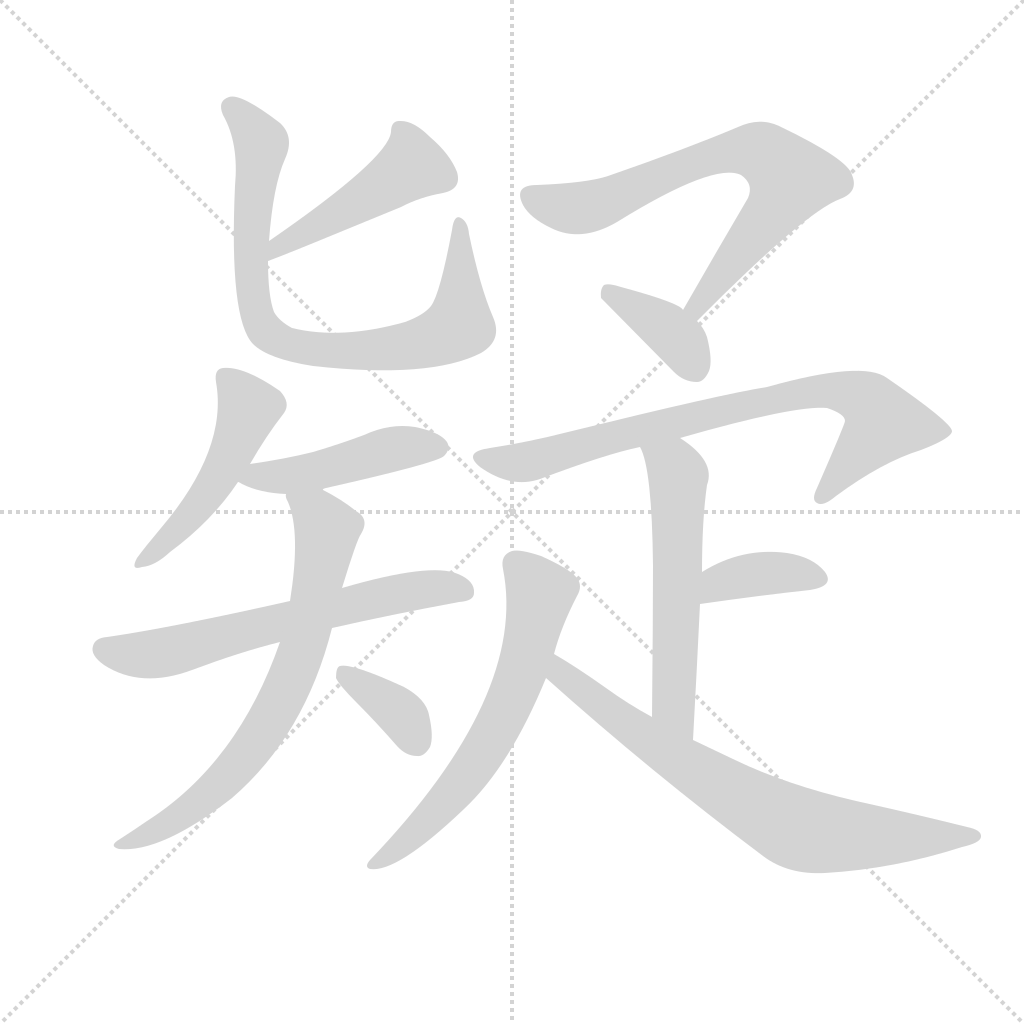
Ancient characters. Pronounced yi (rising tone). Meaning: doubt or uncertainty. As defined in the Guangyun (Broad Rhymes), meaning: indecisive. Book of Changes (Yijing), Hexagram Qian: "The phrase 'perhaps' indicates doubt." Book of Rites (Liji), Fangji: "Ritual is used to clarify doubts, distinguish subtle differences, and serve as a standard for the behavior of the people." The Commentary (Shu) states: Doubt refers to matters of right and wrong that are difficult to decide, which should be clarified through ritual.
Also means to conjecture or estimate. Book of Etiquette and Ceremonial (Yili), Shi Xiangjian Li: "Whenever meeting a ruler on an informal occasion, one must determine whether the ruler is facing south. If one cannot be certain, one should stand directly and not attempt to guess the ruler's orientation." The Annotation (Zhu) states: Doubt here means to conjecture; one should not attempt to pre-calculate the ruler's orientation and stand at an angle.
Also, per the Guangyun (Broad Rhymes), meaning: fear.
Also, per the Zengyun (Expanded Rhymes), meaning: similarity, or suspicion.
Also, per the Erya (Approaching Elegance), Shiyan section, meaning: perverse or contrary.
Also, the name of a mountain. Huainanzi (Yuandao Xun): "South of Mount Jiuyi, there are few terrestrial affairs but many aquatic affairs." The Annotation (Zhu) states: Jiuyi is the name of a mountain, located in Cangwu.
Also, the name of a deity. Classic of Mountains and Seas (Shanhaijing): "On Mount Futi, there are many palm trees and nanmu trees, and the mountain produces much gold and jade; a deity named Jiangyi dwells there."
Also, an official title. Book of Rites (Liji), Wenwang Shizi: "During the Yu, Xia, Shang, and Zhou dynasties, there were Teachers (Shi), Protectors (Bao), as well as Doubters (Yi) and Assistants (Cheng)." The Commentary (Shu) states: Anciently, the Son of Heaven was always accompanied by four assistants: the one in the front was called Yi, the one behind was called Cheng, the one on the left was called Fu, and the one on the right was called Bi.
Also, per the Yunhui (Collection of Rhymes), pronounced ning. Meaning: to stabilize or rest. Book of Odes (Shijing), Daya: "There is no place to settle and rest; where can one go?" The Commentary (Zhuan) states: Yi means to stabilize. The Commentary (Shu) states: The correct meaning is that Yi has the sense of stillness, thus it is explained as stabilizing. Zhuangzi, Dasheng: "When the mind is not distracted, the spirit can be stabilized like a deity."
Also, pronounced yi (entering tone). Book of Etiquette and Ceremonial (Yili), Xiangshe Li: "The guest ascends the western steps and stands upright upon them." The Annotation (Zhu) states: Yi means to stand still, exhibiting a grave and solemn demeanor. The Explanation of Text (Shiwen) states: Yi is pronounced yi (entering tone).
Also, Book of Etiquette and Ceremonial (Yili), Shi Hunli: "The bride stands upright on the west side of the mat." The Annotation (Zhu) states: Yi refers to the appearance of standing upright with a settled and calm demeanor.
Also, per the Jiyun (Collection of Rhymes) and Yunhui (Collection of Rhymes), meaning the same as ni (to compare or emulate). Book of Changes (Yijing), Wenyan: "Yin qi and yang qi oppose one another (ni)." Book of Rites (Liji), Sheyi: "One does not invite a minister to be the guest, but rather an official, to allow for emulation (to allow those of lower status to emulate those of higher status)." The Annotation (Zhu) states: Yi is a term used when those of lower status emulate those of higher status. The Commentary (Shu) states: Yi means ni. This is a term for those below emulating those above.
Also, according to the Yunbu (Rhyme Supplement), rhymes with yi (falling tone). Book of Changes (Yijing), Sheng Hexagram: "Ascending to an empty city, there is nothing to be doubtful about."
Also rhymes with ni (level tone). Jia Yi, Fu Niao Fu: "The person of virtue has no encumbrances; knowing the mandate of heaven, they have no sorrows. Regarding trivial and petty matters, why should there be any cause for doubt?"