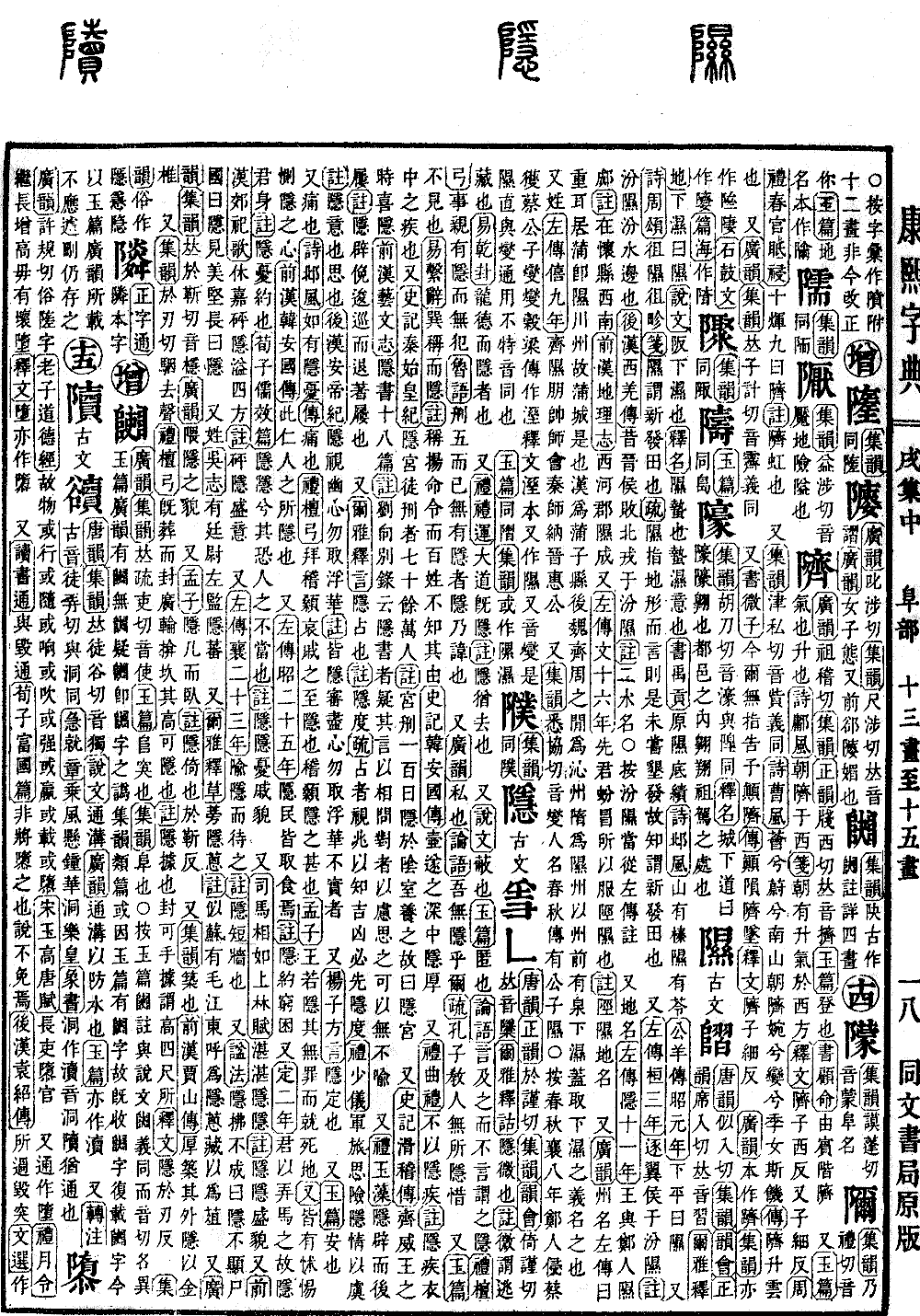
Xu Collection, Middle Volume
Radical: Mound (fù)
Xí
Kangxi strokes: 22
Page number: 1362, item 12
Ancient form.
Pronunciation: In Tang Rhyme (Tangyun), pronounced sìrù; in Collected Rhymes (Jiyun), Rhyme Compendium (Yunhui), and Correct Rhymes (Zhengyun), pronounced xírù. Pronounced Xí.
In Explaining Land (Erya): A low, wet place is called xí.
In Shuowen Jiezi (Shuowen): A damp place at the foot of a mountain.
In Explanations of Names (Shimíng): Xí means to lie dormant. Zhestill carries the meaning of dampness.
In Tribute of Yu (Shangshu): Achievements were made in both high plains and low, wet lands.
In Odes of Bei (Shijing): On the mountains are hazel trees, in the lowlands are ling herbs.
In Gongyang Commentary (Gongyang Zhuan), 1st year of Duke Zhao: A low and flat place is called xí.
Also, in the Odes of Zhou (Shijing): "Go to the low-lying fields, go to the paths between the fields." Commentary (Jiàn) states: "Xí refers to newly cultivated land." Sub-commentary (Shū) states: "Topographically, xí refers to uncultivated land, thus it is known to mean newly cultivated land."
Also, in the Zuo Commentary (Zuozhuan), 3rd year of Duke Huan: "Pursued Marquis Yi in the lowlands by the Fen River." Annotation (Zhù) states: "Fénxí refers to the area by the Fen River." In the History of the Later Han (Hou Hanshu), Account of the Western Qiang: "Formerly, Marquis Jin defeated the Northern Rong in the lowlands by the Fen River." Annotation (Zhù) states: "These are the names of two rivers." Note: "Fénxí should follow the Zuo Commentary's explanation."
Also, a place name. In the Zuo Commentary (Zuozhuan), 11th year of Duke Yin: "King Zhou granted the people of Zheng the place Xíchéng." Annotation (Zhù) states: "Southwest of Huai County." In the Book of Han (Hanshu), Treatise on Geography: "Xīhé Commandery had Xíchéng County."
Also, in the Zuo Commentary (Zuozhuan), 16th year of Duke Wen: "Our former ruler Fénmào was able to conquer Jīngxí." Annotation (Zhù) states: "Jīngxí is a place name."
Also, in the Guangyun (Guangyun): "A prefecture name." The Zuo Commentary (Zuozhuan) says: "Chóng'ěr resided in Pú, which is Xíchuān Prefecture, formerly Púchéng. During the Han Dynasty, it was Púzǐ County. Later, between the Northern Wei, Northern Qi, and Northern Zhou, it was Qìn Prefecture. During the Sui Dynasty, it was Xí Prefecture, named so because there was a spring in front of the prefectural city and the terrain was low and damp, likely deriving its name from this meaning of low and damp."
Also, a surname. In the Zuo Commentary (Zuozhuan), 9th year of Duke Xi: "Xí Péng of Qi led his army to meet the Qin army, escorting Duke Huì of Jin back to assume his throne."
Also, in the Jiyun (Jiyun): "Pronounced xiè." A person's name. In the Spring and Autumn Annals (Chūnqiū Zhuàn), there is Duke Xi. Note: In the 8th year of Duke Xiang of Spring and Autumn (Chūnqiū Zhuàn), the people of Zheng invaded Cai and captured Gongzi Xiè of Cai. Xiè is written as shī in the Guliang Commentary (Guliang Zhuan). The explication (Shìwén) states that shī is sometimes written as xí in other versions, and also pronounced xiè. This indicates that the character xí is directly interchangeable with the character xiè, not just sharing the same pronunciation.
In the Yupian (Yupian): Same as variant form wèi.
In the Jiyun (Jiyun): Sometimes written as shī (wet/damp).