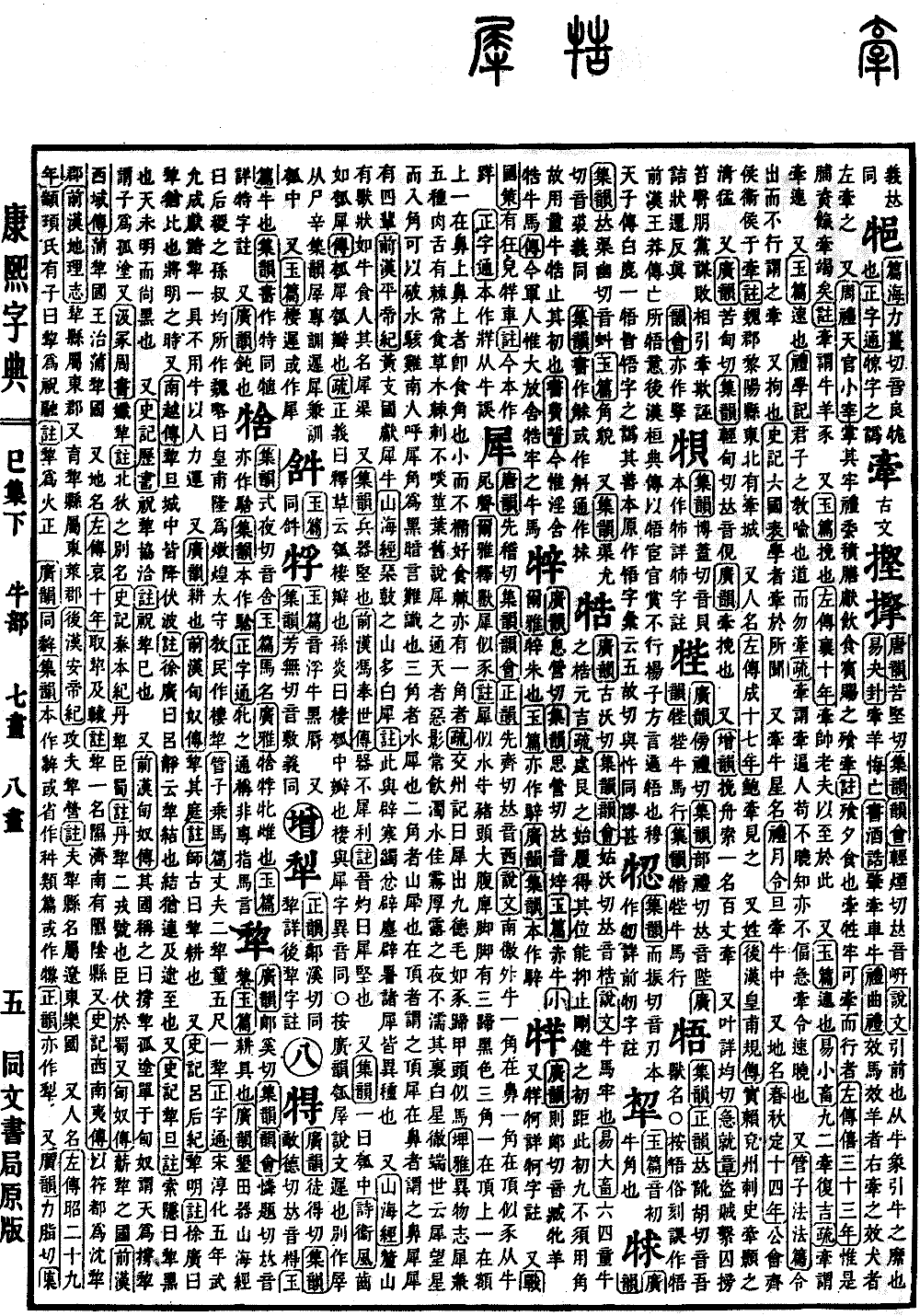
Supplementary Note
Si Collection, Middle Volume
Radical: Cow (niú)
Kangxi Strokes: 12
Page 701, Entry 14
Wuyin Pianhai states it is the same as the character used for rhinoceros.
Tangyun, Jiyun, Yunhui, and Zhengyun state: pronounced xi.
Shuowen Jiezi states: A type of ox from the remote southern border regions; it has one horn on its nose and one on its forehead; it resembles a pig. The character is formed with the radical for cow and the phonetic component for the sound xi.
Erya, Explanation of Animals states: The rhinoceros resembles a pig. The commentary states: The rhinoceros is like a water buffalo, with a head like a pig, a large belly, short legs, and three-toed feet; its body is black. It has three horns: one on the crown, one on the forehead, and one on the nose. The nose horn is the one it uses to forage. The horns are small and not oval-shaped; it likes to eat thorns. There are also rhinoceroses with a single horn. The commentary states: The Record of Jiaozhou says: The rhinoceros is produced in Jiude; its hair resembles that of a pig, and it has hooves, claws, and a head like a horse.
Piya, Records of Strange Things states: There are five types of rhinoceroses. They have fleshy thorns on their tongues and eat the thorns of plants, but do not eat the stems or leaves. Traditional lore claims that among rhinoceroses there are those with heaven-reaching spirituality; they dislike their own shadows and often drink murky water. They do not get wet even on nights of dense fog and heavy dew. Their horns have white veins that run straight to the tip. People of the world say: When a rhinoceros looks up at the stars, the starlight enters its horn; such a horn can be used to part water or frighten a flock of chickens. Southerners call the rhinoceros horn dark, meaning it is difficult to distinguish. The three-horned rhinoceros is the water rhinoceros. The two-horned rhinoceros is the mountain rhinoceros. The one with a horn on the crown is called the crown rhinoceros. The one with a horn on the nose is called the nose rhinoceros. There are four types of rhinoceroses.
Book of Han (Hanshu), Annals of Emperor Ping states: The Kingdom of Huangzhi presented a rhinoceros.
Classic of Mountains and Seas (Shanhaijing) states: Mount Qinqi has many white rhinoceroses. The commentary states: This white rhinoceros, along with the cold-averting rhinoceros, the anger-clearing rhinoceros, the dust-averting rhinoceros, and the heat-averting rhinoceros, are all different species.
Classic of Mountains and Seas (Shanhaijing) also states: On Mount Li there is a wild beast that looks like an ox and eats humans; its name is Xiqu.
Jiyun states: It also refers to the durability of weapons.
Book of Han (Hanshu), Biography of Feng Fengshi states: The weapons were neither sharp nor durable. The commentary states: Jin Zhuo says: Xi means durable.
Jiyun states: Another meaning is the seeds of a calabash.
Book of Odes (Shijing), Odes of Wei states: Teeth like calabash seeds. The commentary states: Huxi refers to the segments of a calabash. The sub-commentary states: The orthodox interpretation says: Explanation of Plants says: Hu means the segments of a calabash. Sun Yan says: Xi means the segments in the middle of a calabash. The characters for xi (durability) and xi (rhinoceros) are different but are pronounced the same. According to Guangyun, it is written as huxi (calabash seed), while Shuowen Jiezi explains it as slow. It is also written as xi, formed with the radical for corpse and the phonetic component for xin. In Jiyun, xi is defined specifically as slow, while xi (rhinoceros) additionally holds the definition of calabash seed.
Yupian states: The term xichi (lingering) is sometimes written using the character for rhinoceros.