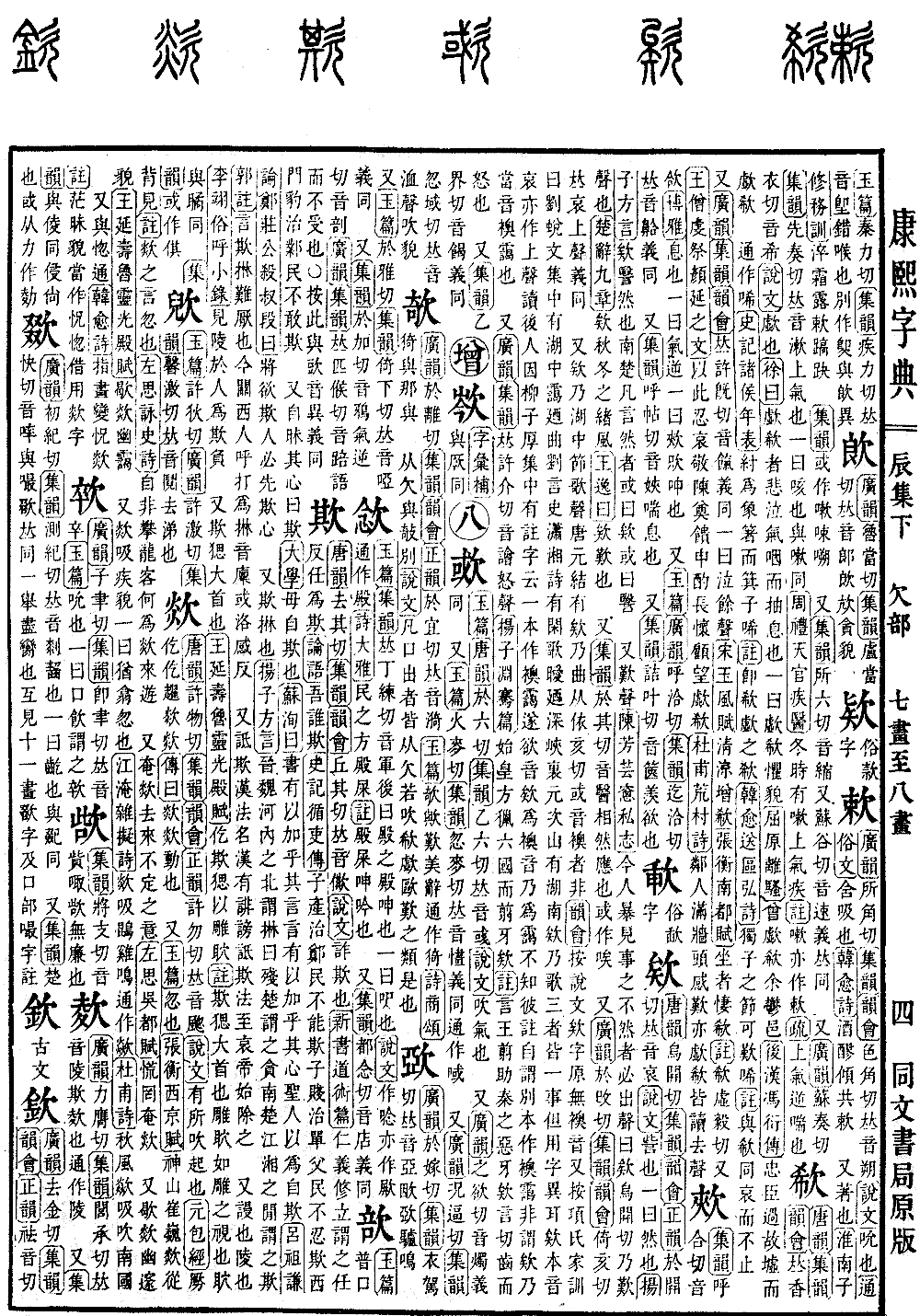
Chen Collection, Lower Volume
Radical: Lack (qiàn)
Kangxi Strokes: 11
Page 568, Entry 04
Pronounced xi.
Shuowen Jiezi (Dictionary of Explaining Characters): To sob.
Xu Kai says: To sob and sigh is the sound of gasping while weeping with choked breath. Another interpretation says it describes the appearance of fear.
Qu Yuan, Encountering Sorrow (Lisao): I sighed and sobbed in my melancholy.
History of the Later Han (Hou Hanshu), Biography of Feng Yan: A loyal official passes the ruins of the past and sobs.
Commonly written as the variant form xi.
Records of the Grand Historian (Shiji), Chronological Table of the Feudal Lords: When Zhou made ivory chopsticks, Jizi sighed.
Commentary: This is the same as the xi in xuxi.
Han Yu, Poem Sending Off Qu Hong: Your integrity alone is enough to make one sigh.
Commentary: Same as xi. Grief that does not cease.
Pronounced xi (falling tone).
Same meaning as above. Another interpretation: the sound remaining after weeping.
Song Yu, Rhapsody on the Wind (Feng Fu): The cool air increases the sobbing.
Zhang Heng, Rhapsody on the Southern Capital (Nandu Fu): Those sitting were mournful and sobbing.
Commentary: Xi is pronounced xi (falling tone).
Wang Sengqian, Essay Sacrificing to Yan Yanzhi: Enduring grief, I respectfully present these offerings. I pour a libation in deep remembrance, looking back and sobbing.
Du Fu, Poem on the Desolate Village: The neighbors fill the walls, sighing and sobbing as well. All are read with a falling tone.