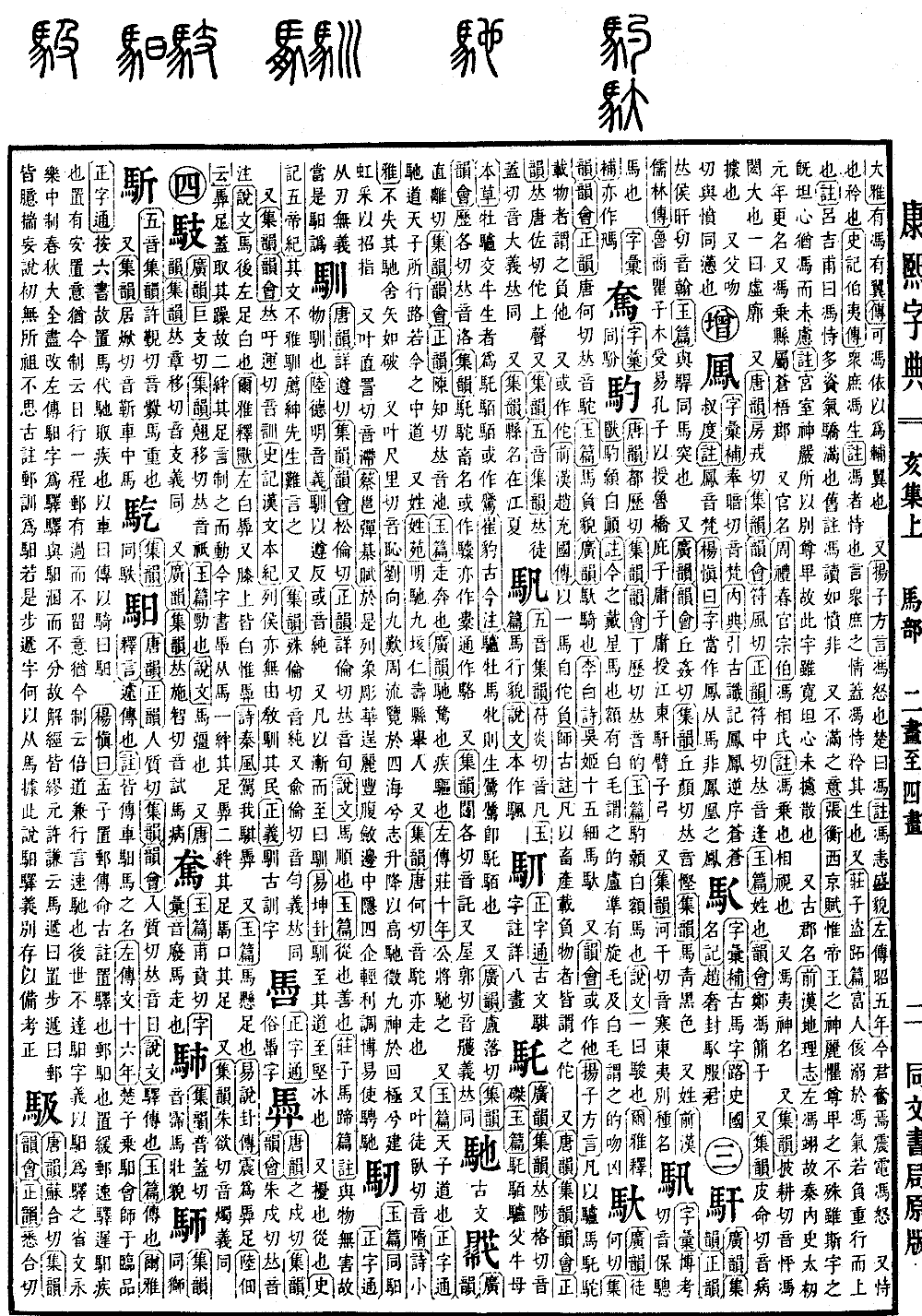
Hai Collection, Upper Volume
Radical: Horse (mǎ)
Entry: 驯
Kangxi stroke count: 13
Page 1434, Entry 01
Pronounced xun.
According to the Analytical Dictionary of Characters (Shuowen Jiezi), it refers to a horse that is docile.
According to the Jade Chapters (Yupian), it means to follow or to be virtuous.
According to the commentary on the Horse's Hooves chapter of the Zhuangzi, it means that because one does no harm to others, other creatures become docile.
According to Lu Deming's Sound and Meaning (Yinyi), the character is also pronounced chun.
It also denotes arriving gradually. According to the Book of Changes (Yijing), under the Earth Hexagon, this describes the gradual reaching of the way until reaching hard ice.
It also means to tame or to follow. According to the Records of the Grand Historian (Shiji), Five Emperors Era, it is stated that his writing was not refined or docile, and the scholars and gentlemen found it difficult to speak about.
Pronounced chun.
Pronounced yun. The meaning is the same.
Pronounced xun. According to the Records of the Grand Historian (Shiji), Annals of Emperor Wen of Han, it is stated that the marquises had no means to teach or tame their people. According to the Correct Meaning (Zhengyi), this character is the ancient form of the character for instruction.