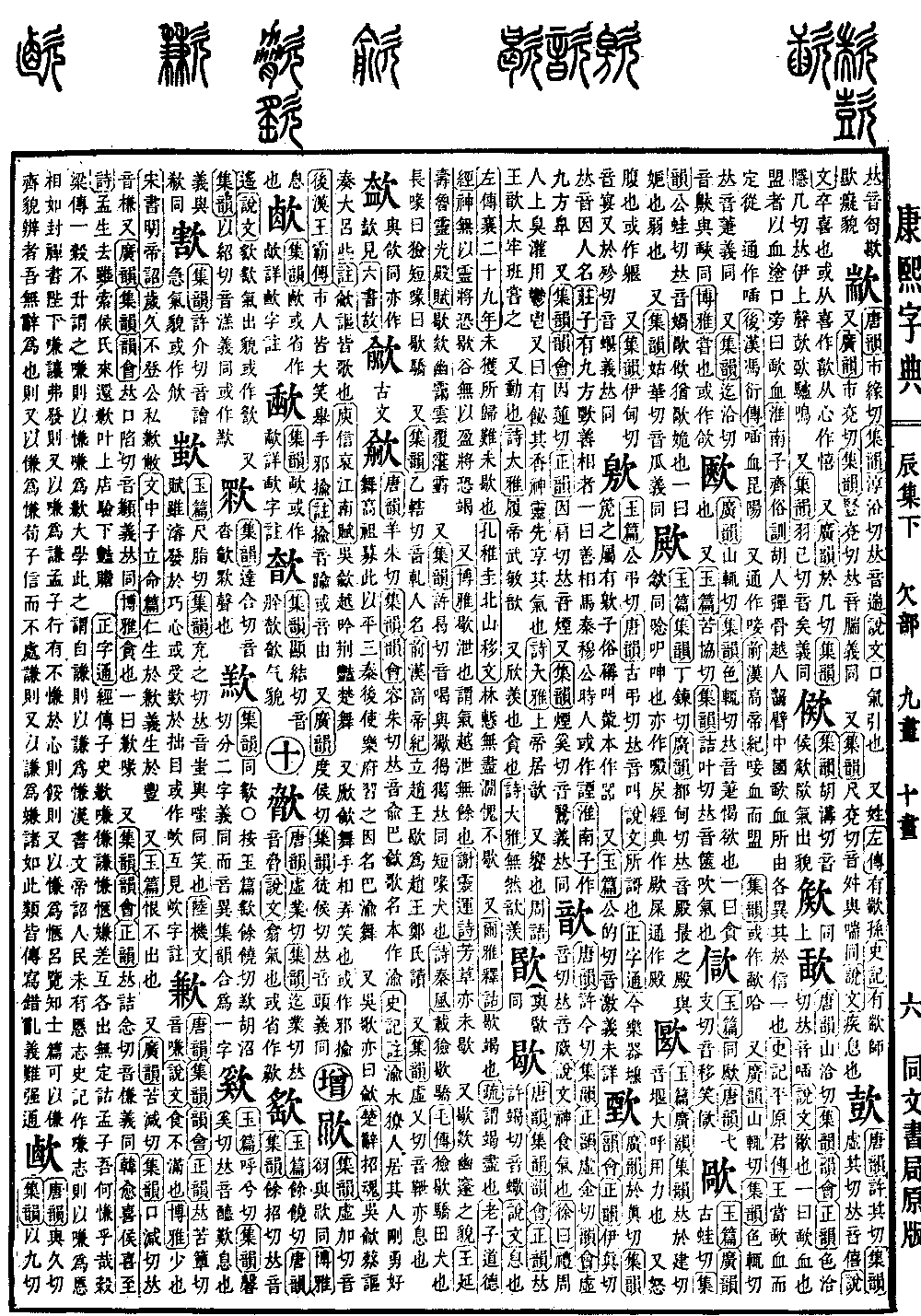
Chen Collection, Lower Volume
Radical: Lack (qiàn)
Kangxi Strokes: 13
Page 570, Entry 15
Pronounced xie. According to the Analytical Dictionary of Characters (Shuowen Jiezi), it means to rest. In the Commentary on the Zuo Tradition (Zuo Zhuan), twenty-ninth year of Duke Xiang, it is stated that if there is no destination found, calamities will not cease. In Kong Zhigui's North Mountain Removal Proclamation (Beishan Yiwen), it is written that the forests and mountains are ashamed and exhausted, and the shame does not cease. Also, according to the Er Ya (Erya), a dictionary of classical synonyms, xie means to exhaust. The sub-commentary explains it as meaning to reach an end. In the Laozi (Daodejing), it states that if the spirit cannot remain subtle, it is feared it will wither; if the valleys cannot remain full, it is feared they will dry up. Furthermore, the Guangya (Boya) states that xie means to release, meaning the breath dissipates and nothing remains. Xie Lingyun's poetry mentions that the fragrant grasses have not yet withered. It also denotes xiechua, appearing deep and dark. In Wang Yanshou's Rhapsody on the Lingguang Hall (Lu Lingguangdian Fu), it is described as deep, dark, and remote, covered and obscured by clouds and mist.
Additionally, pronounced he. It is the same as the characters for a short-muzzled dog. In the Book of Odes (Shijing), it mentions carrying the xian and xiejiao hounds. The Mao Commentary states that the xian and xiejiao are both hunting dogs; the long-muzzled are called xian, and the short-muzzled are called xiejiao.
Also, pronounced ya. Used in a personal name. In the Records of the Grand Historian (Shiji), Biography of the Supreme Ancestor, Zhao Xie was made king. The Xu Guang commentary notes the pronunciation as wu-xia.
Also, pronounced xie. It also means to rest.
Textual Criticism: In the Ji Yun, pronounced ya, used in a personal name. In the Book of Han (Hanshu), Biography of Emperor Gao, Zhao Xie was established as the King of Zhao. Zheng reads it this way. Note: According to the Records of the Grand Historian, Biography of the Supreme Ancestor, the character xie is annotated by Xu Guang with the pronunciation wu-xia, and Zheng De annotates it as e. Since wu-xia and ya are phonetically identical, the entry for ya should cite the reading of Xu Guang, not that of Zheng. We have amended the entry for the Biography of Emperor Gao to: Records of the Grand Historian, Biography of the Supreme Ancestor, Zhao Xie was made king. The Xu Guang commentary notes the pronunciation as wu-xia. Furthermore, the pronunciation ya in the fifteenth volume of the Ji Yun does not correspond to the character za, which appears in the fourteenth volume under the rhyme group xia. The entry has been corrected to reflect the proper sound.