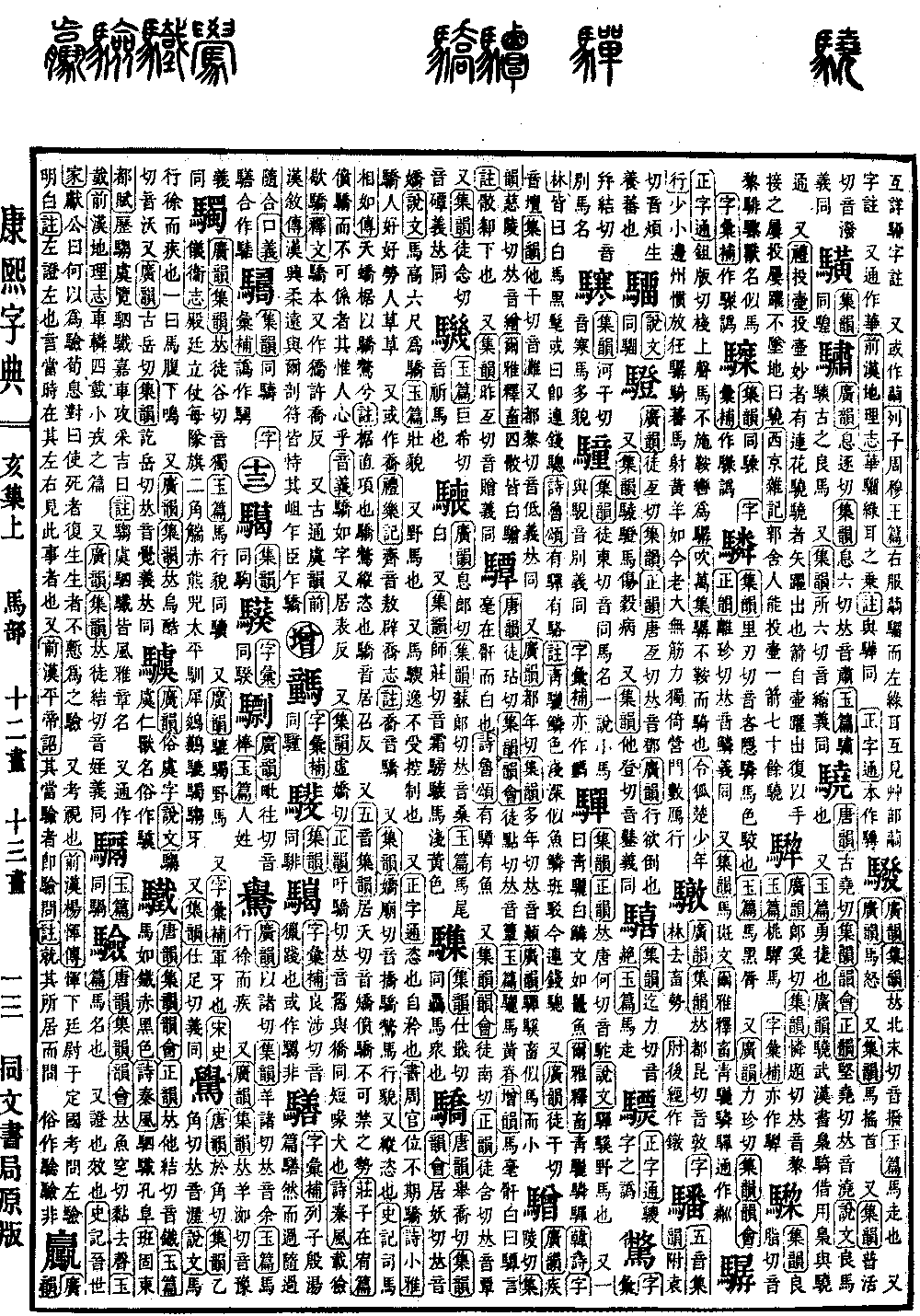
Hai Collection, Upper Volume
Radical: Horse (mǎ)
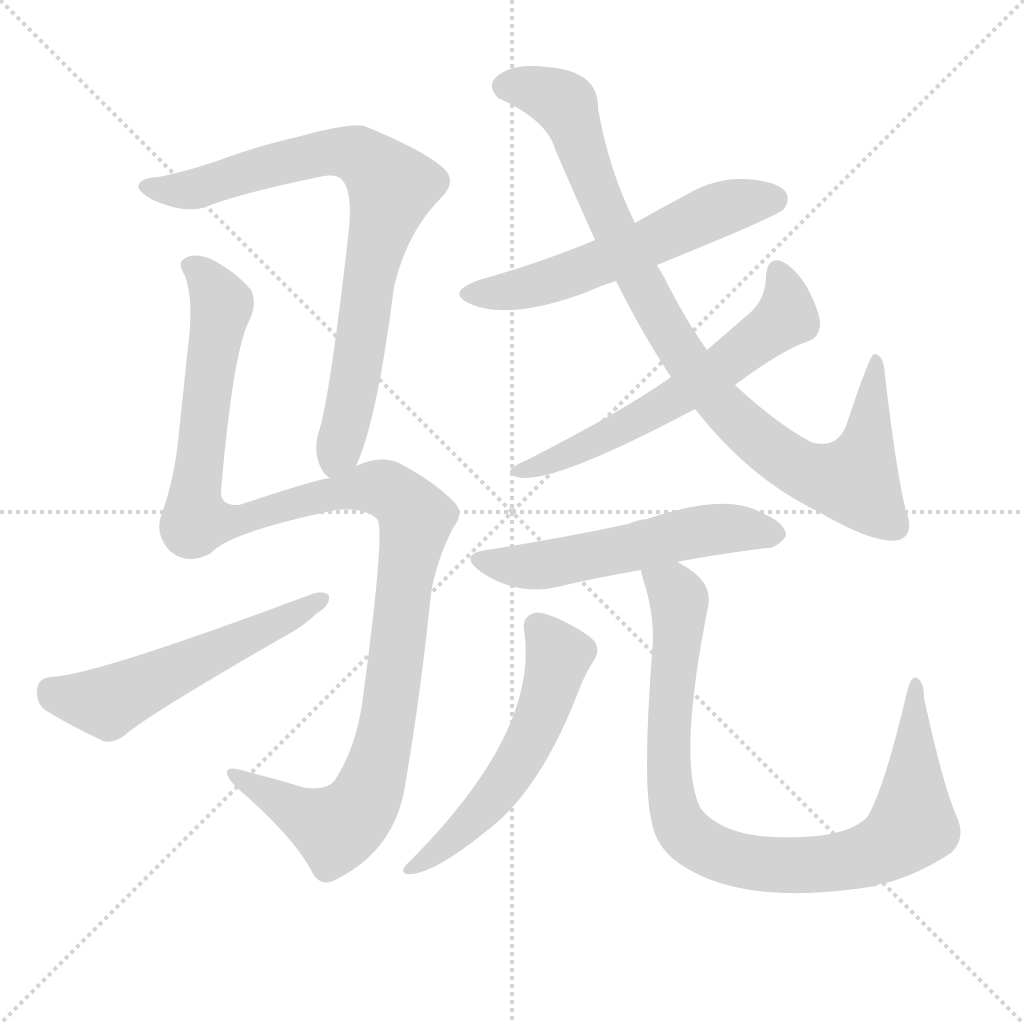
Entry: 驍
Kangxi stroke count: 22
Page 1445, Entry 01
Pronounced jiao.
According to the Explaining Graphs and Analyzing Characters (Shuowen Jiezi), it refers to a fine horse.
According to the Jade Chapters (Yupian), it means brave and agile.
According to the Broad Rhymes (Guangyun), it refers to martial bravery; in the History of the Han (Hanshu), it refers to a fierce cavalcade. It is used interchangeably with the character for owl (xiao).
According to the Western Capital Miscellaneous Records (Xijing Zaji), in ancient games of pitch-pot, the goal was to hit the target without the arrow returning, but Master Guo would deflect the arrow to make it bounce back, sometimes over a hundred times in a single throw, which was called xiao.
According to the Yan Family Instructions (Yanshi Jiaxun), Zhou Gui of Runan and Hui Hui were able to perform over forty xiao with a single arrow.
Textual verification:
Rituals: Pitch-pot states that for those skilled at pitch-pot, there is the continuous flower xiao. Xiao refers to the arrow leaping out. The arrow leaps out of the pot and is caught again by hand, jumping repeatedly without falling to the ground, which is called xiao.
Western Capital Miscellaneous Records (Xijing Zaji) states that Master Guo could perform over seventy xiao in one arrow throw.
Upon investigation, the phrase regarding those skilled at pitch-pot is not present in the pitch-pot chapter, and the citation from the Western Capital Miscellaneous Records does not match the original text. It has been corrected to: The Western Capital Miscellaneous Records states that in ancient pitch-pot, the goal was to hit the target without the arrow returning, but Master Guo would deflect the arrow to make it bounce back, sometimes over a hundred times in a single throw, which was called xiao. Also, the Yan Family Instructions states that Zhou Gui of Runan and Hui Hui were able to perform over forty xiao with a single arrow.