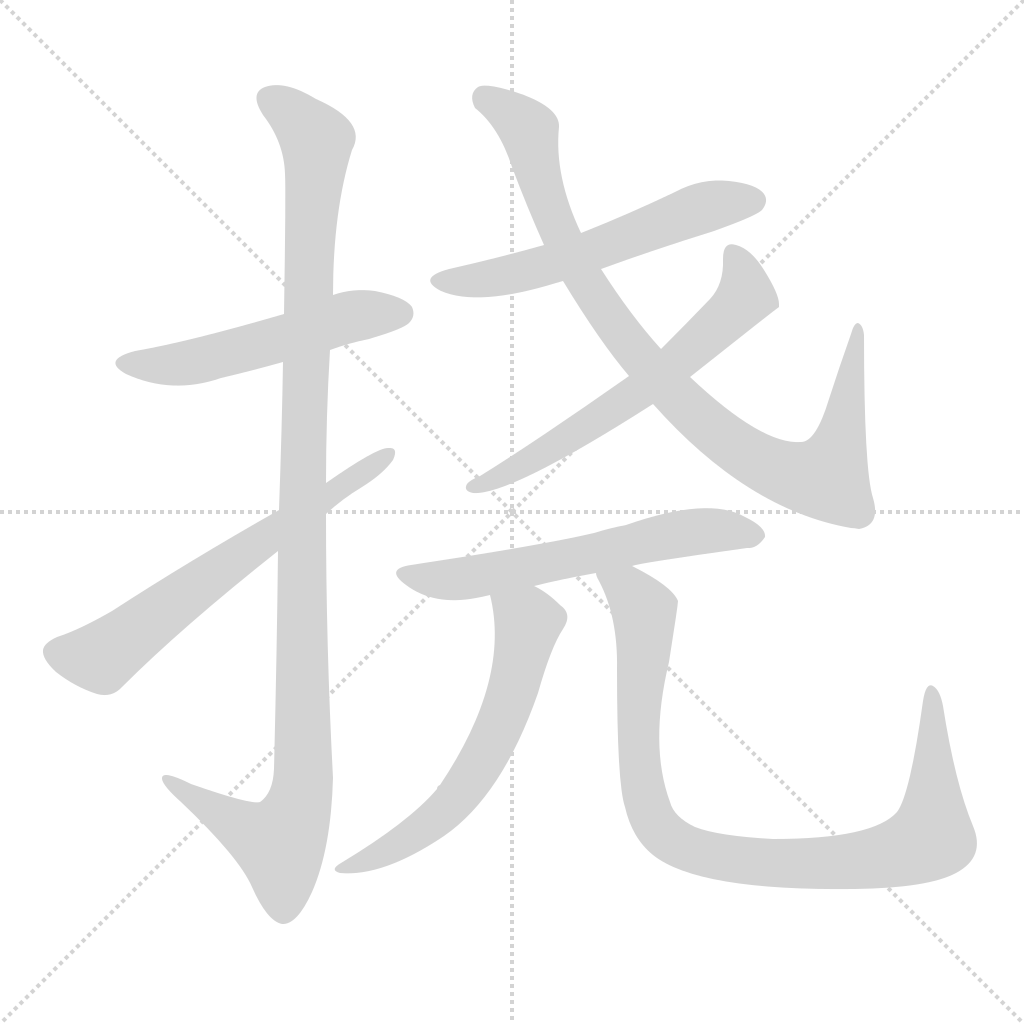
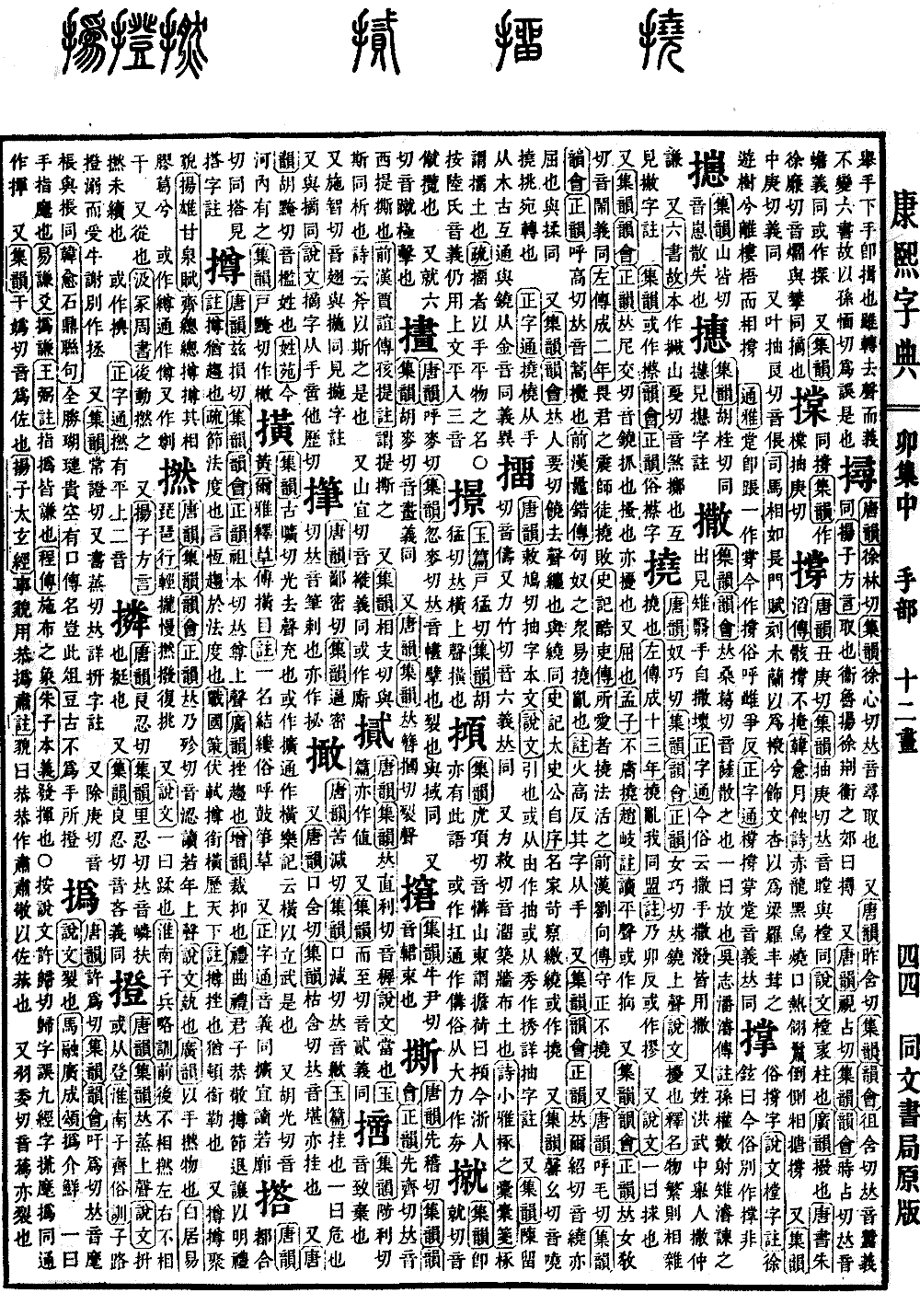
Mao Collection, Middle Volume. Radical: Hand (shǒu). Kangxi strokes: 16. Page 454, Entry 01.
Pronounced nǎo. According to Explaining Graphs and Analyzing Characters (Shuowen Jiezi), it means to disturb. According to Explaining Names (Shiming), when things are numerous, they become mixed and disturbed. In the Zuo Tradition (Zuo Zhuan), thirteenth year of Duke Cheng: To disturb and disrupt our alliance. Note: Pronounced nǎo. Sometimes written as a variant form.
Also according to Explaining Graphs and Analyzing Characters (Shuowen Jiezi), one meaning is to crook or bend.
Pronounced náo. To scratch or to claw; also, to disturb. Also, to bend. In the Mencius: Not bending the skin. Zhao Qi commentary: Read with a level tone. Sometimes written as a variant form.
Pronounced nào. The meaning is the same. In the Zuo Tradition (Zuo Zhuan), second year of Duke Cheng: Fearing the tremors of the lord, the troops were disturbed and defeated. In the Records of the Grand Historian (Shiji), Biography of Harsh Officials: Those whom one loves, one bends the law to save. In the History of the Former Han (Qian Hanshu), Biography of Liu Xiang: Do not bend against the multitude of injustices.
Pronounced hāo. To stir up. In the History of the Former Han (Qian Hanshu), Biography of Chao Cuo: The masses of the Xiongnu are easily stirred into chaos. Note: Pronounced hāo, and the character is formed with the hand radical.
Pronounced rào. Also, to bend. Same as to flex.
Pronounced rào (falling tone). To entwine. Same as to wind. In the Records of the Grand Historian (Shiji), Grand Historian’s Preface: The School of Names is overly scrutinizing and entangling. Sometimes written as a variant form.
Pronounced xiāo. Disturbed and agitated, moving in a winding manner. According to Correct Character Mastery (Zhengzitong), the characters for bend and stir use the hand and wood radicals, which were interchangeable in ancient times. It is different in meaning but same in pronunciation as the character formed with the metal radical.
Textual research: In the History of the Former Han (Qian Hanshu), Biography of Liu Xiang: Upholding righteousness without bending. According to the original text, uphold righteousness is one clause, and not bending against the multitude of injustices is another. I have revised it to: Do not bend against the multitude of injustices.