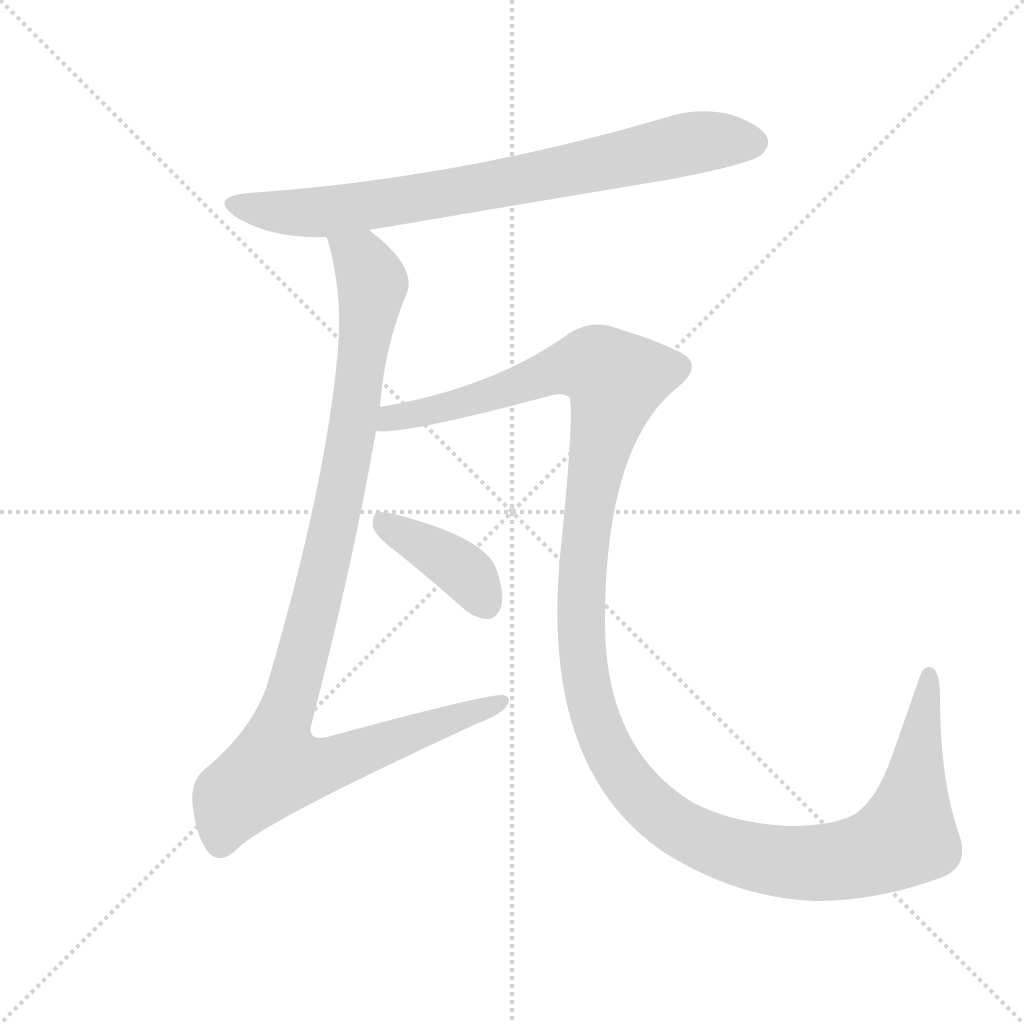
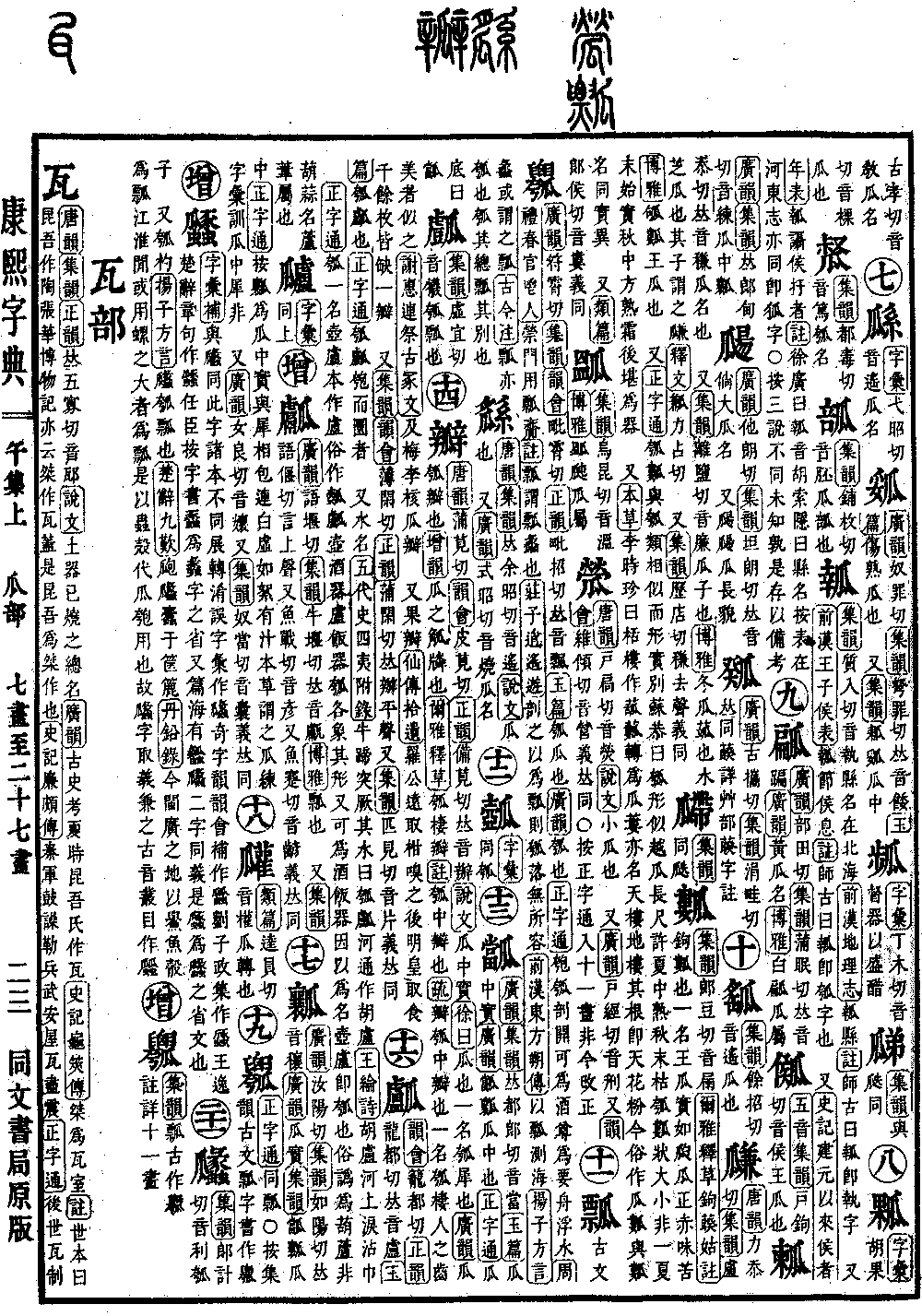
Wu Collection, Upper Volume. Radical: Tile (wǎ); Kangxi strokes: 5; Page 747, Entry 36.
Tangyun (Tang Dynasty Rhyme Dictionary), Jiyun (Compilation of Rhymes), and Zhengyun (Correct Rhymes) state the pronunciation is wǎ, identical to the character wǎ.
Shuowen Jiezi (Explaining Graphs and Analyzing Characters) explains it as: a general term for vessels fired from clay.
Guangyun (Expanded Rhyme Dictionary) cites the Ancient History Examination (Gǔshǐkǎo) record: During the Xia dynasty, the Kunwu clan invented tiles.
Records of the Grand Historian (Shǐjì), Biography of Turtle and Milfoil Divination, records: Jie of Xia built a house of tiles.
Commentary: The Genealogy (Shìběn) states: The Kunwu made pottery. Zhang Hua's Record of Things (Bówùjì) also says: Xia Jie made tiles, likely because the Kunwu made them for Xia Jie.
Records of the Grand Historian, Biography of Lian Po, records: When the Qin army beat drums and shouted while drilling at Wu'an, the tiles on the houses all shook.
Zhengyutong (Compilation of Correct Characters) states: Later generations of tiles are not as well-made as the ancient ones, and there is more than one type. The Story of Han Wudi (Hànwǔ Gùshì) records that the Spirit House was built using copper tiles coated with lacquer. Furthermore, the Record of Wu (Wúguó Zhuàn) records that the palace of the Da Qin kingdom had tiles made of crystal. Additionally, the Miscellaneous Records of the Bright Emperor (Mínghuáng Zálù) records: The Lady of Guo was once in great favor and forcibly occupied Wei Sili's residence to expand her own. Later, when the residence was returned to the Wei family, a strong wind damaged the house, and tiles fell onto the hall without breaking. Upon closer inspection, those tiles were all made of hard wood. Furthermore, the Biography of Wang Jin (Wáng Jǐn Zhuàn) records: The shrines of Mount Wutai used copper-cast tiles coated in gold.
Book of Odes (Shījīng), Minor Odes, contains the line: "He plays with a tile."
Commentary: Tile here refers to a spindle whorl.
Book of Etiquette and Ceremonial (Yílǐ), Banquet Rites, records: The sovereign's wine vessel is a "wa-da," and there are two of them.
Commentary: "Da" is pronounced the same as tai. "Wa-da" is a vessel used by the Youyu clan.
Zuo Tradition (Zuǒzhuàn), 26th Year of Duke Zhao, records: An arrow struck the ridge of the shield.
Commentary: Tile refers to the raised central part of a shield.
Also the term "wa-he" (tile-joining).
Book of Rites (Lǐjì), Conduct of the Scholars, contains the saying: "Destroy the square and join like tiles."
Commentary: Master Lu explains: When a potter makes tiles, he must first create a circle and then divide it. Separated, they are tiles; joined together, they are a circle, yet they do not lose the essential quality of being tiles.
Also the term "wa-jie" (tile-disintegration).
Records of the Grand Historian, Account of the Xiongnu, records: When they were in distress and defeated, it was like tiles shattering and clouds scattering.
Also used as a personal name.
Zuo Tradition, 23rd Year of Duke Zhao, records: Nang Wa of the state of Chu served as Lingyin (Prime Minister).
Commentary: Nang Wa is Zichang, the grandson of Zinan.
Also used as a place name.
Spring and Autumn Annals (Chūnqiū), 8th Year of Duke Yin, records: The Duke of Song, the Marquis of Qi, and the Marquis of Wei held an alliance at Wuwu.
Commentary: Wuwu is a place name from the Zhou dynasty.
Also, the 8th Year of Duke Ding records: Duke Ding of Lu met with the Jin army at the land of Wa.
Commentary: Wa is a place name in the state of Wei.
History of the Later Han (Hòuhànshū), Treatise on Prefectures and States, records: There is a place called Wating in Dongjun.
Additionally, Guangyun states the pronunciation is yà, and Jiyun states the pronunciation is yà, identical to the character yà.
Guangyun explains it as: to smear a roof with mud.
Jiyun explains it as: to lay tiles on a roof.
Also, Jiyun and Yunhui (Compendium of Rhymes) state the pronunciation is wéi, identical to the character wéi. This refers to the brick and tile of a roof construction.
Zhuangzi (Zhuāngzǐ), Webbed Toes chapter, contains the sentence: "For those tied to distinctions, they stack tiles and knot them."
Commentary: The character "wa" should be read as wéi. Here, it should be treated as the character wan.
Also, in the Rhyme Supplement (Yùnbǔ), the rhyming pronunciation is given as wǔ.
Han Yu's Poem on the Sagely Virtues of the Yuanhe Era contains the line: The Emperor is diligent and frugal, using clay tiles for washing; discarding splendor, he favors coarse cloth and fine hemp.