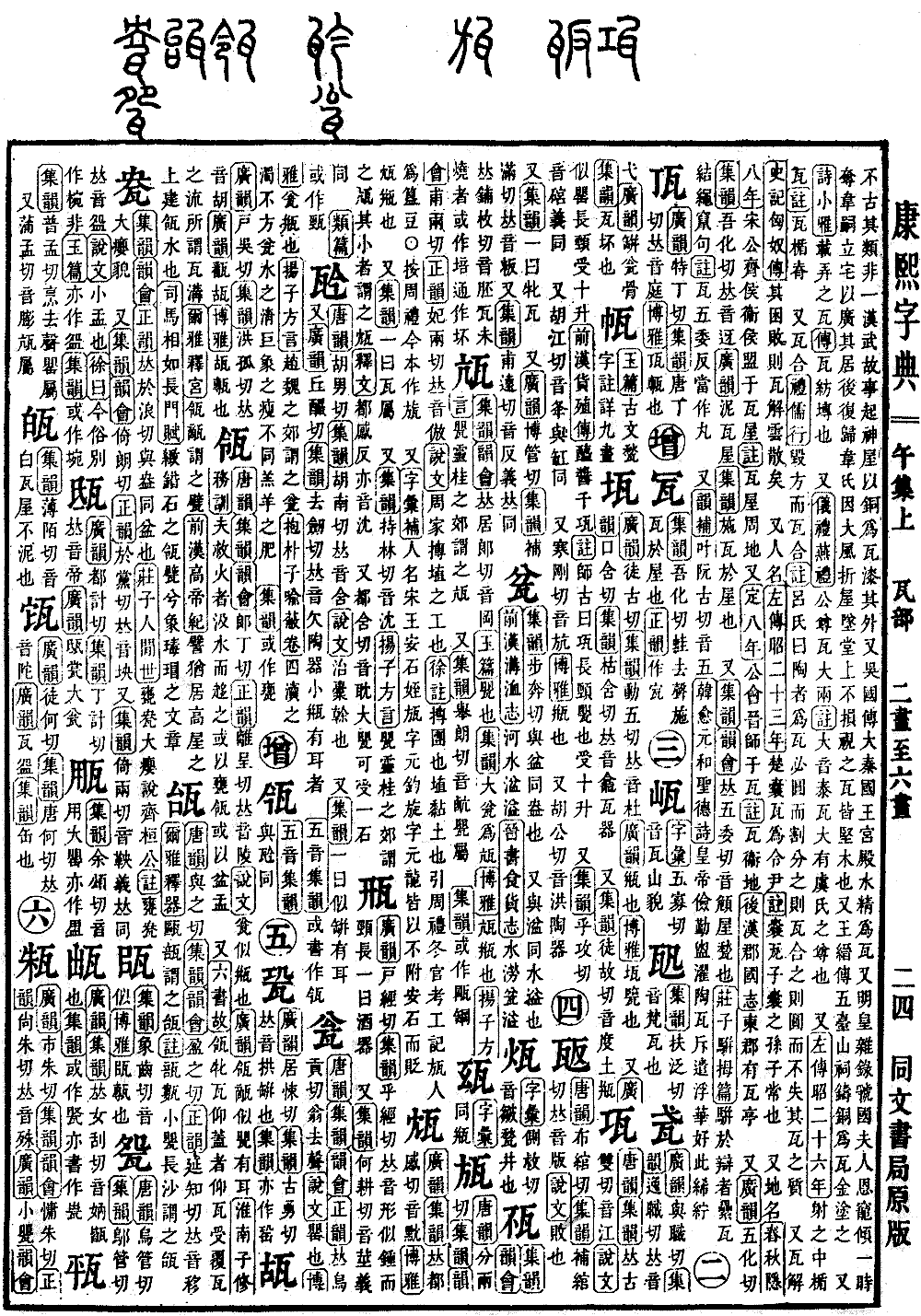
Wu Collection, Upper Volume
Radical: Tile (wǎ)
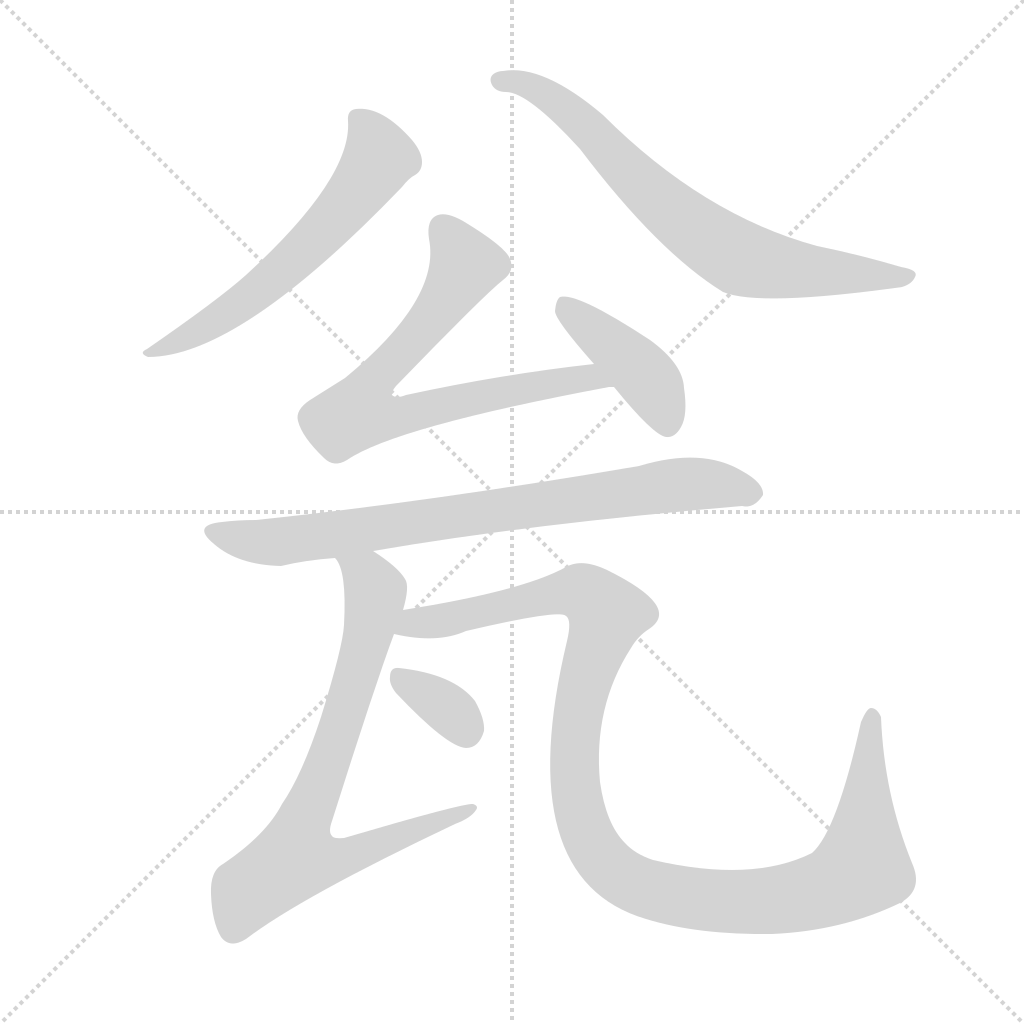
Weng; Kangxi stroke count: 18; Page 748, Entry 19
Pronounced weng (falling tone). According to the Shuowen Jiezi, it is a type of small-mouthed jar (ying). According to the Guangya, a weng is a bottle. According to the Fangyan (Regional Languages) by Yang Xiong, in the regions of Zhao and Wei, it is called a weng. In the Baopuzi, it states that the turbidity of the four great rivers cannot compare to the clarity of the water in a jar, and the thinness of a giant elephant cannot compare to the fatness of a lamb. The Jiyun dictionary notes it is sometimes written in a variant form (wèng).
Wèng
Pronounced weng (falling tone). Same as weng. According to the Yupian, it is a type of small-mouthed jar (ying). According to the Yunhui, it is a submerged bottle. In the Book of Changes (Yijing), regarding the Well hexagram, it mentions the well being muddy and the jar being broken and leaking. In the Book of Rites (Liji), in the Tangong chapter, it mentions one hundred jars of vinegar and pickled meat. In the Petition to the First Emperor of Qin by Li Si, it mentions beating jars and knocking on earthen basins, strumming zithers, and slapping thighs to sing, which are the true sounds of Qin. Also, in the Book of Rites (Liji), in the Ruxing chapter, it mentions a house with a door made of mugwort and a window made of a broken jar. The commentary explains that a jar window is a window round like the mouth of a jar, or made from a broken jar mouth. In the Zhuangzi, in the Rangwang chapter, it mentions using a mulberry branch as a door pivot and a jar as a window for two rooms. The commentary states that bending a mulberry branch into a pivot and breaking a jar for a window creates separate rooms. In the Zhuangzi, in the Renjianshi chapter, it mentions a goiter as large as a jar while speaking to Duke Huan of Qi. The commentary states that jar describes the size of the goiter. According to the Jiyun, it is also written in a variant form (wèng). Also written in a variant form (wèng). In the History of the Former Han (Hanshu), in the Biography of Zhang Qian, it mentions the country of Dayuan presenting a large bird egg, as large as a jar. The commentary notes it is also written in a variant form (wèng).
Pronounced yong (level tone). In the History of the Former Han (Hanshu), in the Record of the Western Regions, it mentions the country of Wuyi presenting a large bird egg, as large as a jar. The commentary by Yan Shigu states the pronunciation is level tone.
Pronounced yong (rising tone).
Pronounced yong (falling tone). The meaning is the same.