Si Collection, Middle Volume
Radical: Fire (huǒ)
Kangxi Strokes: 12
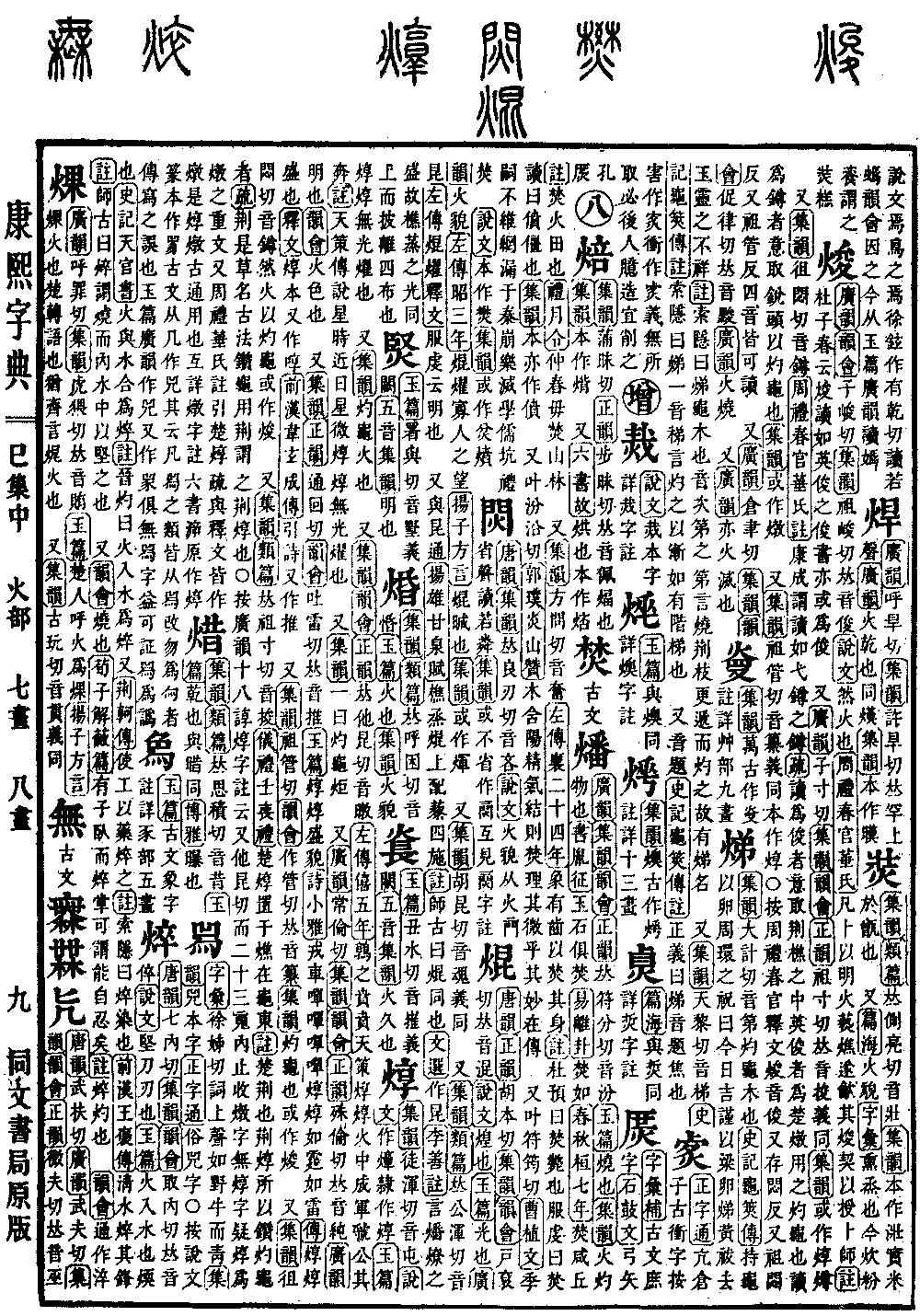
Page 673, Entry 20
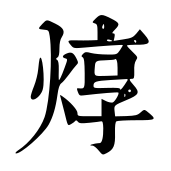
Collected Rhymes (Jiyun): Pronounced tun.
Explaining Graphs (Shuowen): Written as [character missing]. In clerical script, it is written as 焞.
Jade Chapter (Yupian): Tun-tun. The appearance of having no brilliance.
Also, Collected Rhymes (Jiyun): The fire used for scorching tortoise shells in divination.
Also, Collected Rhymes (Jiyun), Rhyme Meetings (Yunhui), Correct Rhymes (Zhengyun): Pronounced tun.
Commentary of Zuo (Zuo Zhuan), Fifth Year of Duke Xi: The quail star flickers and pulses, the celestial tally star is dim and lacks brilliance, when the quail fire star appears in the south the army will be successful, the Duke of Guo is about to flee.
Commentary: The celestial tally star is the Fu Yue star; at that time it was close to the sun, its light was weak, dim, and lacked brilliance.
Also, Collected Rhymes (Jiyun): One account refers to the torch used for scorching tortoise shells.
Also, Broad Rhymes (Guangyun): Pronounced chun.
Collected Rhymes (Jiyun), Rhyme Meetings (Yunhui), Correct Rhymes (Zhengyun): Pronounced chun.
Broad Rhymes (Guangyun): Bright.
Rhyme Meetings (Yunhui): The color of fire.
Also, Collected Rhymes (Jiyun), Correct Rhymes (Zhengyun): Pronounced tui.
Rhyme Meetings (Yunhui): Pronounced tui.
Jade Chapter (Yupian): Tun-tun, the appearance of grandeur.
Book of Odes (Shijing), Lesser Odes (Xiao Ya): Military chariots rumble, the momentum is vast, resounding like thunder.
Commentary: Tun-tun, the appearance of grandeur.
Explanation of Text (Shiwen): Tun, originally also written as [variant form].
History of the Former Han (Qianhan), Biography of Wei Xuancheng: Citing the Book of Odes, it is also written as [variant form].
Also, Collected Rhymes (Jiyun): Pronounced zuan.
Rhyme Meetings (Yunhui): Pronounced zuan.
Collected Rhymes (Jiyun): Scorching a tortoise shell. Sometimes written as [variant form].
Also, Collected Rhymes (Jiyun): Pronounced zun.
To light a fire in order to scorch a tortoise shell. Sometimes written as [variant form].
Also, Collected Rhymes (Jiyun), Classified Chapters (Leipian): Pronounced zhun.
Book of Etiquette and Ceremonial (Yili), Rites for the Funeral of an Officer (Shi Sangli): The chutu (a chaste tree divination stick) is placed on the dry brushwood, to the east of the tortoise shell.
Commentary: Chu is the chaste tree (Jingtiao), and the Jingtun is the tool used for drilling and scorching the tortoise shell.
Sub-commentary: Jing is the name of a plant. In ancient times, the method of drilling the tortoise shell used the chaste tree, which is called Jingtun.
Note: The Broad Rhymes (Guangyun), section eighteen (zhun), in the entry for 焞, states: Also pronounced tun. However, section twenty-three (nei) only contains the character for stewed (dun), and does not contain the character for 焞, leading to the suspicion that 焞 is a variant form of the character for stewed (dun).
Also, the Rites of Zhou (Zhouli), Notes on the Master of the Tortoise (Chuo Shi), cites the Chutun; both the sub-commentary and the Explanation of Text (Shiwen) write it as the character for stewed (dun), which indicates that 焞 and the character for stewed (dun) were used interchangeably in ancient times. Cross-reference the entry for the character for stewed (dun).
The Six Writings (Liushu) traces the original form to 焞.
Textual Research:
Commentary of Zuo (Zuo Zhuan), Fifth Year of Duke Xi: The quail star flickers and pulses, the celestial tally star is 焞-焞.
Commentary: The celestial tally star is the Fu Yue star.
Corrected in accordance with the original text, changing "legendary star" to "Fu Yue star."