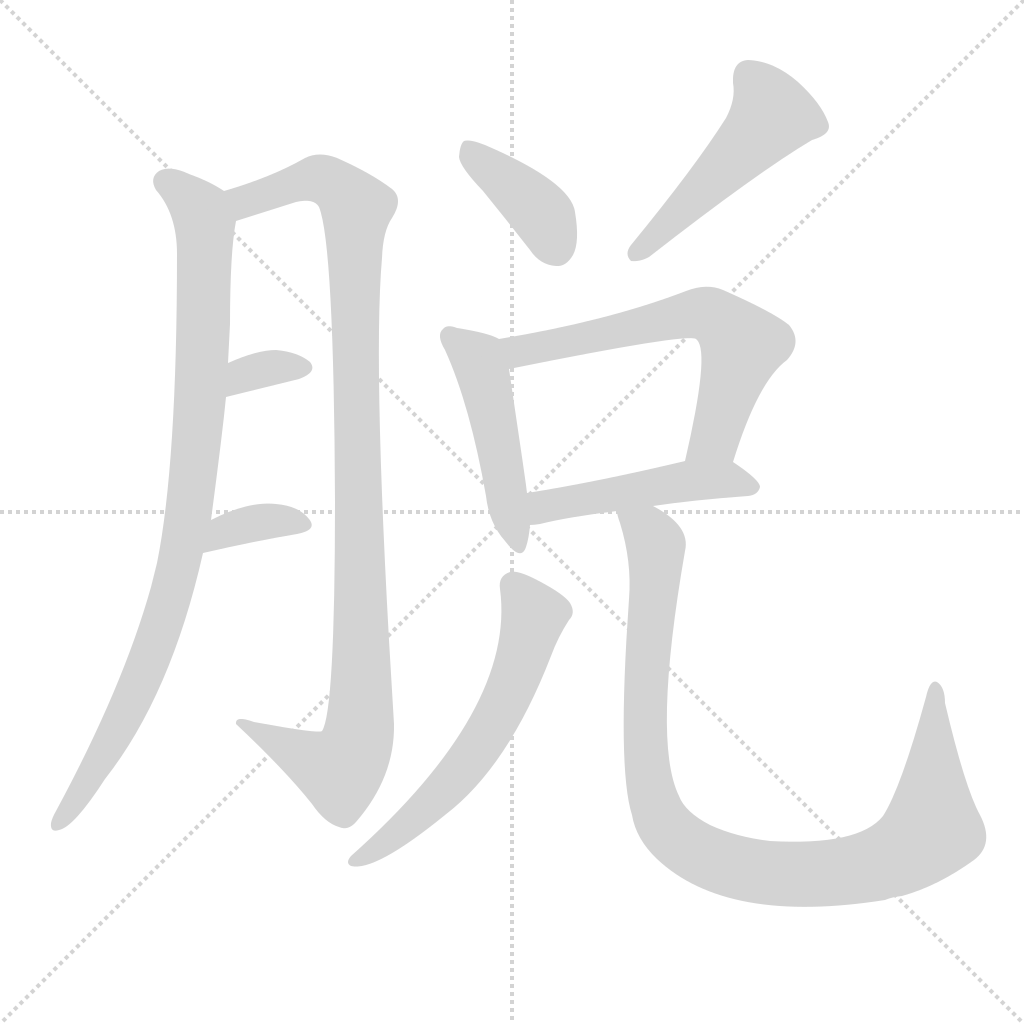
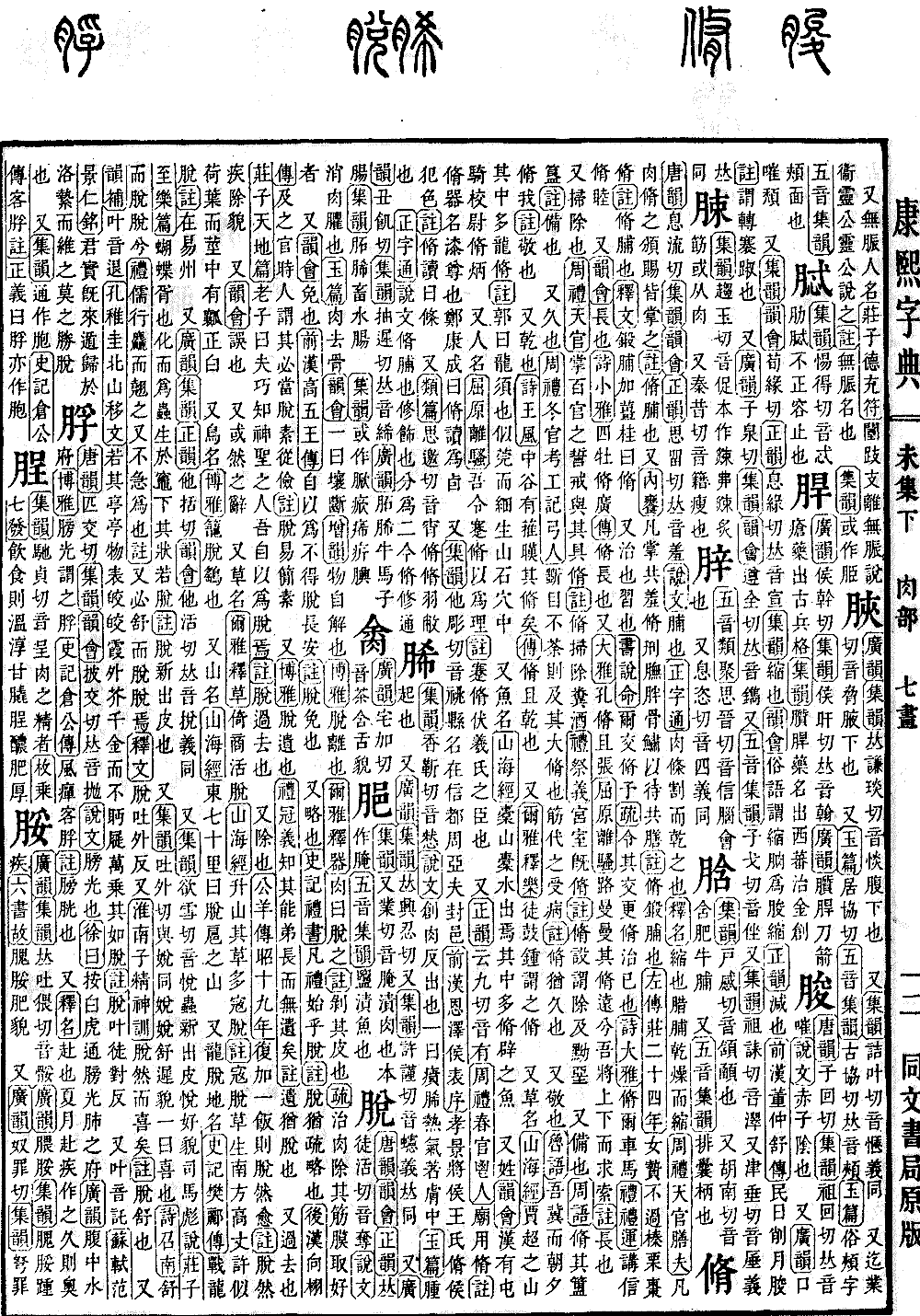
Wei Collection, Lower Volume
Radical: Meat (ròu)
Kangxi Strokes: 13
Page 984, Entry 01
Tang Rhymes (Tangyun), Rhyme Collection (Yunhui), Correct Rhymes (Zhengyun): Pronounced duo.
Explaining Graphs and Analyzing Characters (Shuowen Jiezi): Flesh diminishing and becoming thin.
Jade Chapter (Yupian): Meat removed from the bone.
Rhyme Collection (Yunhui): Another meaning is to break or separate.
Expanded Rhymes (Zengyun): Things coming apart by themselves.
Broad Refinements (Boya): To escape, to separate.
Approaching Elegance (Erya), Explaining Implements: Meat is called tuozhi.
Note: To peel its skin.
Commentary: Processing meat, removing the fascia, and selecting the good parts.
Also, Rhyme Collection (Yunhui): To escape or be exempted.
History of the Former Han (Qianhan), Biography of the Five Kings of Gaozu: Thinking one could not escape Chang'an.
Note: Tuo means to be exempted.
Also, to be brief or negligent.
Records of the Grand Historian (Shiji), Treatise on Rites: Generally, rites begin with negligence.
Note: Tuo is like being careless or negligent.
History of the Later Han (Houhan), Biography of Xiang Xu: When he took office, people of the time thought he would surely cast off his simplicity and follow thrift.
Note: Tuo means to cast off or change simplicity.
Also, Broad Refinements (Boya): To leave behind or forget.
Book of Rites (Liji), Meaning of the Capping Ceremony: Knowing that one can respect elders and siblings and leave nothing behind. Note: Leaving behind is like being detached.
Also, to pass by.
Zhuangzi, Chapter on Heaven and Earth: Laozi said: Those who are cunning and holy, I myself consider that I have already moved past that state.
Note: Tuo means to pass by.
Also, to eliminate or remove.
Gongyang Commentary (Gongyangzhuan), 19th Year of Duke Zhao: Adding another bowl of rice, he was suddenly and completely recovered.
Note: Tuoran means the appearance of illness being eliminated.
Also, Rhyme Collection (Yunhui): A mistake.
Also, a word of supposition.
Also, the name of a plant.
Approaching Elegance (Erya), Explaining Plants: Yishang is called huotuo.
Classic of Mountains and Seas (Shanhaijing): Mount Sheng, the plants there are mostly koutuo.
Note: The koutuo plant grows in the south, about one zhang in height, resembling a lotus leaf, with a white, pithy substance inside the stem.
Also, a bird name.
Broad Refinements (Boya): Longtuo is a species of hawk.
Also, a mountain name.
Classic of Mountains and Seas (Shanhaijing): Seventy miles to the east is called Tuohu Mountain.
Also, Longtuo, a place name.
Records of the Grand Historian (Shiji), Biography of Fan and Li: Fought at Longtuo.
Note: Located in Yizhou.
Also, Broad Rhymes (Guangyun), Collection of Rhymes (Jiyun), Correct Rhymes (Zhengyun): Pronounced tuo. Meaning is the same.
Also, Collection of Rhymes (Jiyun): Pronounced yue. The appearance of an insect just emerging, its skin glossy and beautiful. This is the opinion of Sima Biao.
Zhuangzi, Chapter on Supreme Joy: Butterflies are formed from the xu insect, transforming into a worm born under the stove, appearing as if it has just shed its skin.
Note: Tuo means newly grown skin.
Also, Collection of Rhymes (Jiyun): Pronounced tuo (in a different tone). Equivalent to tuo. Tuotuo means to be relaxed and composed. Another opinion is that it means the appearance of being joyful.
Book of Odes (Shijing), Shao South: So relaxed and composed.
Book of Rites (Liji), Conduct of the Scholars: Coarse and raised, yet not hurried. Note: It must be relaxed and composed.
Explanation of Terms (Shiming): Pronounced tuo.
Also, Master of Huainan (Huainanzi), Treatise on the Spirit: Joyful and relaxed.
Note: Tuo means to be relaxed or stretched out.
Also, Rhyme Supplement (Yunbu): Rhyming as tui.
Kong Zhigui, Rhapsody on the North Mountain (Beishan Yiwen): As for him, he stands lofty above ordinary objects, pure and transcending the clouds and mist, viewing a thousand gold pieces as mere grass and not deigning to look at them, casting away the dignity of ten thousand chariots like discarding worn-out shoes.
Note: Tuo rhymes here as tuo and dui.
Also, rhyming as tuo.
Su Shi, Inscription for Fan Jingren: Junshi (Sima Guang) has already arrived, and has retired back to Luoyang. Wishing to tether and detain him, there is no one who can allow him to take his leave.