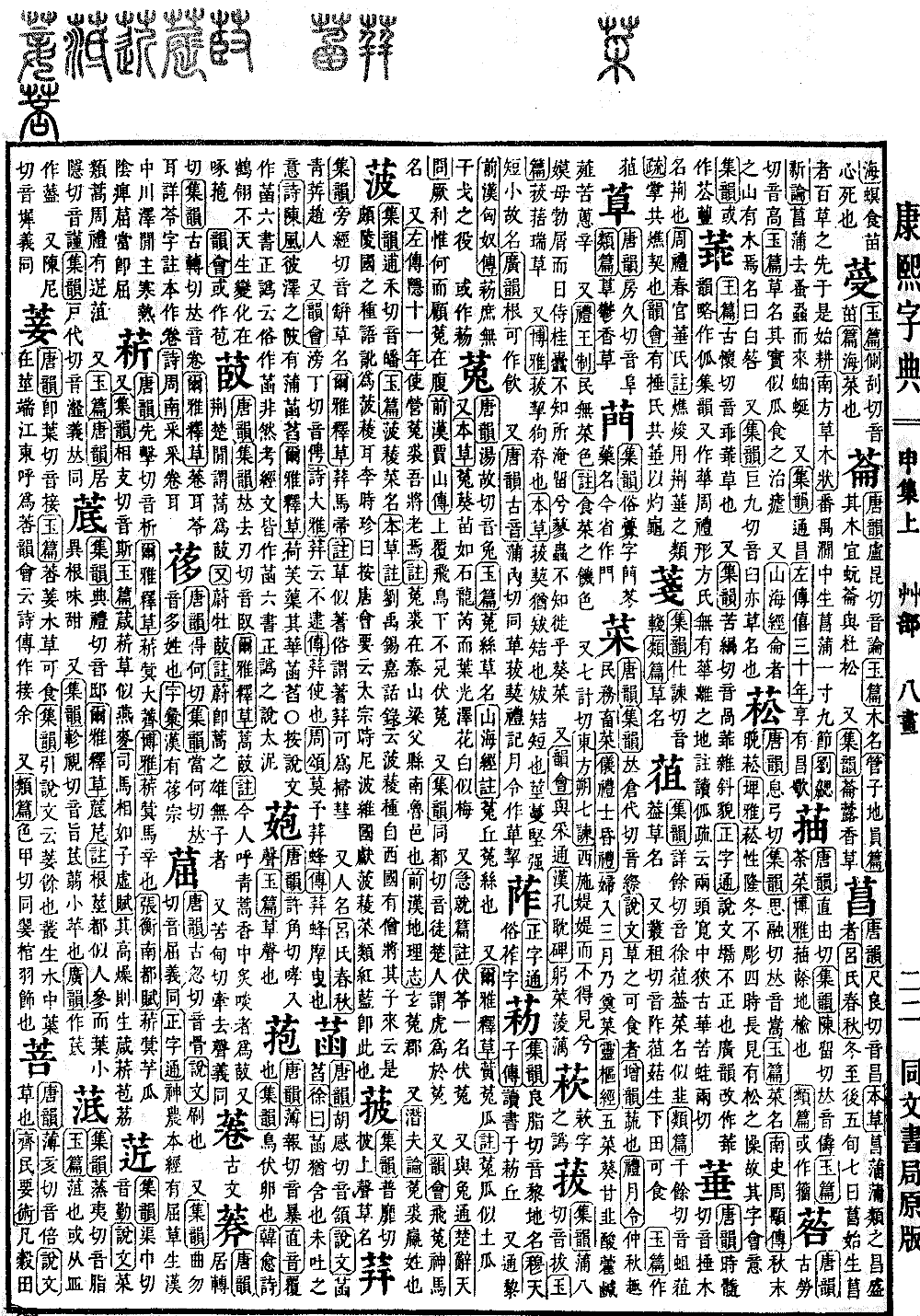
Shen Collection, Upper Volume
Radical: Grass (cǎo)
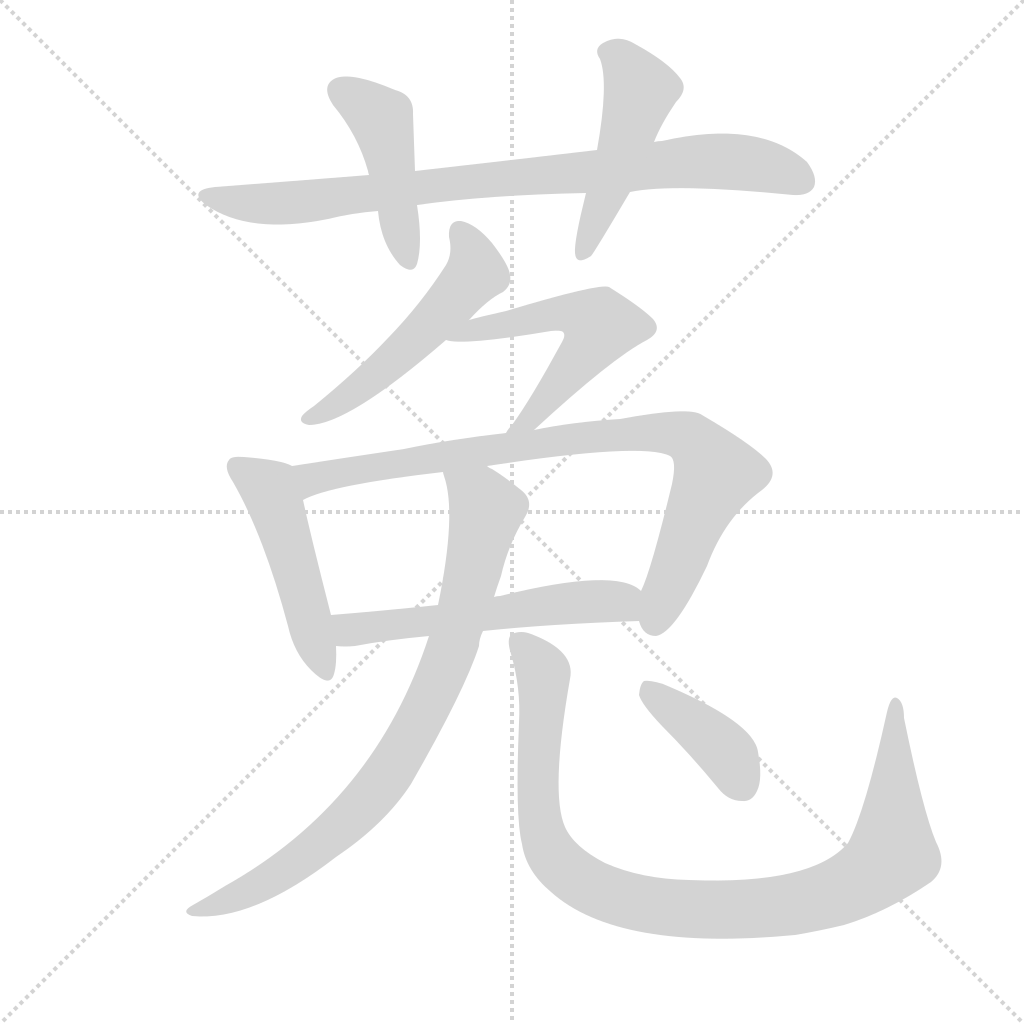
菟
Kangxi Strokes: 14
Page 1038, Entry 18
Pronounced tu (falling tone).
In the Jade Collection (Yupian): tusi, a type of grass.
In the Commentary to the Classic of Mountains and Seas (Shanhaijing zhu): tuqiu is tusi.
Also, in the Erya, Explanation of Plants (Erya shicao): the plant ren is a type of tugua.
Commentary: The tugua resembles the soil melon.
Also, in the Materia Medica (Bencao): tukui, a plant with sprouts like the Ranunculus sceleratus (shilongrui) but with shiny leaves and white flowers resembling plum blossoms.
Also, in the Commentary to the Quick Guide (Jijiupian zhu): fuling is also called futu.
Also, interchangeable with the character for rabbit.
In the Songs of the South, Questions of Heaven (Chuci tiantian): what is the profit, and why is the rabbit in the belly.
In the History of the Former Han, Biography of Jia Shan (Qianhan jia shan zhuan): above it covers the flying birds, below it cannot be seen by the crouching rabbit.
Also, pronounced tu (rising tone).
The people of Chu call a tiger a wutu.
Also, in the Rhyme Collection (Yunhui): feitu, the name of a divine horse.
Also, in the Zuo Tradition (Zuo zhuan), 11th year of Duke Yin: ordered the building of Tuqiu, where I shall grow old.
Commentary: Tuqiu is in the south of Liangfu County in Mount Tai, and was a city of the Lu state.
In the History of the Former Han, Treatise on Geography (Qianhan dilizhi): Tuju Commandery.
Also, in the Discourses of a Recluse (Qianfulun): Tuqiu is of the Ying surname.