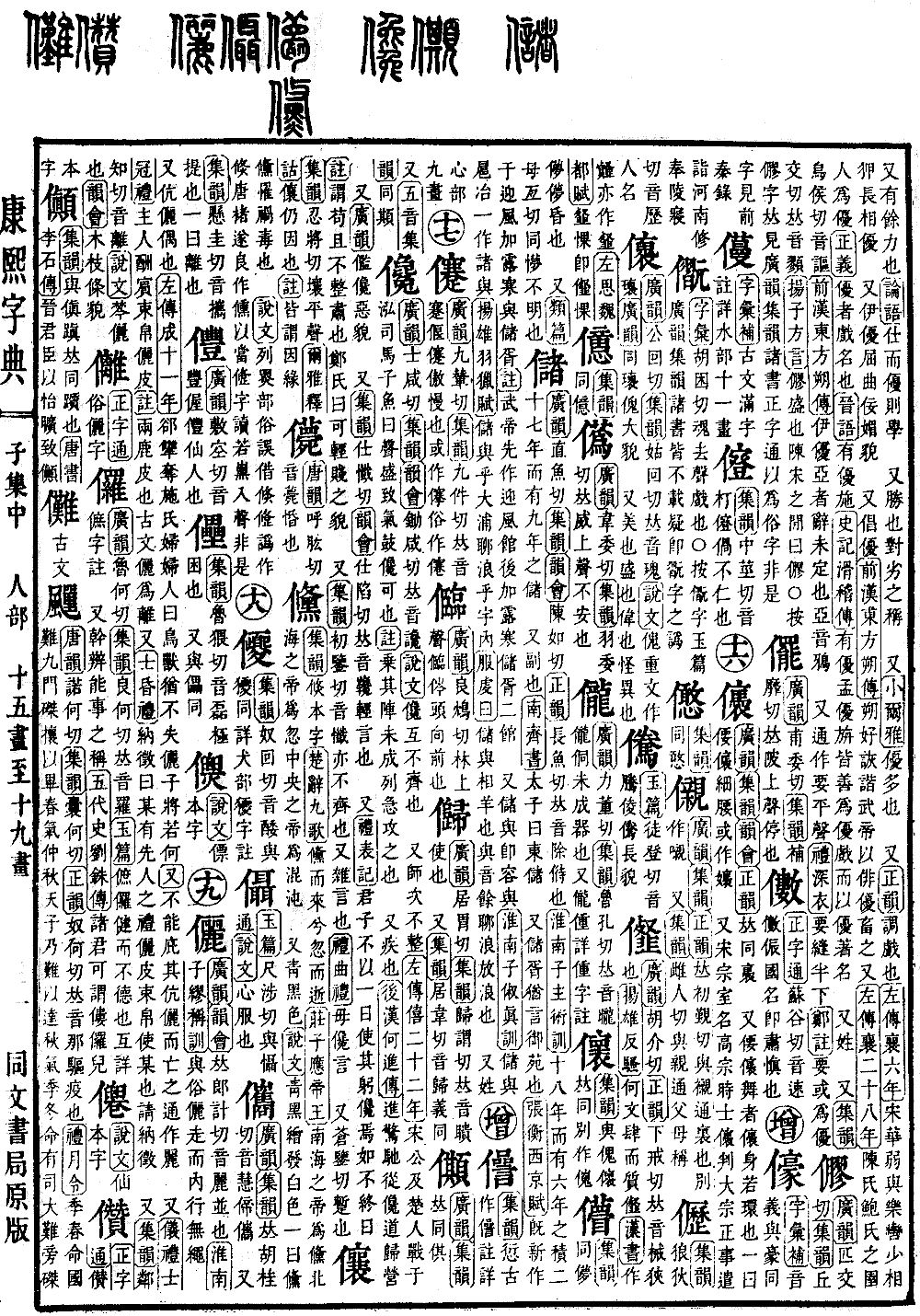
Zi Collection, Middle Volume
Radical: Person (rén)
Entry: 儳
Kangxi strokes: 19
Page 121, Entry 26
According to the Extensive Rhyme (Guangyun), pronounced chán. According to the Collected Rhymes (Jiyun) and the Rhyme Compilation (Yunhui), pronounced chán.
According to the Explaining Graphs and Analyzing Characters (Shuowen), the term denotes a lack of uniformity or order. It also refers to a military encampment that is not arranged in a regular formation.
In the Commentary on the Spring and Autumn Annals (Zuo Zhuan), twenty-second year of Duke Xi: The Duke of Song engaged the forces of Chu at the Hong River. Sima Ziyu remarked: When the sound is robust, it can encourage morale; it is acceptable to beat the drums and attack while the opponent's formation is not yet fully arrayed. The commentary explains: This refers to attacking while the opponent's formation is still disordered.
It also refers to being swift or rapid. In the History of the Later Han (Hou Hanshu), Biography of He Jin: He Jin traveled in a panicked, rapid manner, taking a shortcut back to the military camp.
According to the Extensive Rhyme (Guangyun), the compound term refers to an ugly appearance.
According to the Collected Rhyme (Jiyun), pronounced chàn. According to the Rhyme Compilation (Yunhui), pronounced chàn. This refers to speaking in a rash or imprudent manner.
In the Book of Rites (Liji), section on the Record of Personal Conduct (Biaoji): A gentleman would not allow himself to appear rash or lacking in gravity for even a single day, as if he had but one day left to live. The commentary explains: This refers to an informal and unrefined demeanor. Master Zheng notes: This describes an appearance of lowliness.
According to the Collected Rhymes (Jiyun), pronounced chàn. This also refers to a lack of uniformity. It is further used to describe speaking in a confused or disorderly manner.
In the Book of Rites (Liji), section on the Summary of the Rules of Propriety (Quli): Do not interrupt or speak in a disorderly fashion.
Also pronounced càn. This refers to a brief or fleeting duration.
Textual research: In the Commentary on the Spring and Autumn Annals (Zuo Zhuan), twenty-second year of Duke Xi, the text reads: The Duke of Song engaged the forces of Chu at the Hong River. Sima Ziyu remarked: When the sound is robust, it can encourage the spirit... This conforms to the original text.