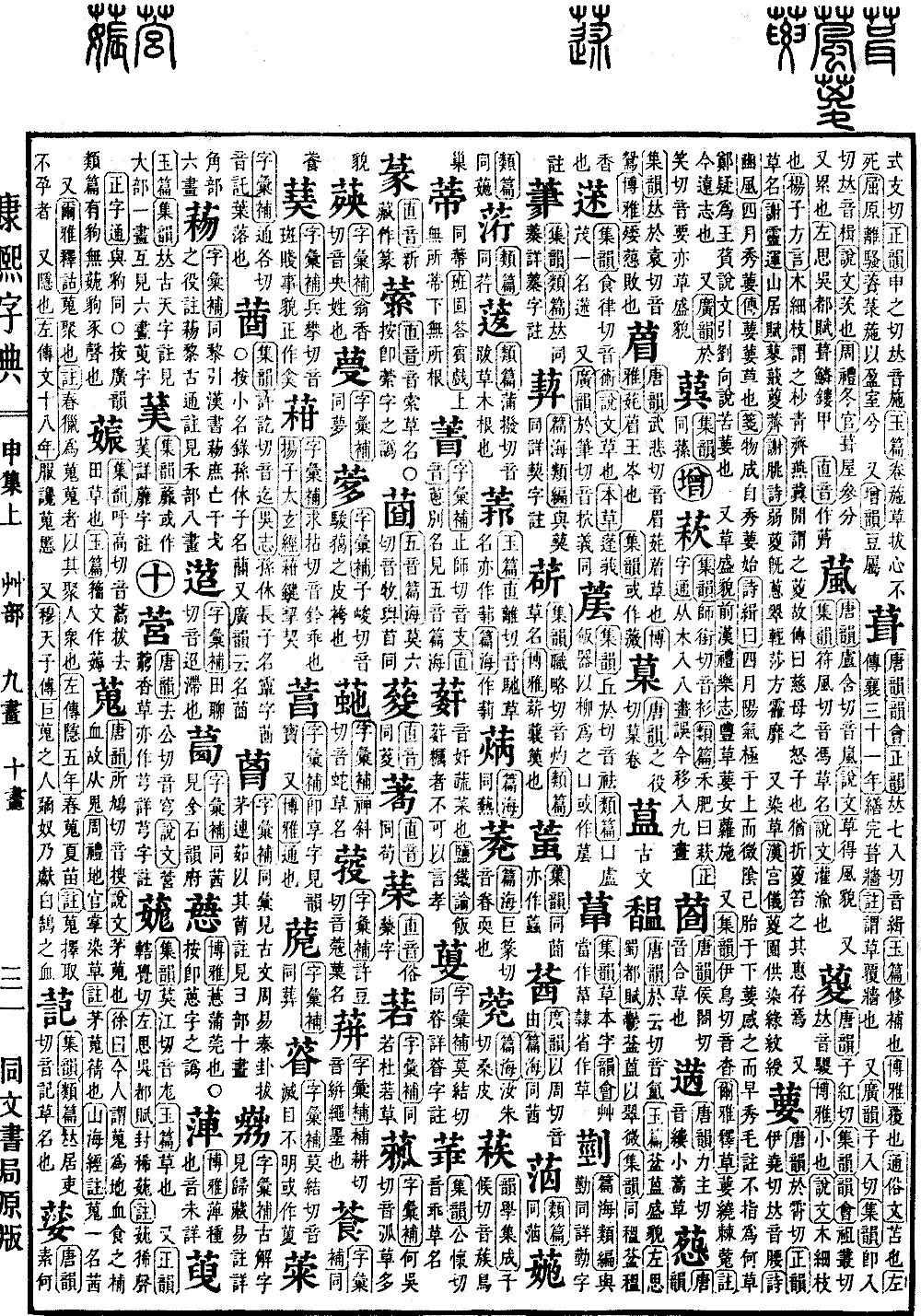
Shen Collection, Upper Volume
Radical: Grass (cǎo)
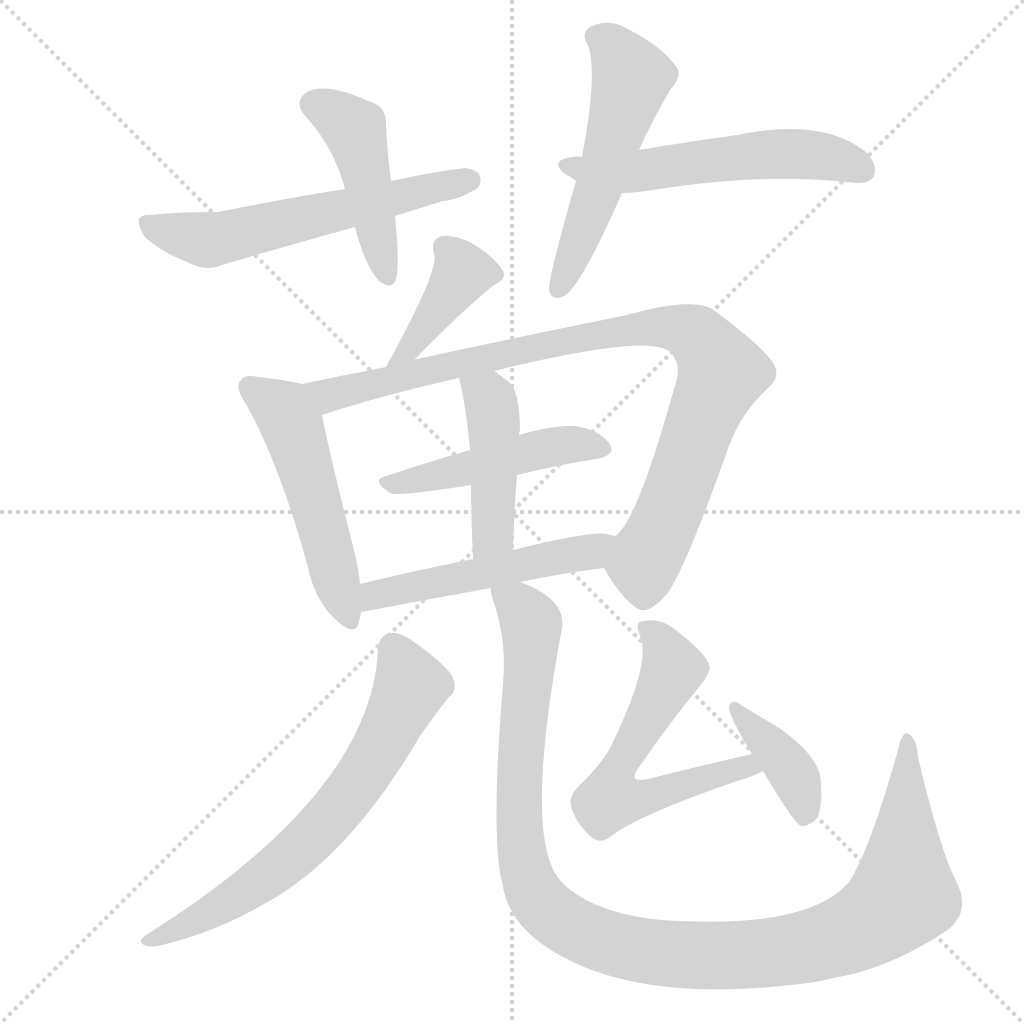
蒐
Kangxi strokes: 16
Page 1047, Entry 71
According to the Tang Rhyme (Tangyun), pronounced sou.
According to the Explaining Graphs and Analyzing Characters (Shuowen), it refers to madder. Xu states that people today call this plant earth-blood; eating it nourishes the blood, which is why the character is formed with the component for ghost.
In the Rites of Zhou (Zhouli), Earth Office, it is mentioned as a grass used for dyeing. According to the Explanation of Text (Shiwen), madder is also known as qian. The commentary to the Classic of Mountains and Seas (Shanhaijing) notes that sou is another name for madder.
Also, according to the Erya, a dictionary of synonyms (Erya), sou means to gather. The commentary notes that hunting in the spring is called sou; it is so named because it gathers many people together.
In the Zuo Tradition (Zuozhuan), fifth year of Duke Yin, it says spring hunting and summer weeding. The commentary explains that sou refers to selecting and taking those that are not pregnant.
It also means to hide. In the Zuo Tradition (Zuozhuan), eighteenth year of Duke Wen, it mentions suppressing slander and hiding evil.
Also, in the Account of Mu, Son of Heaven (Mu Tianzi Zhuan), it mentions that the people of Juso presented white swan blood.
Textual Research:
In the Rites of Zhou, Earth Office, regarding the grass used for dyeing: the commentary states that madder is qian. We have carefully corrected this to match the original text of the Explanation of Text.