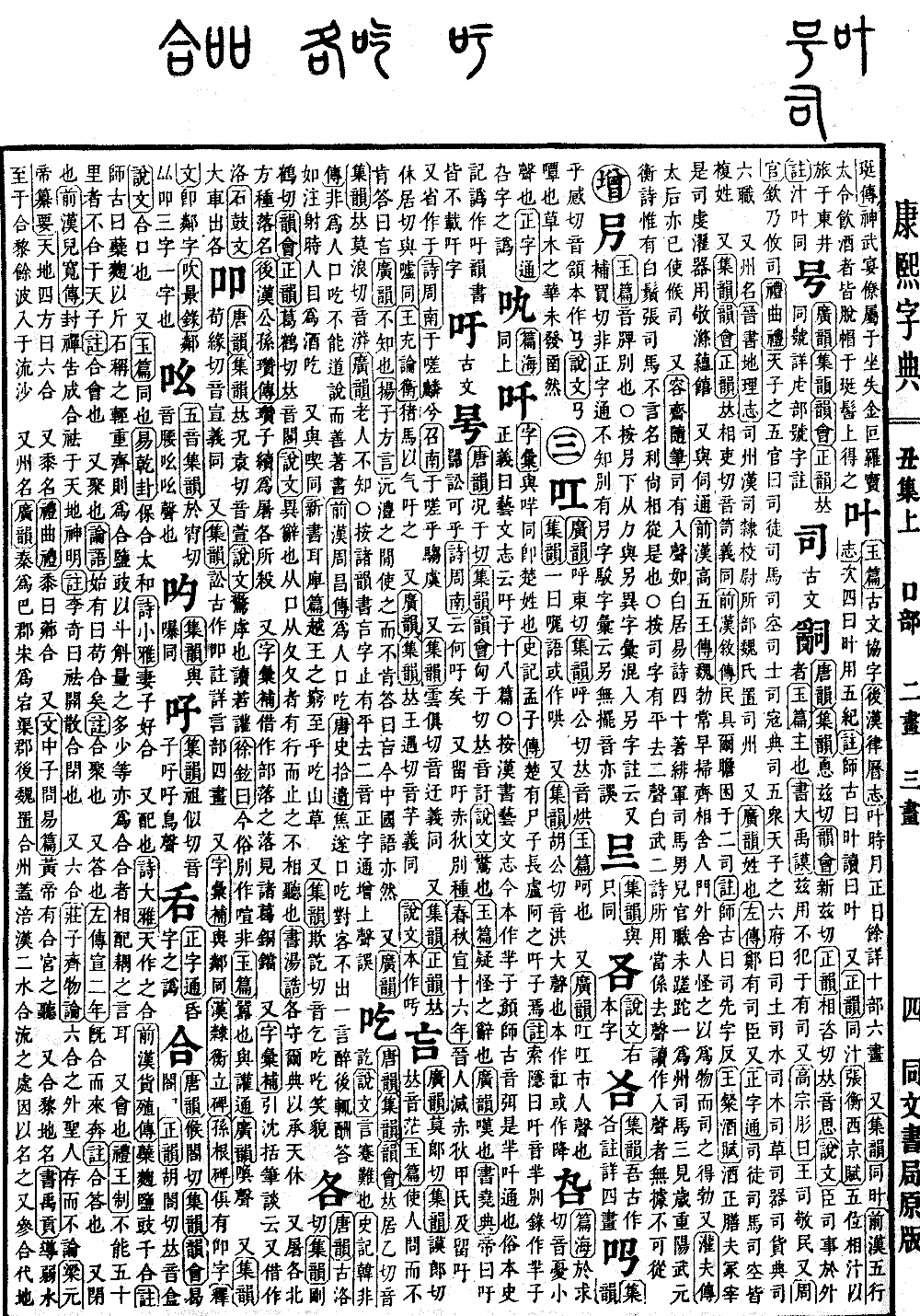
Chou Collection, Upper Volume. Radical: Mouth (kǒu). Kangxi strokes: 5. Page 174, Entry 03.
Ancient character. According to Tang Rhymes (Tangyun) and Collected Rhymes (Jiyun), pronounced si (level tone). According to Rhyme Compilation (Yunhui), pronounced si (level tone). According to Correct Rhymes (Zhengyun), pronounced si (level tone). In all cases, pronounced si.
According to Explanation of Script and Elucidation of Characters (Shuowen Jiezi), it refers to a minister who manages affairs externally. According to Jade Chapters (Yupian), it means to preside over or govern. In the Book of Documents (Shujing), specifically the Counsels of the Great Yu (Da Yu Mo), it says, "By this means, do not offend the officials." In the same book, under the Day of the Supplementary Sacrifice of Gaozong (Gaozong Rongri), it says, "The King manages and respects the people." In the Rites of Zhou (Zhouguan), it says, "Respect your assigned duties." In the Book of Rites (Liji), specifically the Summary of the Rules of Propriety (Quli), it says, "The Son of Heaven has five officials: the Minister of Instruction, the Minister of War, the Minister of Works, the Minister of Justice, and the Minister of Interior, who manage the five categories of the populace. The Son of Heaven has six storehouses: the manager of land, the manager of water, the manager of wood, the manager of herbs, the manager of implements, and the manager of goods, who manage the six categories of duties."
Also refers to a prefecture name. According to the History of Jin (Jinshu), in the Geography Treatise, Si Prefecture was the region governed by the Colonel of the Retainers in the Han Dynasty. The Wei dynasty established Si Prefecture.
According to Broad Rhymes (Guangyun), it is a surname. In the Zuo Tradition (Zuo Zhuan), it mentions Si Chen of Zheng. According to Correct Character Mastery (Zhengzitong), Si Tu, Si Ma, and Si Kong are all compound surnames.
According to Collected Rhymes (Jiyun), Rhyme Compilation (Yunhui), and Correct Rhymes (Zhengyun), pronounced si (departing tone). The meaning is the same. In the Book of Han (Hanshu), specifically the Biographical Overview (Xuzhuan), it says, "The people all look to you, distressed by the two officials." The commentator Yan Shigu says, "Si is pronounced like the character xian." In the Wine Rhapsody (Jiufu) by Wang Can, it says, "The Wine Master, the Chief Steward, and the Grand Minister are in charge; they respectfully wash the vessels and purify the hidden grains."
Also interchangeable with the character meaning to observe or spy. In the Book of Han (Hanshu), in the Biography of the Five Princes of Gaozu, Wei Bo often swept the door of the Qi Chancellor's attendant in the early morning; the attendant found it strange, suspected a supernatural entity, and lay in wait to observe (si), thus capturing Bo. In the Biography of Guan Fu, the Empress Dowager also sent someone to observe (si).
According to Rongzhai Essays (Rongzhai Suibi), the character Si has a entering tone. For example, in the poems of Bai Juyi: "At forty, I wore the crimson of an Army Assistant (Sima); a man's official career has not yet wasted away." "Once as a Prefecture Assistant (Sima), I have seen the Double Ninth Festival three times." In the poem by Wu Yuanheng: "Only Zhang, the white-bearded Assistant (Sima), does not speak of fame or profit and still follows me." Note: The character Si has both a level tone and a departing tone. The usage in the poems of Bai and Wu, which is said to be a departing tone read as an entering tone, lacks evidence and should not be followed.