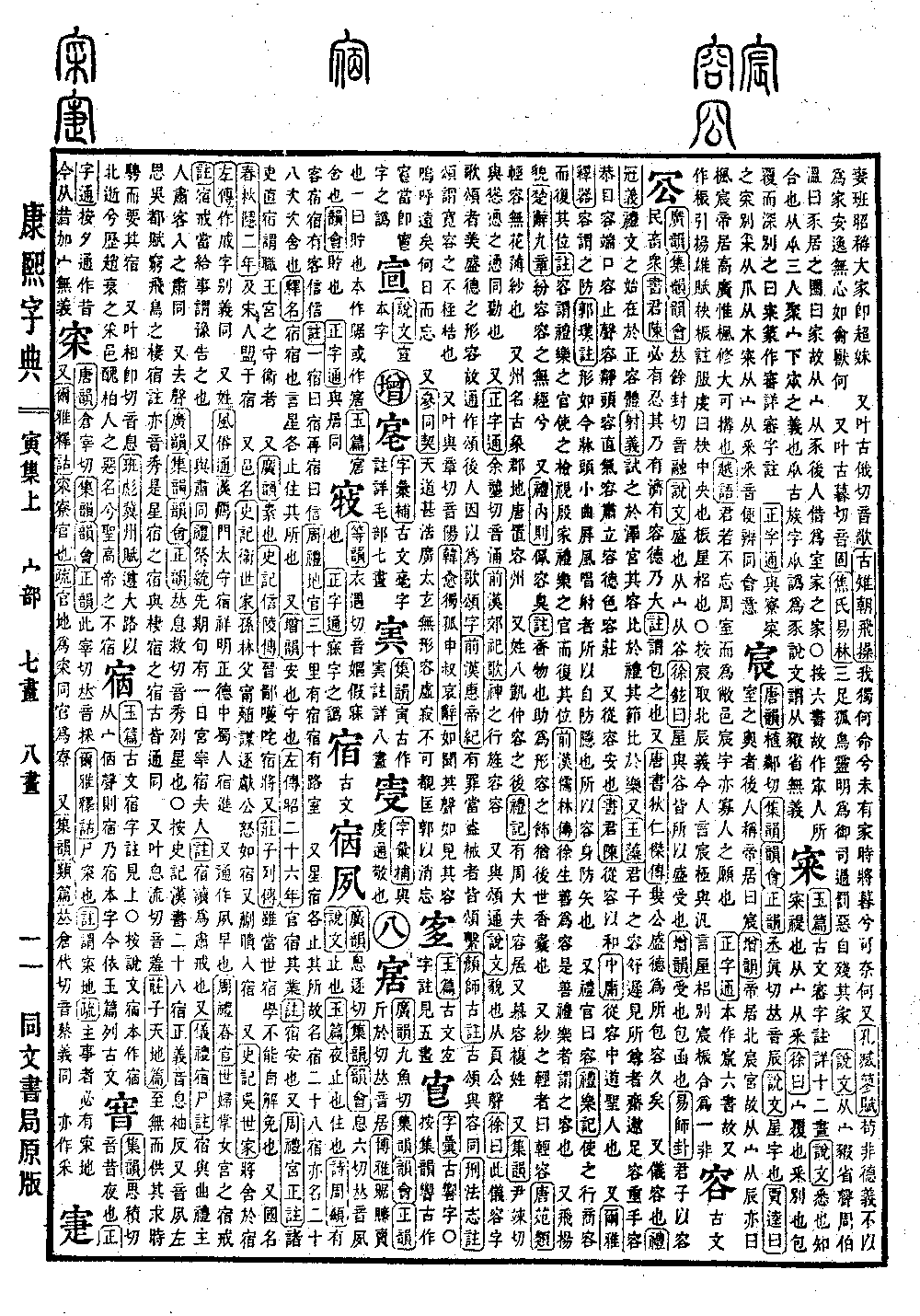
Yin Collection, Upper Volume
Radical: Roof (bù)
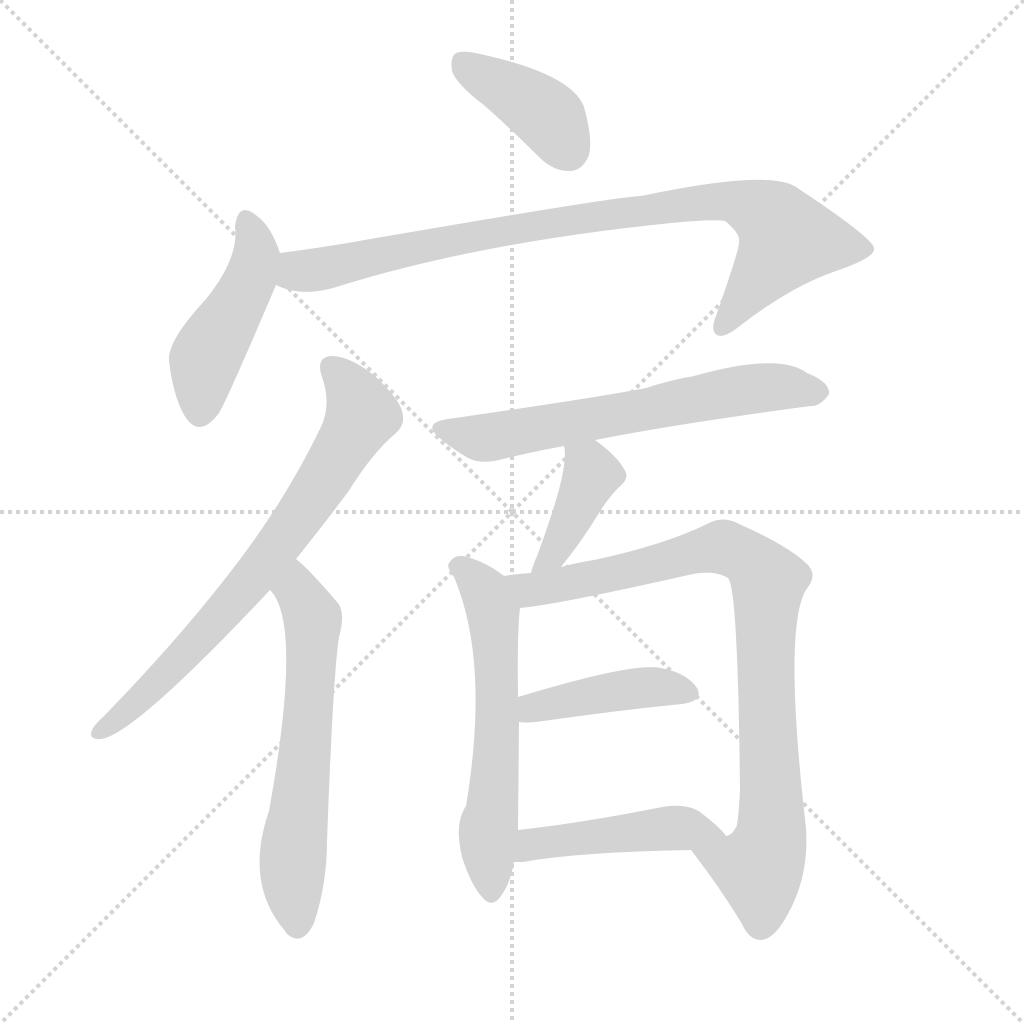
Character: 宿
Kangxi Brush Strokes: 11
Page 287, Entry 13
Ancient form is Su.
Pronounced su.
Pronounced su.
Shuowen Jiezi (Shuowen): To stop.
Yupian: To stop at night; to dwell.
Book of Odes (Shijing), Zhou Odes: There are guests who stay one night, there are guests who stay two nights. Commentary: Staying one night is called su, staying two nights is called xin.
Rites of Zhou (Zhouli), Earth Officials: Every thirty miles there is a stopping place; the stopping place has a roadside chamber.
Also, the stars (xiu) each stop in their own place, hence they are named xiu. The twenty-eight celestial mansions are also called the twenty-eight stations. Station means lodging.
Explanation of Names (Shiming): Xiu means to lodge, meaning the stars each dwell in their respective places.
Also, Zengyun: To be secure; to guard.
Zuo Tradition (Zuo Zhuan), 29th Year of Duke Zhao: Officials are settled in their professions. Commentary: Su means to be secure.
Also, Rites of Zhou (Zhouli), Palace Officials Commentary: Officials on duty for night watch are those who guard the royal palace.
Also, Guangyun: Plain or simple (su).
Records of the Grand Historian (Shiji), Biography of Lord Xinling: Jin Bi was a boisterous veteran general.
Also, Zhuangzi, Biographies: Even those with deep learning (su xue) of the current age cannot resolve or avoid it.
Also, name of a state. Spring and Autumn Annals (Chunqiu), 2nd Year of Duke Yin: And made a pact with the people of Song at Su.
Also, name of a city. Records of the Grand Historian (Shiji), House of Wei: Sun Linfu and Ning Zhi plotted to expel Duke Xian, who fled to Su. Also, Kuai Kui entered Su.
Also, Records of the Grand Historian (Shiji), House of Wu: They intended to stay at Su. Zuo Tradition (Zuo Zhuan) writes this as Qi; the characters are distinct but the meanings are the same.
Also, a surname. Customs and Manners (Fengsu Tong): Han dynasty Administrator of Yanmen, Su Xiang; in the Zhengde period of the Ming dynasty, a man from Shu named Su Jin.
Also, interchangeably used with Su, meaning early. Rites of Zhou (Zhouli), Spring Officials: The matrons are in charge of the early summons of the palace women. Commentary: Early summons refers to the necessity of performing duties, meaning to notify in advance.
Also, same as Su (respect/solemnity). Record of Sacrifices (Jitong): Eleven days before the date, the palace intendant instructs the wife to prepare. Commentary: Su is read as Su-jie (preparatory warning).
Also, Book of Etiquette and Ceremonial (Yili), Commentary on lodging the ritual impersonator: Su is the same as the su in the Record of Rituals (Quli) regarding the host respectfully leading guests inside.
Also, in the departing tone (falling tone). Pronounced xiu. The arrayed stars. Note: The Records of the Grand Historian (Shiji) and Book of Han (Hanshu) mention the twenty-eight mansions. The Correct Meaning (Zhengyi) says it is pronounced xiu, and also pronounced su. In Zuo Si's Rhapsody on the Capital of Wu (Wudu Fu), there is the phrase exhausted are the nests of flying birds, and the commentary also pronounces it xiu. Thus, the su of star mansions and the su of roosting are anciently interchangeable.
Also, rhyming with xiu. Zhuangzi, Heaven and Earth Chapter: Attaining the state of nothingness to provide for their needs, riding the times to reach their destination (su).
Also, rhyming with xi. Ban Biao, Rhapsody on Jizhou (Jizhou Fu): Following the great road, I journeyed north, passing the fief of Zhao Cui. Detesting the foul reputation of Bo Ren, the holy Emperor Gao did not remain (su) long.