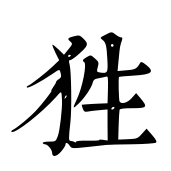
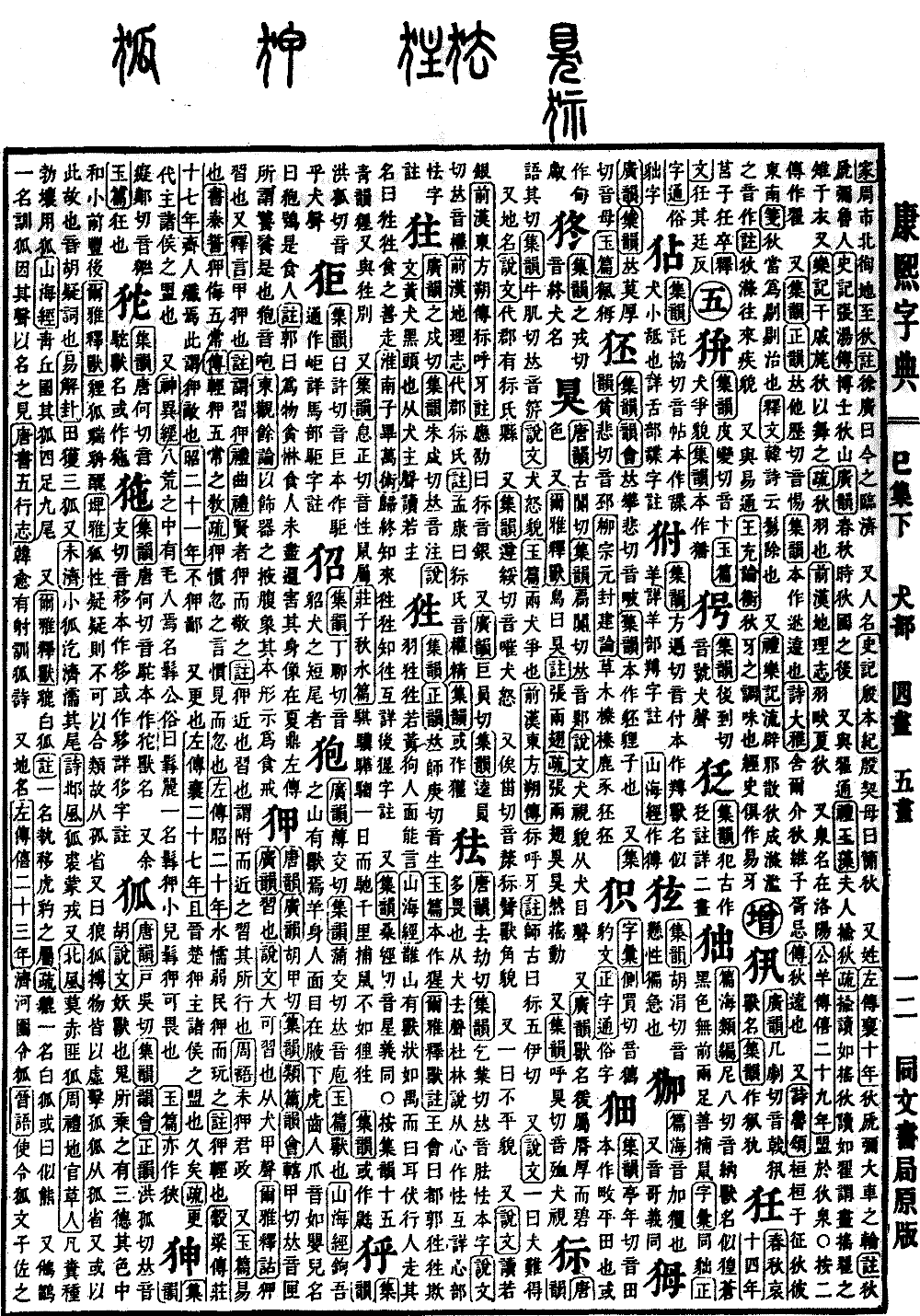
Si Collection, Lower Volume
Radical: Dog (quǎn)
Sheng; Kangxi stroke count: 9
Page 708, Entry 20
Collected Rhymes (Jiyun) and Orthographic Rhymes (Zhengyun) record the pronunciation as sheng (level tone).
Jade Chapters (Yupian) notes it was originally written as xing.
Er-ya: Explanations of Animals (Er-ya, Shishou) commentary on the Tribute of Wang (Wanghui) states: In the Dugu region there are creatures called sheng-sheng which deceive birds; the sheng-sheng resembles a yellow dog, has a human face, and can speak.
Classic of Mountains and Seas (Shanhaijing): There is a beast on the mountain shaped like a monkey with white ears, which moves by crouching; when it sees a person, it runs. Its name is sheng-sheng. Eating its meat allows one to run well.
Huainanzi: Arts of Bi Wan (Huainanzi, Biwanshu): The guizhong knows the future, the sheng-sheng knows the past. See the note under the character xing later for further details.
Also, Collected Rhymes (Jiyun) records the pronunciation as xing (level tone). The meaning is the same. Note: In the fifteen qing rhyme category of Collected Rhymes, xing is distinguished from sheng.
Also, Collected Rhymes (Jiyun) records the pronunciation as xing (falling tone). It refers to a type of rodent.
Zhuangzi: Autumn Floods (Zhuangzi, Qiushuipian): The stallions Qiji and Hualiu can gallop one thousand li in a day, yet in catching rats they are not as skilled as the wildcat or the sheng.
Collected Rhymes (Jiyun) notes it is sometimes written as sheng.
Textual Research: In the Er-ya: Explanations of Animals (Er-ya, Shishou) commentary, it says the Tribute of Wang (Wanghui) notes, In the Dugu region there are sheng-sheng which deceive birds, the sheng-sheng resembles a yellow dog, has a human face, and can speak. Adjusted according to the original text of the commentary.