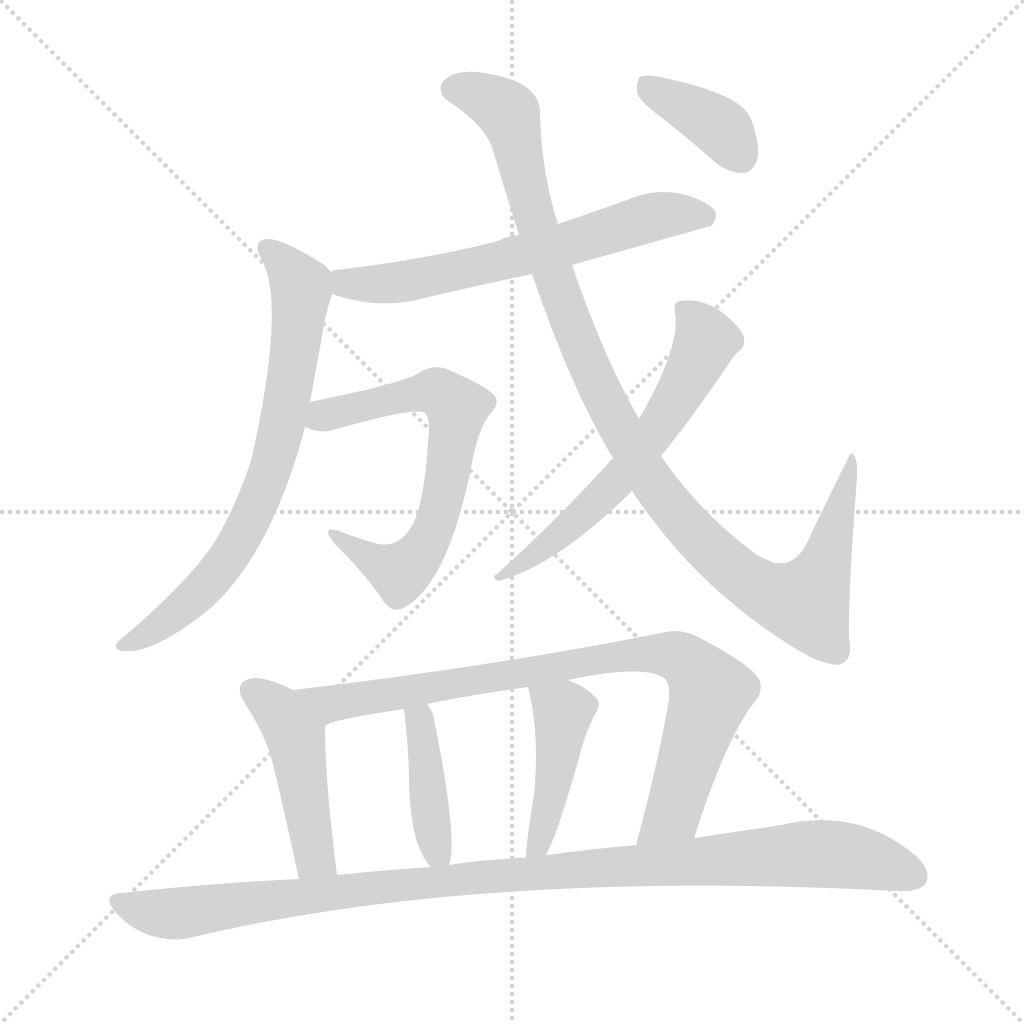
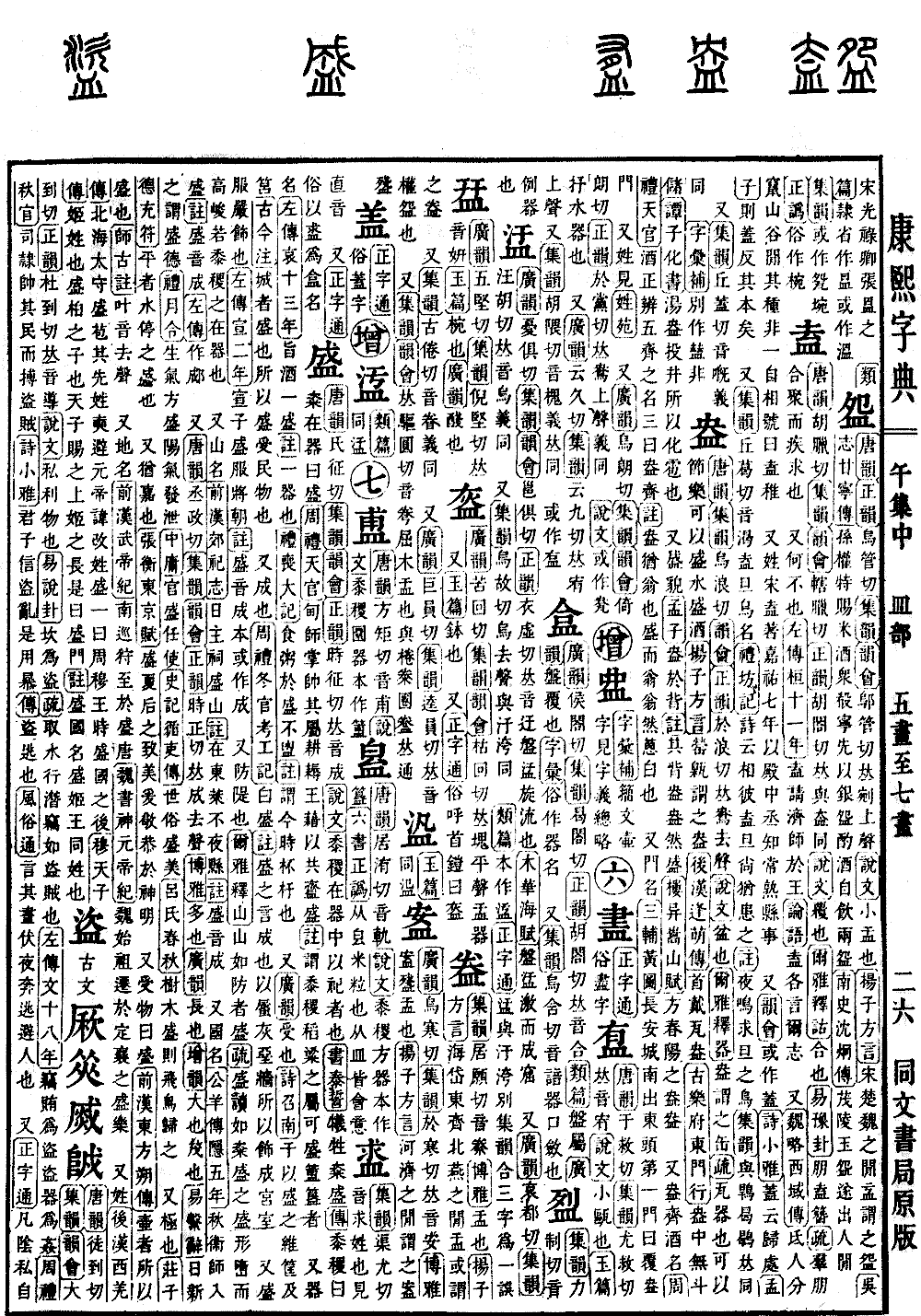
Wu Collection, Middle Volume
Radical: Vessel (mǐn)
Kangxi Strokes: 12
Page 794, Entry 20
Pronounced chéng.
According to the Explaining Graphs and Analyzing Characters (Shuowen Jiezi), it refers to millet used in containers for sacrificial offerings.
In the Book of Documents (Shangshu): Sacrifice and offerings. The commentary states that millet is called zī, and when placed in a container it is called chéng.
In the Rites of Zhou (Zhouli): The official in charge leads his subordinates to cultivate the royal fields to provide grain for sacrifices. The commentary explains this refers to grains like millet, panicled millet, rice, and sorghum that can be held in vessels such as the fǔ and guǐ.
Also refers to a type of vessel. In the Zuo Tradition (Zuozhuan): One vessel of fine wine. The commentary states this refers to a single container.
In the Book of Rites (Liji): Drinking porridge from a container requires no hand washing. The commentary refers to the cups and bowls of the time.
Also, per the Extensive Dictionary of Sounds and Meanings (Guangyun), it means to hold or receive.
In the Book of Odes (Shijing): With what shall we contain it? With those square and round baskets.
In the Ancient and Modern Notes (Gujinzhu): A city is a container, used to hold the people and their supplies.
Also refers to completion or achievement. In the Rites of Zhou (Zhouli): White completion. The commentary explains that completion means finished. Using clam-shell lime to coat walls is a means of completing the decoration of a palace.
Also refers to formal attire, meaning solemn and neat clothing. In the Zuo Tradition (Zuozhuan): Xuanzi wore formal court dress in preparation for his appearance at court. The commentary notes: pronounced chéng; some editions write it as the character meaning complete.
Also refers to a shape like a dike. In the Literary Expositor (Erya): A mountain shaped like a dike is called chéng. The commentary explains: pronounced like the chéng in zī chéng, referring to a form that is narrow, long, and high, resembling the way grain is piled in a container.
Also refers to the name of a mountain. In the Book of Han (Hanshu): Sacrificed to the Sun Lord at Mount Cheng. The commentary notes: located in Buye County, Donglai Commandery. Pronounced chéng.
Also refers to the name of a feudal state. In the Gongyang Tradition (Gongyangzhuan): In the autumn, the army of the State of Wei entered the State of Cheng. The commentary notes: pronounced chéng. The Zuo Tradition (Zuozhuan) writes it as the character chéng.
Pronounced shèng (falling tone).
According to the Broad Art (Boya), it means many. Per the Extensive Dictionary of Sounds and Meanings (Guangyun), it means long. According to the Augmented Dictionary (Zengyun), it means large or lush.
In the Book of Changes (Yijing): Renewing oneself daily is called a magnificent virtue.
In the Book of Rites (Liji): Life force is currently flourishing, and the solar energy is radiating.
In the Doctrine of the Mean (Zhongyong): The number of subordinate officials is sufficient for the tasks required.
In the Records of the Grand Historian (Shiji): Social customs are very flourishing.
In the Spring and Autumn Annals of Master Lü (Lüshi Chunqiu): When trees are lush, birds will congregate in them.
Also refers to a peak or vertex. In the Zhuangzi: Equilibrium is the ultimate state of still water.
Also equivalent to fine or beautiful. In Zhang Heng’s Rhapsody on the Eastern Capital (Dongjing Fu): Extolling the ultimate beauty of the supreme virtue of Yu the Great, he thus respectfully served the spirits.
Also refers to the act of placing things in a container. In the Book of Han (Hanshu): A pot is used to contain things. The commentary notes: the sound is modified to the falling tone.
Also refers to a place name. In the Book of Han (Hanshu): Moving south to hunt, he arrived at Chengtang. In the Book of Wei (Weishu): The founding ancestor of Wei moved to Chengle in Dingxiang.
Also refers to a surname. In the Book of the Later Han (Houhanshu): The Administrator of Beihai, Sheng Bao; his ancestors were surnamed Shi, but he changed it to Sheng to avoid the taboo of the personal name of Emperor Yuan of Han. Another tradition holds that they were descendants of the people of the State of Cheng during the time of King Mu of Zhou. According to the Chronicle of King Mu (Mu Tianzi Zhuan): They were of the Ji surname, sons of Cheng Bai. The Emperor rewarded him. The elders of the senior branch of the Ji surname were called the Sheng clan. The commentary notes: Cheng is the name of a state; Sheng Ji refers to those sharing the Emperor's surname.