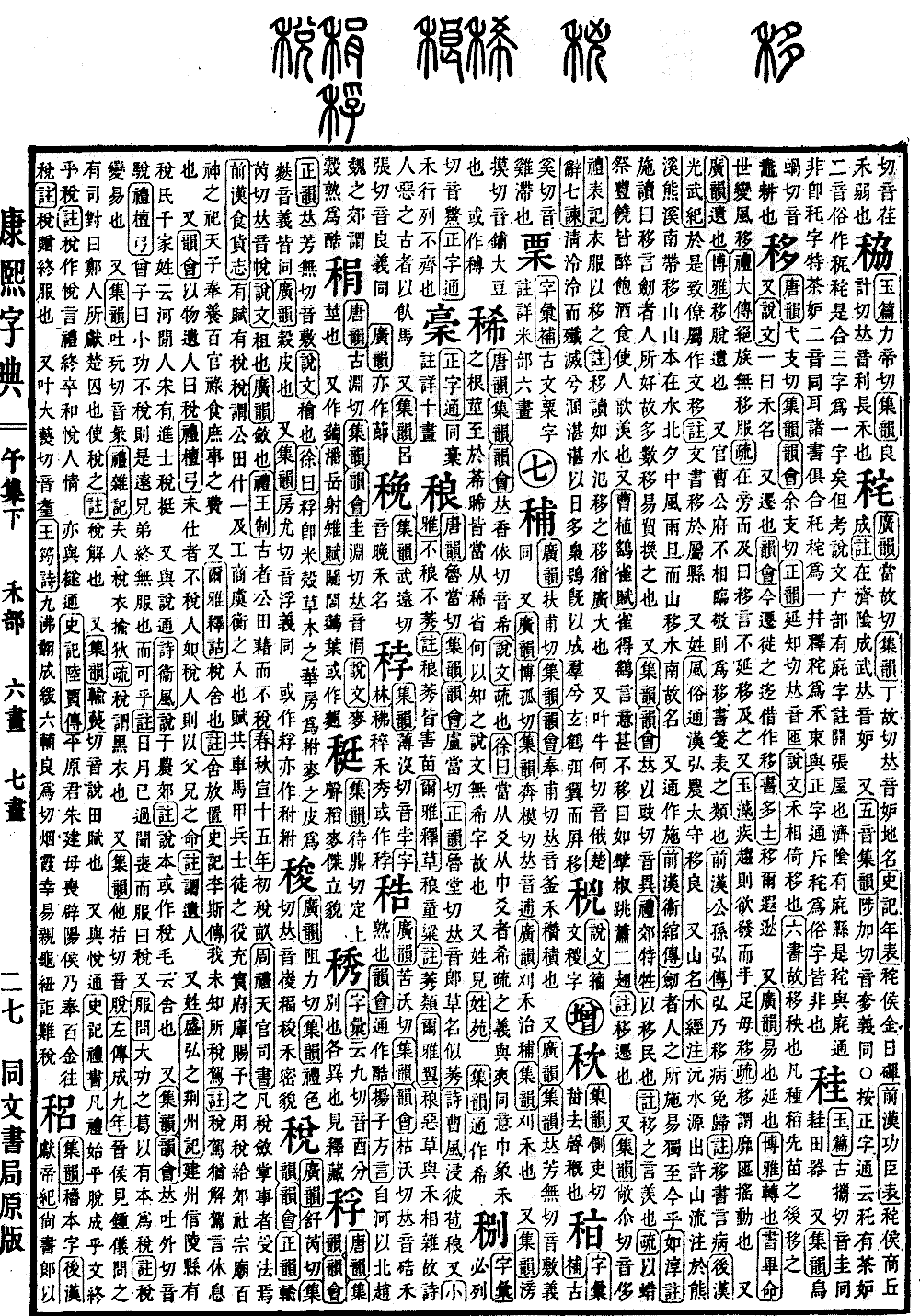
Wu Collection, Lower Volume
Radical: Grain (hé)
Kangxi Strokes: 12
Page 853, Entry 01
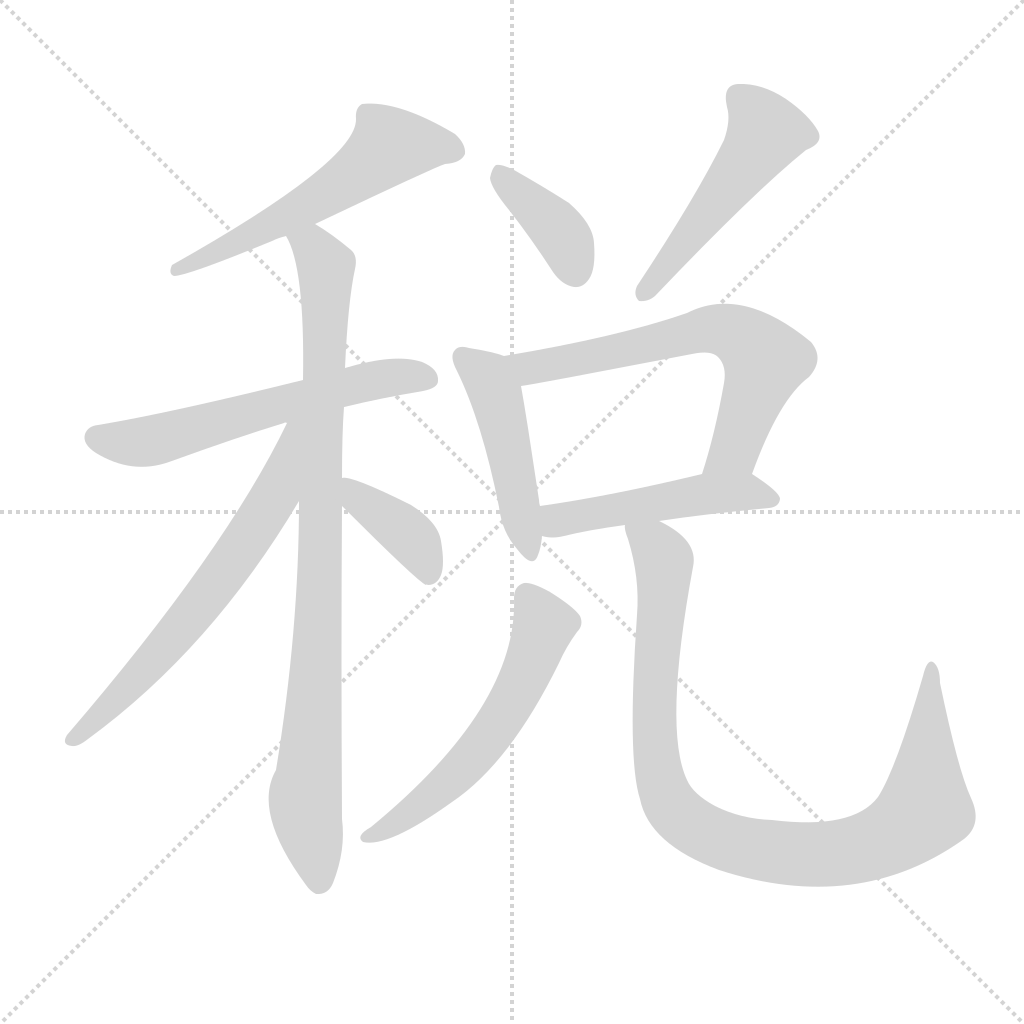
Pronounced shui.
According to the Guangyun (Broad Rhymes), the Jiyun (Collected Rhymes), the Yunhui (Collection of Rhymes), and the Zhengyun (Correct Rhymes), it is pronounced shui, the same as the character meaning a kerchief (shui).
In the Shuowen (Explanation of Characters): A land tax.
In the Guangyun (Broad Rhymes): To collect taxes.
In the Book of Rites (Liji), Wangzhi (Royal Regulations): In ancient times, communal land was cultivated with the labor of the people without collecting land tax.
In the Spring and Autumn Annals (Chunqiu), 15th year of Duke Xuan: Began to levy taxes based on land acreage.
In the Rites of Zhou (Zhouli), Heaven's Officials, Minister of Records: For all taxes collected, the responsible officials must comply with the statutes.
In the Book of Han (Qianhan), Treatise on Food and Money: There are impositions and there are taxes. Tax refers to taking one-tenth from communal lands, as well as revenue from industry, commerce, mountains, forests, and wetlands. Impositions are used to supply carriages, horses, armor, weapons, military service, and labor, to replenish the treasury, and to provide rewards. Taxes supply the expenses for sacrifices to heaven, earth, ancestral temples, and the hundred spirits, as well as the upkeep of the Son of Heaven and the salaries of the hundred officials, and the expenses of various matters.
Also, in the Erya (Approaching Elegance), Explanations of Words: Tax means to lodge.
Note: To lodge means to place or set down.
In the Records of the Grand Historian (Shiji), Biography of Li Si: I do not know where my lodging is (original meaning: where to park the carriage and rest).
Note: To unyoke the carriage is like removing the carriage horses, meaning to rest.
Also, in the Yunhui (Collection of Rhymes): To present gifts to others is called tax.
In the Book of Rites (Liji), Tan Gong: One who does not hold office does not present property to others; if one must present it, it should be in the name of one's father or elder brother.
Note: Refers to presenting a person with gifts.
Also, a surname.
In Sheng Hongzhi's Records of Jingzhou (Jingzhou Ji): There are families with the surname Tax in Xinling County, Jianzhou. The Qianjia Xing (List of One Thousand Surnames) says: They are people from Hejian. In the Song Dynasty, there was a scholar named Tax Ting.
Also, interchangeable with the character meaning to speak (shuo).
In the Book of Odes (Shijing), Yongfeng: To stay at the outer suburbs for agriculture.
Note: Shuo; some versions write it as tax. Mao's commentary says: It means to lodge.
Also, according to the Jiyun (Collected Rhymes) and the Yunhui (Collection of Rhymes), it is pronounced tui, the same as the character for a horse.
In the Book of Rites (Liji), Tan Gong: Zengzi said: If a person wearing the small mourning dress hears of the death after the mourning period has passed and does not retrospectively wear it, then distant brothers will never wear mourning dress at all; is this acceptable?
Note: When the mourning period has passed and one hears of the death, wearing the dress is called tax.
Also, in the section on mourning questions: The kudzu band used for heavy mourning dress, which must be changed because of the original heavy mourning.
Note: Tax means to change.
Also, according to the Jiyun (Collected Rhymes), it is pronounced tuan, the same as the character for a group.
In the Book of Rites (Liji), Miscellaneous Records: The empress's black ceremonial robes and the robes patterned with pheasants.
Commentary: Tax refers to black clothing.
Also, according to the Jiyun (Collected Rhymes), it is pronounced tuo, the same as the character for to remove.
In the Zuo Commentary (Zuozhuan), 9th year of Duke Cheng: The Duke of Jin saw Zhongyi and asked about him. The responsible official replied: It is a captive from Chu offered by the people of Zheng. [The Duke] had him unbound.
Note: Tax means to release.
Also, according to the Jiyun (Collected Rhymes), it is pronounced shuo, the same as the character meaning to speak. Land tax.
Also, interchangeable with the character meaning happy (yue).
In the Records of the Grand Historian (Shiji), Treatise on Ritual: In general, rituals begin with simplicity, take form through ornamentation, and conclude in harmony and happiness.
Note: Tax is written as yue, meaning that rituals ultimately make human emotions harmonious and happy.
Also, interchangeable with the character for funerary clothes (sui).
In the Records of the Grand Historian (Shiji), Biography of Lu Jia: When the mother of Lord Pingyuan, Zhu Jian, passed away, the Marquis of Biyang presented a hundred catties of gold to offer funerary garments.
Note: Tax means to present funerary garments.
Also, rhyming with die (rising tone).
In the poems of Wang Yun: Nine boilings turn to slowness, six supports truly cut [the process]. It is fortunate that smoke and mist are easy to approach; how could the tortoise-shaped carriage knob be difficult to remove?