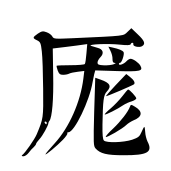
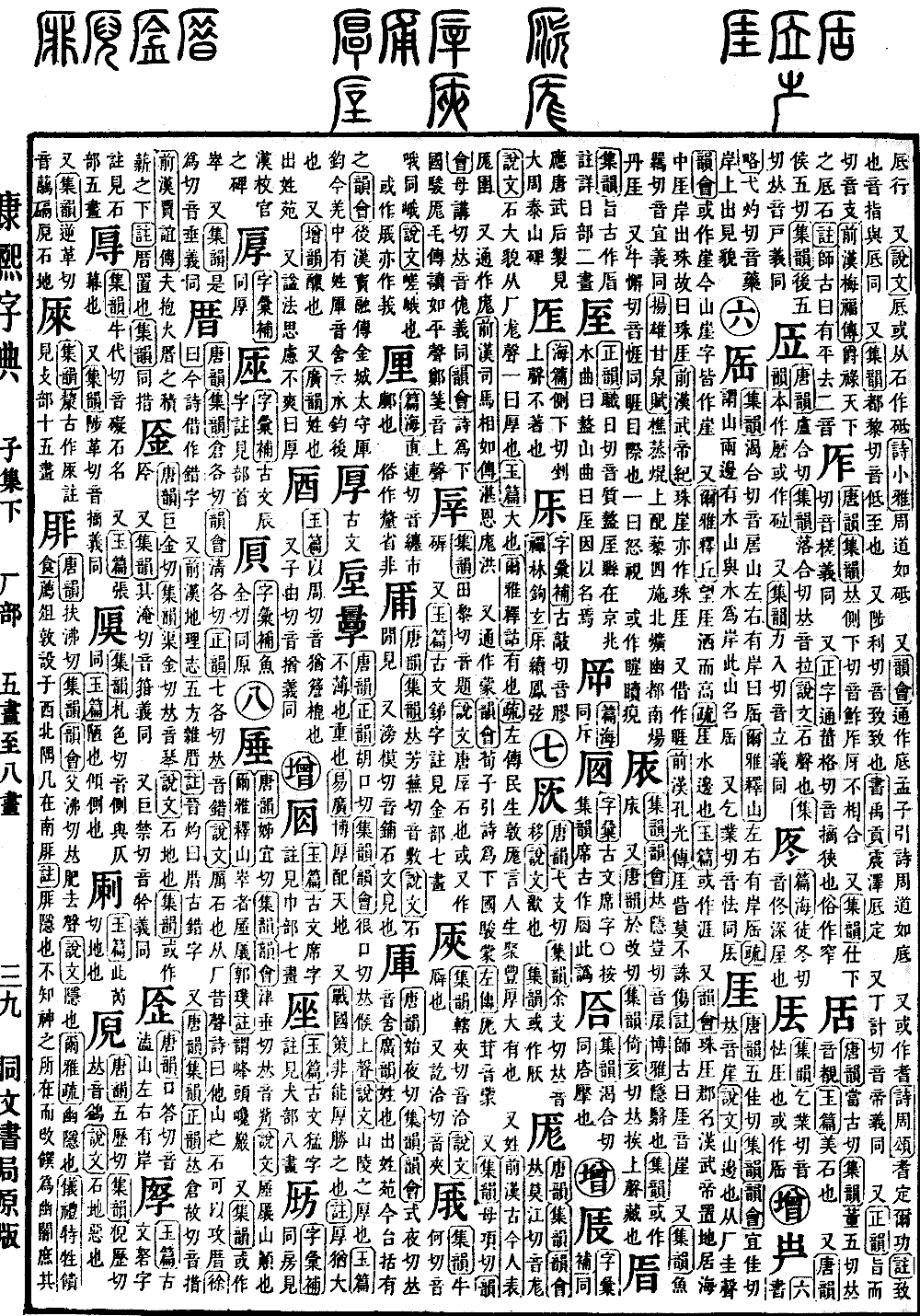
Zi Collection, Page Position: Lower. Radical: Cliff (chǎng). Máng. Kangxi stroke count: 9. Page 161, number 19.
The Tang Rhymes (Tangyun), Collected Rhymes (Jiyun), and Collected Rhyme Classes (Yunhui) define the pronunciation through the fanqie method as mò combined with jiāng, sounding the same as the character máng.
The Explanations of Characters (Shuowen Jiezi) defines this as the appearance of a massive stone. The character structure consists of the radical Cliff (chǎng) and the character máng, which acts as the phonetic component. Another interpretation describes it as thick and heavy.
The Jade Chapters (Yupian) defines it as huge.
The Approaching the Correct (Erya) section on Explaining Ancient Terms (Shigu) defines it as to possess.
The Commentary on the Zuo Tradition (Zuozhuan) regarding the phrase "the livelihood of the people is solid and simple" explains that it refers to the population being gathered and concentrated, abundant and thick, or wealthy and vast.
It is also used as a surname.
The Table of Ancient and Modern People in the Book of Han (Hanshu) includes the name Máng Yǔ.
It is also used interchangeably with the character páng.
In the Biography of Sima Xiangru within the Book of Han, the term appears in the phrase "deep grace, vast and great."
It is also used interchangeably with the character méng.
The Collected Rhyme Classes notes that Master Xun (Xunzi) quotes the Book of Odes (Shijing) using a variant meaning "acting as a great protection for the lower states."
In the Zuo Tradition, the term mángróng is pronounced as méng.
Furthermore, the Collected Rhymes provides a fanqie pronunciation of mǔ and xiàng, while the Collected Rhyme Classes provides mǔ and jiǎng, referring to a specific sound missing in the original text, though the meaning remains identical.
The Collected Rhyme Classes notes that for the phrase "acting as a great protection for the lower states" in the Book of Odes, the Mao Commentary (Maozhuan) reads the word in the level tone, whereas Zheng Xuan’s commentary reads it in the rising tone.