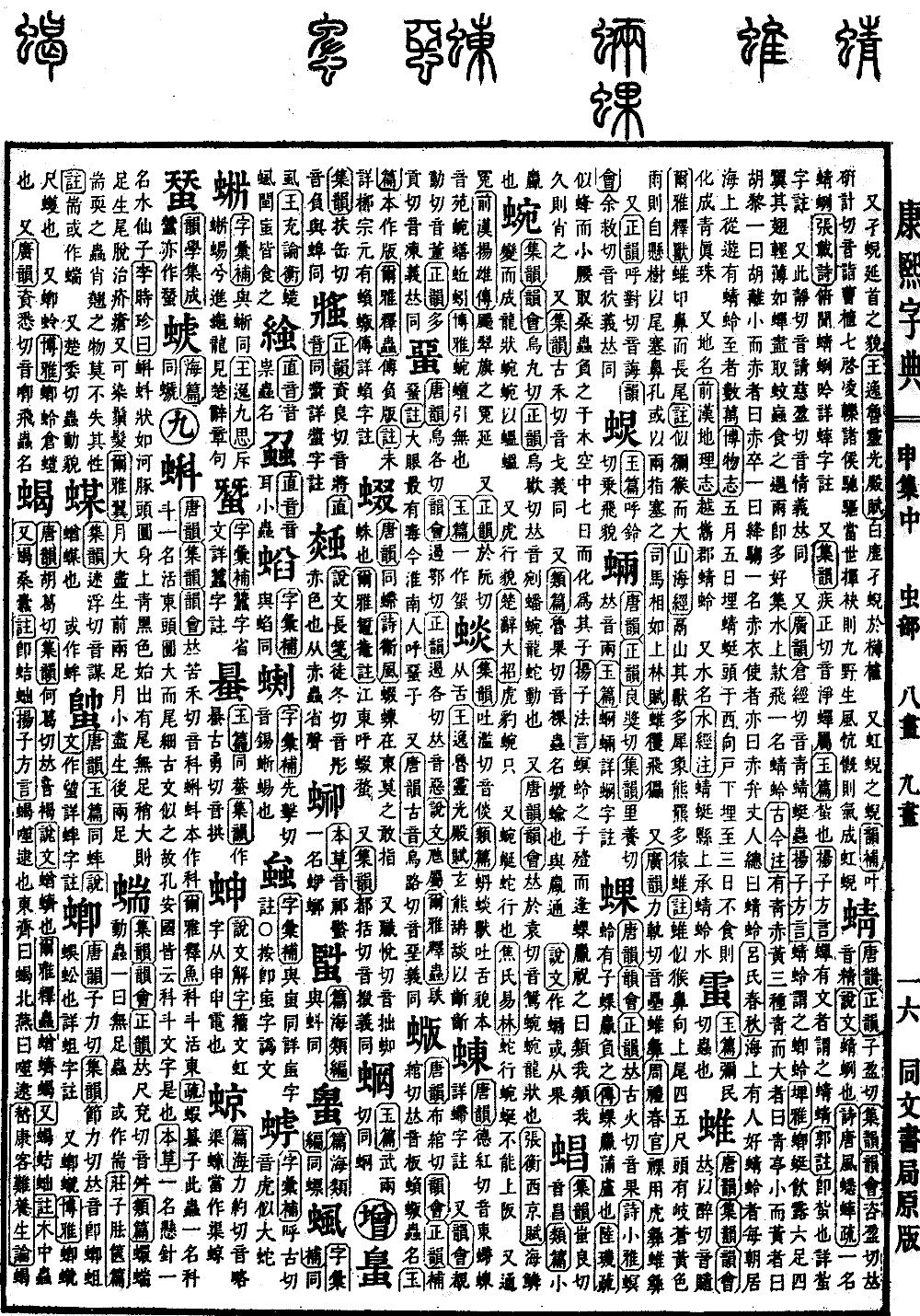
Shen Collection, Middle Volume. Radical: Insect (chóng). Kangxi stroke count: 14. Page 1088, Entry 01.
Pronounced jing.
According to the Shuo Wen Jiezi (Shuowen), it is a type of cricket. According to the commentary on the Cricket entry in the Book of Odes (Shijing), it is also known as a cricket. Zhang Zai’s poetry mentions hearing the cricket chirp. See the entry for the character shuai for further details.
Pronounced jing. A species of cicada. According to the Yu Pian, it is a type of tree cicada. According to Yang Xiong’s Dialect (Fangyan), those with markings are called qingqing. Guo Pu’s commentary states that it is the same as a tree cicada. See the entry for the character zha for further details.
Also pronounced qing. Also pronounced qing. The meaning is the same.
Pronounced qing. A dragonfly. According to Yang Xiong’s Dialect (Fangyan), the dragonfly is known as jiling. According to the Pi Ya, the dragonfly drinks dew, possesses six legs and four wings, and has wings as light and thin as those of a cicada; it feeds exclusively on mosquitoes and horseflies, and gathers in large numbers over water when it rains, flying low. It is also known as a dragonfly. According to the Gujin Zhu, there are three types: blue, red, and yellow. The large blue ones are called qingting, the small yellow ones are called huli (also known as huli), and the small red ones are called chizu (also known as jiangzou), also referred to as the red-robed messenger or the red-capped elder. Collectively, they are known as dragonflies. According to the Lu Shi Chunqiu, there was a man by the sea who loved dragonflies; he would sit by the sea every morning and follow them, and hundreds would come to him. According to the Bowu Zhi, if one buries a dragonfly head under a west-facing door on the fifth day of the fifth lunar month and leaves it for three days without eating, it will transform into a blue pearl.
Also a place name. According to the Book of Han (Hanshu) Geographical Treatise, there is a location called Qiling in Yuexi Commandery.
Also a water name. According to the Commentary on the Classic of Water (Shuijing Zhu), in Qiling County, it originates from the Qiling River.
Textual Correction: The Lu Shi Chunqiu states that a man by the sea loved dragonflies, and every morning he would sit by the sea and follow them, and tens of thousands would arrive. Following the original text from the Jingyu chapter of the Lu Shi Chunqiu, it is corrected to read: There was a man by the sea who loved dragonflies; every morning he would sit by the sea and follow them, and hundreds would come to him.