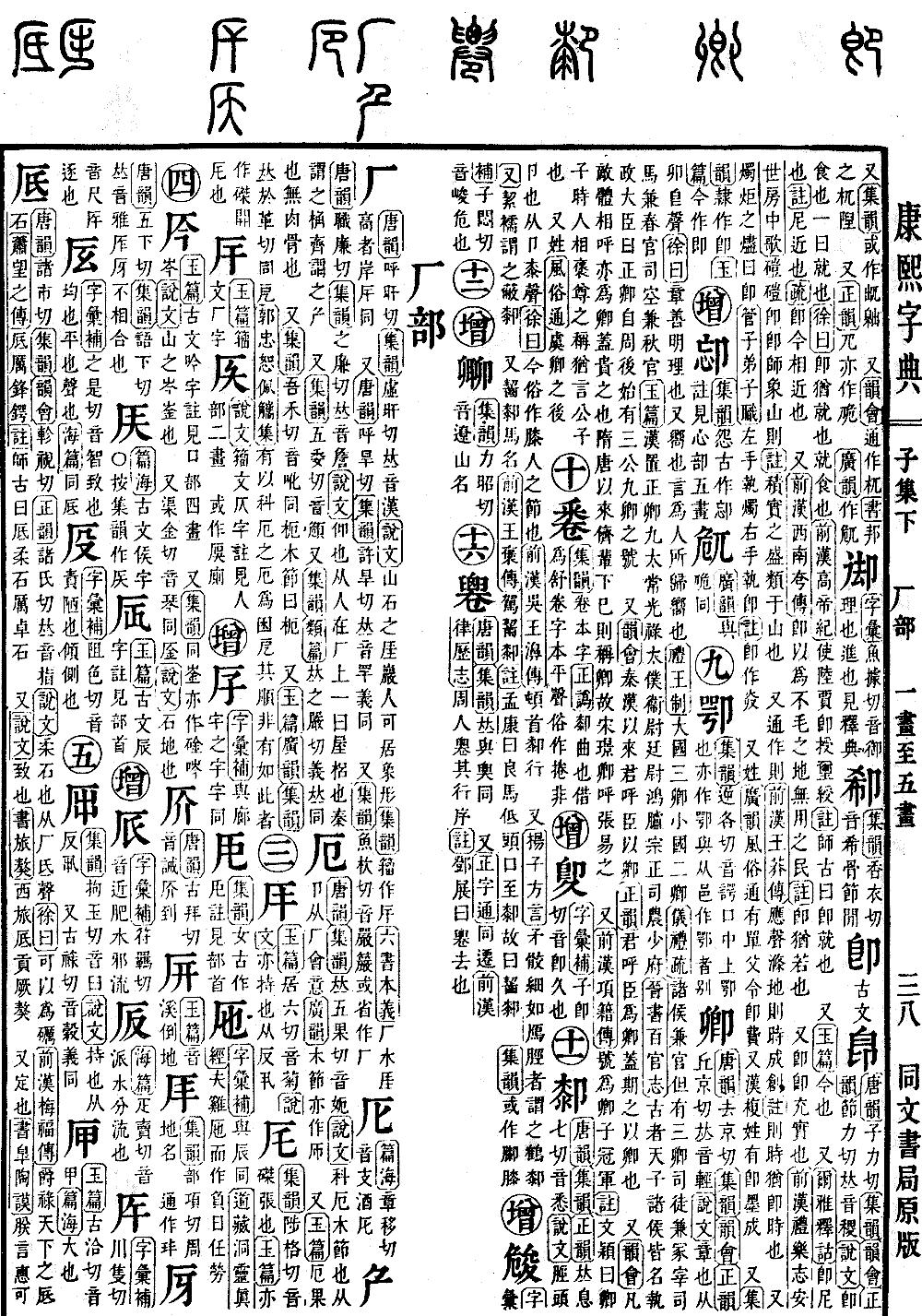
Zi Collection, Page Position: Lower
Radical: Kneeling Person (jié)
卿
Kangxi radical strokes: 11; Page number: Page 160, Entry 08
According to Tang Rhyme, Jiyun, Yunhui, and Zhengyun, the pronunciation is similar to qīng.
Shuowen Jiezi states it refers to 'bright and clear'. The character form uses '皀' as the phonetic component. Xu Yue explains it means 'to make good principles clear and to understand affairs'. It also refers to 'longing for' or 'being admired', indicating being sought after and desired by others.
In the Rites of Zhou (Liji), Wangzhi chapter, it states: "A large state establishes three qīng, a small state establishes two qīng." According to Yili Shu (Commentary on the Book of Etiquette and Ceremonial), feudal lords holding multiple offices only established three qīng: the Minister of Education (sītú) also serving as Chief Minister (zhǒngzǎi), the Minister of War (sīmǎ) also serving as Minister of Spring (chūnguān), and the Minister of Works (sīkōng) also serving as Minister of Autumn (qiūguān).
The Yupian (Jade Chapters) states that during the Han Dynasty, nine principal qīng were established: Grand Master of Ceremonies (tàicháng), Supervisor of Attendants (guānglù), Grand Coachman (tàipú), Commandant of Guards (wèiwèi), Commandant of Justice (tíngwèi), Grand Herald (hónglú), Director of the Imperial Clan (zōngzhèng), Minister of Agriculture (sīnóng), and Privy Treasurer (shàofǔ).
According to the Jinshu (History of Jin), Baiguanzhi chapter (Treatise on Official Ranks), in ancient times, both the Son of Heaven and feudal lords referred to their ruling ministers as principal qīng. The titles of 'Three Ducal Ministers and Nine Principal Ministers' (sāngōng jiǔqīng) only began after the Zhou Dynasty.
Furthermore, Yunhui states that from the Qin and Han Dynasties onward, rulers addressed their subjects using 'qīng'. Zhengyun explains that when a ruler addressed a subject as qīng, it was with the expectation that they would achieve the status of a qīng. Moreover, Yunhui also notes that 'qīng' was used by peers addressing each other, signifying respect. From the Sui and Tang Dynasties onward, 'qīng' could also be used by peers or when addressing someone of lower status. For example, Song Jing once referred to Zhang Yizhi as qīng.
Additionally, in the Hanshu (Book of Han), Xiang Ji Zhuan (Biography of Xiang Ji), it states he was known as Qīngzǐ Guànjūn. The commentary by Wen Ying explains that qīngzǐ was a complimentary and respectful form of address used among people at the time, similar to calling someone gōngzǐ (young master).
It is also a surname. According to Fengsutong (Comprehensive Customs), it originated from the descendants of Yu Qing.