Xu Collection, Upper Volume
Radical: Gate (mén)
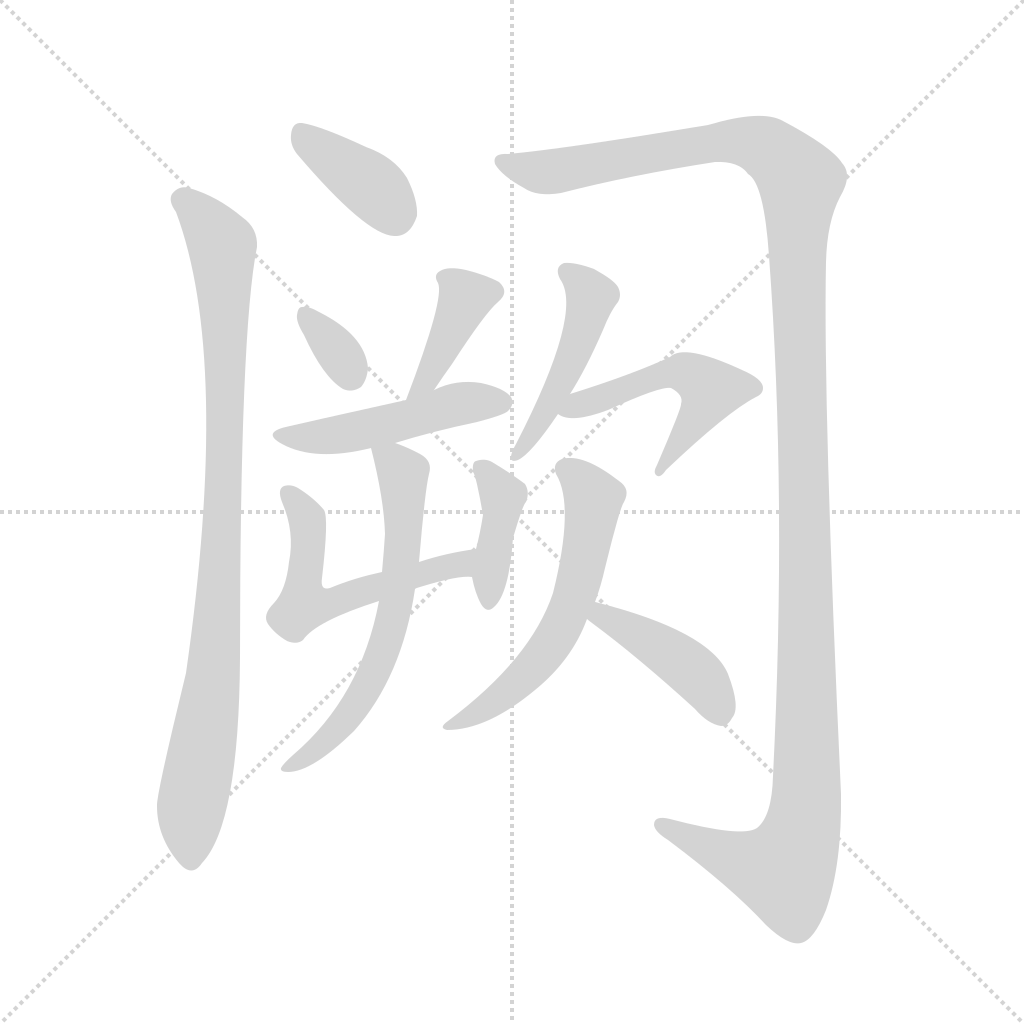
Que
Kangxi stroke count: 18
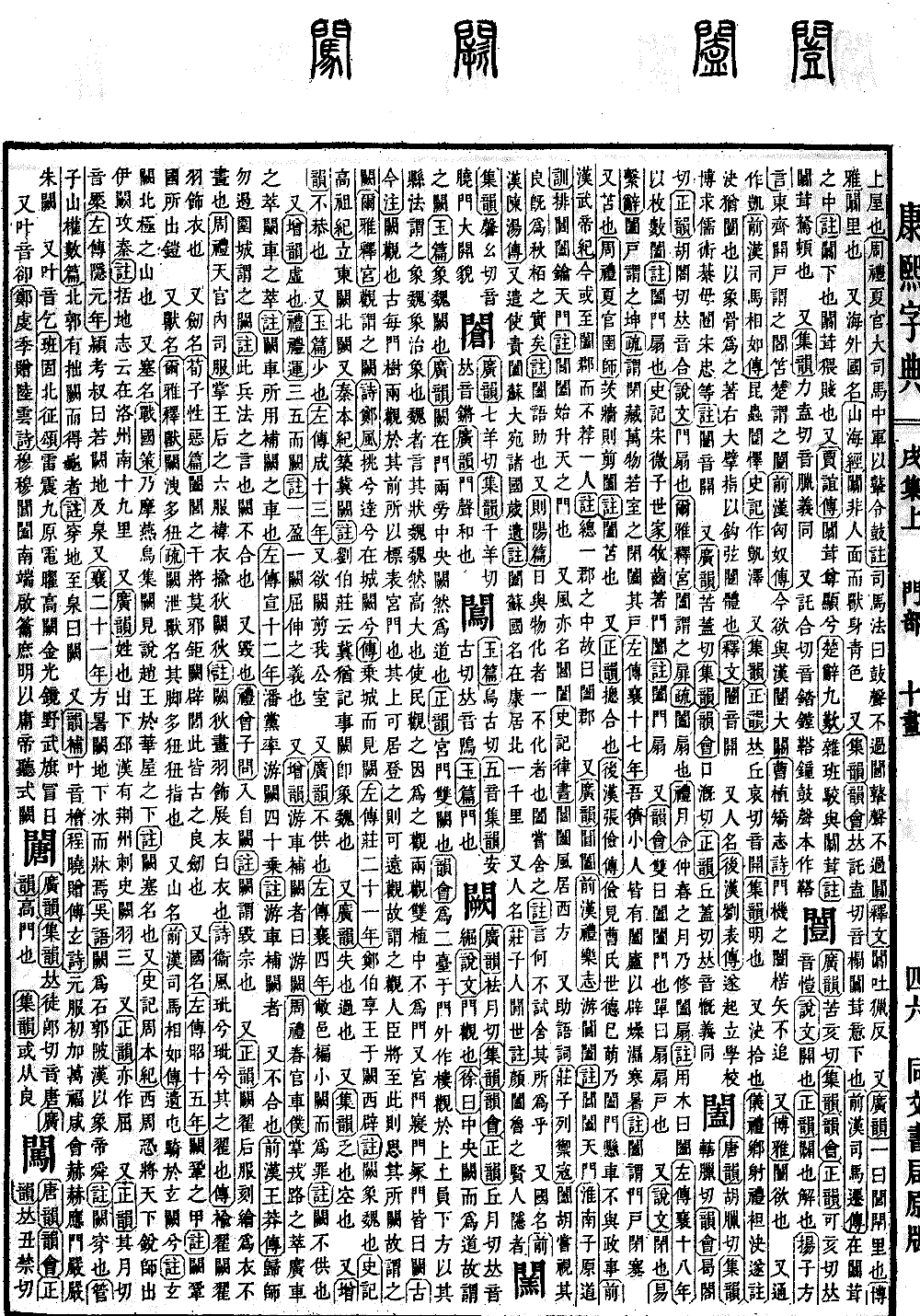
Page 1340, Entry 01
Broad Rhymes (Guangyun): Pronounced que
Collection of Rhymes (Jiyun), Rhyme Meetings (Yunhui), Correct Rhymes (Zhengyun): Pronounced que
Explanations of Characters (Shuowen): A gate watchtower. Xu says: The center is left open to serve as a road, therefore it is called a que. Jade Encyclopedia (Yupian): Resembles the Xiangwei (a type of watchtower). Broad Rhymes (Guangyun): The que are on both sides of a gate, with the center left open to serve as a road. Correct Rhymes (Zhengyun): Twin watchtowers at a palace gate. Rhyme Meetings (Yunhui): Two platforms built outside a gate, with observation towers on top, round at the top and square at the bottom; because they are used to display laws, they are called Xiangwei. Xiang refers to the manifestations of governance; Wei refers to their appearance, which is imposing and grand. People look at them to observe, hence they are called guan (observations). Two watchtowers are erected, but they do not serve as a gate. Also, palace gates, residential gates, and ancestral tomb gates are all called que. Past and Present Records (Gujin Zhu): Que means guan (observation). In ancient times, every gate had two towers erected in front of it to mark and identify the palace gate. One could stay on top of them, and ascending them allowed one to see far, hence they were called guan. When a subject arrived here, he would reflect on his own deficiencies (que), hence it is called a que.
Er-ya, Explaining Palaces (Shigong): Guan are called que.
Book of Odes (Shijing), Odes of Zheng: Proudly and freely, at the city watchtower.
Commentary: Riding the city walls and seeing the watchtower.
Zuo Commentary (Zuozhuan), 21st Year of Duke Zhuang: The Earl of Zheng entertained the King west of the que passage.
Note: Que refers to the Xiangwei.
Records of the Grand Historian (Shiji), Annals of Gaozu: Established the eastern que and the northern que.
Also, Annals of Qin: Built the Ji que.
Note: Liu Bozhuang says: Ji is like recording matters, and que is the Xiangwei.
Also, Broad Rhymes (Guangyun): To lose; a mistake.
Also, Collection of Rhymes (Jiyun): To lack; to be empty.
Also, Increased Rhymes (Zengyun): Disrespectful.
Also, Jade Encyclopedia (Yupian): To be few.
Zuo Commentary (Zuozhuan), 13th Year of Duke Cheng: And want to impair (que) and prune our ducal house.
Also, Broad Rhymes (Guangyun): To fail to supply.
Zuo Commentary (Zuozhuan), 4th Year of Duke Xiang: My humble state is small and cramped, and by failing to supply (que) I have committed a crime.
Note: Que means failing to supply.
Also, Increased Rhymes (Zengyun): Vacant.
Book of Rites (Liji), Evolution of Rites (Liyun): Three or five, then there is a vacuity (que).
Note: One waxing and one waning, the principle of yielding and extending.
Also, Increased Rhymes (Zengyun): Traveling vehicles for replenishing deficiencies are called you-que.
Rites of Zhou (Zhouli), Office of Spring: Managing the essence of military road vehicles, broad carriages, and que carriages.
Note: Que carriages are vehicles used to replenish deficiencies.
Zuo Commentary (Zuozhuan), 12th Year of Duke Xuan: Pan Dang led forty you-que carriages.
Note: Traveling vehicles are those that replenish deficiencies.
Also: Not to match.
History of the Former Han (Qianhan), Biography of Wang Mang: Do not block returning troops; surrounding a city is called que.
Note: This is a term from the art of war. Que means not joining or not matching.
Also: To ruin.
Book of Rites (Liji), Questions of Zengzi: Entering from the que.
Note: Que refers to the ruin of the ancestral temple.
Also, Correct Rhymes (Zhengyun): Que-di (a type of ceremonial garment for an empress) is made by carving silk, without painting.
Rites of Zhou (Zhouli), Office of Heaven: Managing the six garments of the queen: yi-di, yu-di, que-di, ju-yi, zhan-yi, yuan-yi.
Note: Que-di are garments decorated with feathered patterns. Zhan-yi are white garments.
Book of Odes (Shijing), Odes of Wei: Yu-di and que-di are garments with feathered decorations.
Also: Name of a sword.
Xunzi, On the Nature of Evil: Ganjiang, Moye, Juque, and Pilu of King Helu, these are all excellent swords of old.
Also: Name of a state.
Zuo Commentary (Zuozhuan), 15th Year of Duke Zhao: Armor from Quegong.
Note: Armor produced by the state of Quegong.
Also: Name of a beast.
Er-ya, Explaining Beasts: Quexie has many toes.
Commentary: Quexie is the name of a beast. Its feet have many toes.
Also: Name of a mountain.
History of the Former Han (Qianhan), Biography of Sima Xiangru: Leaving the garrison cavalry at Que.
Note: Que is a mountain at the North Pole.
Also: Name of a pass.
Strategies of the Warring States (Zhanguo Ce): Then rubbed the Yan and Wu gates, and had an audience with the King of Zhao under the Flowery Hall.
Note: Que is the name of a pass.
Also, Records of the Grand Historian (Shiji), Annals of Zhou: Western Zhou was afraid and about to lead the elite troops of the world out of Yique to attack Qin.
Note: The Kuodizhi (Geography Records) says: It is located nineteen li south of Luozhou.
Also, Broad Rhymes (Guangyun): A surname. Originated from Xiapi. In the Han dynasty, there was a regional inspector of Jingzhou named Que Yu.
Also, Correct Rhymes (Zhengyun): Also written as qu.
Also, Correct Rhymes (Zhengyun): Pronounced jue.
Zuo Commentary (Zuozhuan), 1st Year of Duke Yin: Ying Kaoshu said: If you dig (que) the earth until you reach the spring.
Also, 21st Year of Duke Xiang: In the summer heat, digging (que) the earth, lowering ice, and bedding down there.
Discourses of Wu (Wuyu): Dug (que) to make a stone rampart and channeled the Han River to emulate Emperor Shun.
Note: Que means to pierce or dig.
Guanzi, On Mountain Weights: In the northern suburb, someone dug (que) and found a turtle.
Note: Digging into the earth until reaching a spring is called que.
Also, Addendum to Rhymes (Yunbu): Rhymes with kuai.
Cheng Xiao, Gift Poem for Fu: The cap of adulthood newly added, ten thousand blessings all gathered. Radiant is the main gate, solemn is the crimson watchtower.
Also rhymes with qi.
Ban Gu, North Expedition Eulogy: Thunder shook the nine plains, lightning shone on the high watchtower. Golden light mirrored the wilderness, war banners obscured the sun.
Also rhymes with que.
Zheng Qianji, Gift Poem for Lu Yun: The gate of heaven, the southern end opens its locks. May it be bright and used, the Emperor's hearing is modeled on the que.
Verification: Zuo Commentary (Zuozhuan), 13th Year of Duke Cheng: And want to impair and prune our ducal house. Note: In the character jian (to prune), the radical below is feather (yu); it is now corrected to jian.
Correct Rhymes (Zhengyun): Que-di, empress's garment, made of carved silk, not painted. Note: According to the original text, "carved silk" (ke zeng) is corrected from "carved painting" (ke hui).
Guanzi, On Mountain Weights: In the northern suburb, someone dug (que) and found a turtle. Note: According to the original text, "dug" (jue) is corrected from "clumsy" (zhuo).