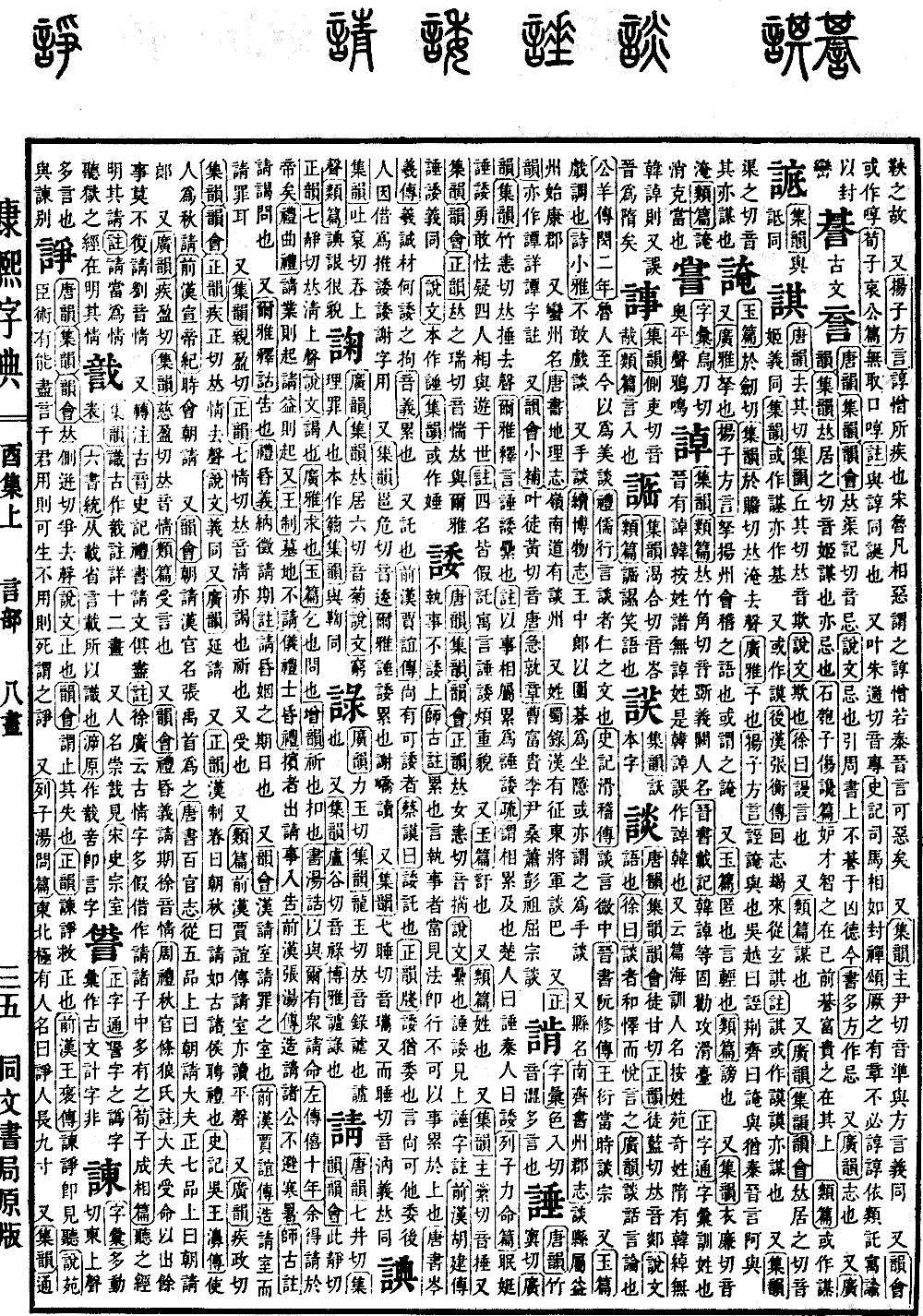
You Collection, Upper Volume
Radical: Speech (yán)
Kangxi Strokes: 15
Page 1167, Entry 18
Pronounced qing (rising tone).
Shuowen Jiezi (Shuowen): To seek an audience.
Guangya: To request.
Yupian: To beg for, to inquire.
Zengyun: To pray for, to ask of.
Book of Documents (Shujing), Tanggao: By this, request that all of you preserve your lives.
Zuo Tradition (Zuo Zhuan), Year 10 of Duke Xi: I have requested this of the Celestial Emperor and have been granted it.
Book of Rites (Liji), Quli: When requesting instruction on lessons, one must stand; when requesting further explanation, one must stand.
Also, Wangzhi: For a cemetery, one does not request a designated location.
Etiquette and Ceremonial (Yili), Shihunli: The host's assistant goes out, requests instructions on the matter, and then returns to report.
History of the Former Han (Qianhan Shu), Biography of Zhang Tang: To visit and pay respects to the various lords and ministers, regardless of cold or heat.
Shigu Note: Qing means to visit and inquire after someone.
Also, Erya: To inform.
Book of Rites (Liji), Hunyi: After the wedding betrothal gifts have been presented, request the date of the marriage.
Note: To request the date for the marriage.
Also, Yunhui: The Qing chamber of the Han Dynasty was a place for confessing crimes.
History of the Former Han (Qianhan Shu), Biography of Jia Yi: To go to the Qing chamber to confess one's crimes.
Also, Jiyun: Pronounced qing (level tone). Also carries the meaning of visiting and praying for. It also means to accept.
Also, Leipian: In the Biography of Jia Yi in the History of the Former Han, the word for Qing chamber is also read in the level tone.
Also, Guangyun: Pronounced qing (falling tone).
Shuowen Jiezi (Shuowen): The meaning is the same.
Also, Guangyun: To invite.
Also, Zhengyun: According to Han Dynasty institutions, the audience in spring was called Zhao, and the audience in autumn was called Qing, similar to the diplomatic visits of feudal lords in ancient times.
Records of the Grand Historian (Shiji), Biography of King Pi of Wu: Sent men to conduct the autumn audience and visit.
History of the Former Han (Qianhan Shu), Annals of Emperor Xuan: Attended the audiences and visits at the appointed times.
Also, Yunhui: Chaoqing was an official title during the Han Dynasty. Zhang Yu was the first to hold this position.
Old Book of Tang (Tangshu), Treatise on Civil Officials: Officials of the fifth rank, upper grade, were called Chaoqing Dafu; those of the seventh rank, upper grade, were called Chaoqing Lang.
Also, Guangyun: Pronounced qing (level tone).
Leipian: To accept words.
Also, Yunhui: In the Book of Rites (Liji), Hunyi, the term for requesting a date is read as qing by Xu Miao.
Rites of Zhou (Zhouli), Autumn Official, Note on Tiaolangshi: When a great officer receives an order to go out, he must request instructions on all other matters. Liu Changzong reads this as qing.
Also, Zhuanzhu Guyin: In the Records of the Grand Historian (Shiji), Rites Book, the meaning of the character Qing is fully expressed.
Note: Xu Guang says: In ancient times, the character for emotion (qing) was often used as a loan for Qing; this occurs frequently in the works of the various philosophers.
Xunzi, Chengxiang Chapter: The root of hearing a lawsuit lies in clarifying the true situation.
Note: Qing should be written as the character for emotion (qing). The root of hearing and judging a lawsuit lies in clarifying the true situation.