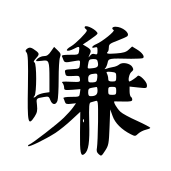
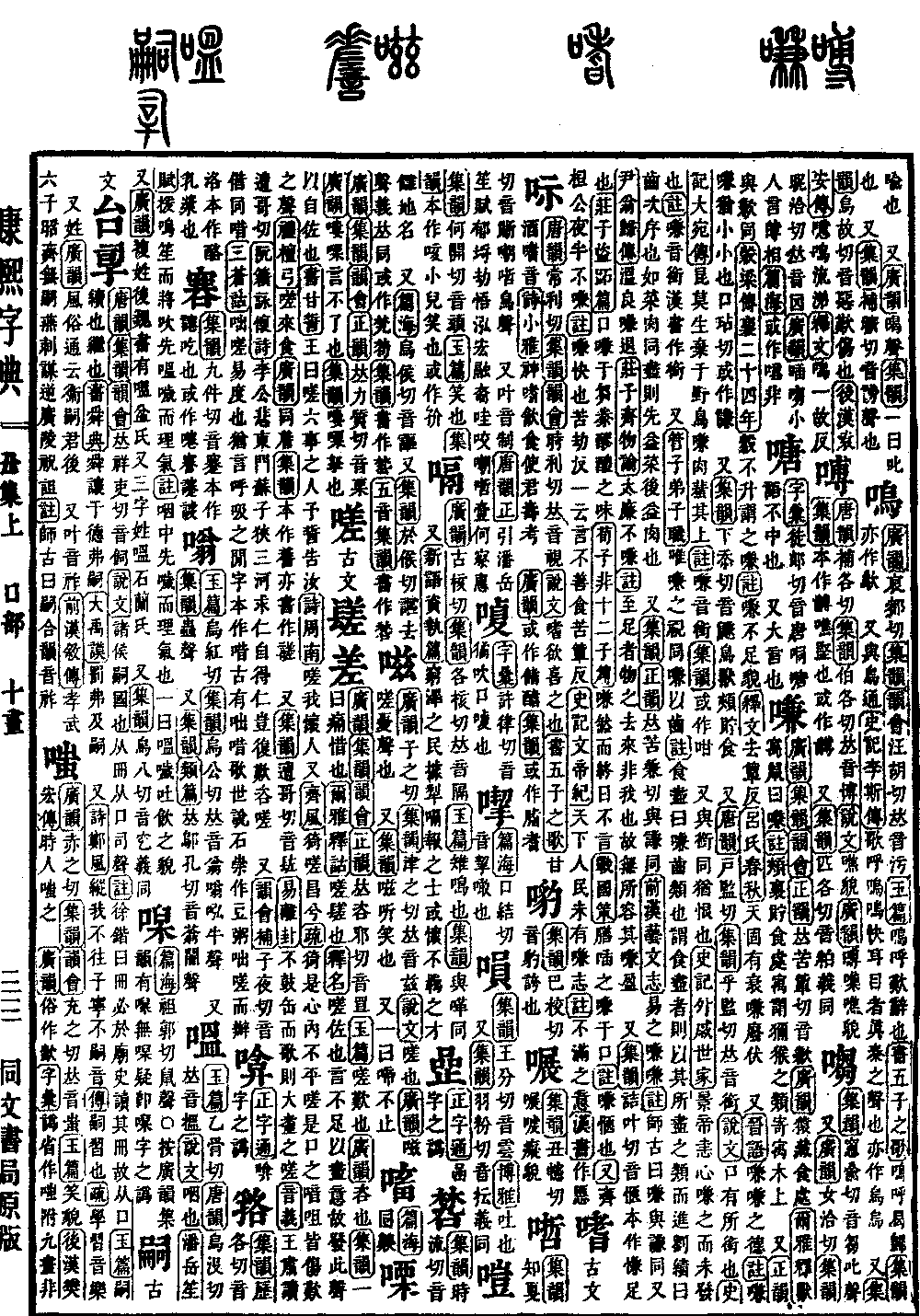
Chou Collection, Upper Volume
Radical: Mouth (kǒu)
13 strokes
Page 203, Entry 05
Pronounced qian (falling tone).
According to the Broad Rhymes (Guangyun), it is a place where monkeys store food.
According to the Erya: Explaining Beasts (Erya), it is called qian for a tree-dwelling rodent.
Note: It refers to the place inside the cheeks where food is stored. It refers to animals like macaques that dwell in trees.
Also, according to the Proper Rhymes (Zhengyun), it is the same as the character for deficient.
According to the Guliang Commentary: The Twenty-Fourth Year of Duke Xiang (Guliang Zhuan), a failure of the grain harvest is called qian.
Note: Qian means the appearance of being insufficient.
According to the Explanation of Texts (Shiwen), pronounced dian (falling tone).
According to the Spring and Autumn of Master Lu (Lushi Chunqiu), Heaven originally possesses decline, insufficiency, abandonment, and concealment.
Also, according to the Discourses of Jin (Jinyu), it refers to a small virtue.
Note: Qian-qian means small, like minor virtues. Pronounced dian (falling tone). Sometimes written as the character for humble.
Also, according to the Collected Rhymes (Jiyun), pronounced xian (dipping tone). It refers to birds and animals storing food in their cheeks.
Also, according to the Tang Rhymes (Tangyun) and Collected Rhymes (Jiyun), pronounced xian (rising tone).
According to the Explaining Graphs (Shuowen), it means to hold something in the mouth.
According to the Records of the Grand Historian: Account of Dayuan (Shiji), when Kunmo was born, he was abandoned in the wild, and a bird held meat in its beak and flew over him.
Note: Qian is pronounced xian.
According to the Collected Rhymes (Jiyun), sometimes written as the character for gan.
Also, it is the same as the character for bit/resentment.
According to the Records of the Grand Historian: Biographies of the Empress and Consorts (Shiji), Emperor Jing resented him in his heart but did not express it.
Note: Qian is pronounced xian, and in the Book of Han (Hanshu), it is written as the character for bit.
Also, according to the Guanzi: Duties of a Disciple (Guanzi), only look at those who have finished eating, and add more to those who have finished according to their age order.
Note: When food is finished, it is called qian. "Chi" refers to categories; it means that when people finish their food, one adds more based on the order in which they finished. Liu Ji said: "Chi" means order; for example, if vegetables and meat are finished at the same time, add the vegetables first and then the meat.
Also, according to the Collected Rhymes (Jiyun) and Proper Rhymes (Zhengyun), pronounced qian (level tone). It is the same as the character for humble.
According to the Book of Han: Treatise on Arts and Letters (Qian Hanshu), the humility of the Book of Changes (Yijing).
Note: Shigu said: Qian is the same as the character for humble.
Also, in the Biography of Yin Wengui, it means gentle and modest.
According to the Zhuangzi: Discussion on Making All Things Equal (Zhuangzi), true integrity does not manifest as humility.
Note: One who is most satisfied, regardless of whether things come or go, does not attribute it to oneself, so there is no space to contain his insufficiency or abundance.
Also, according to the Collected Rhymes (Jiyun), pronounced qie (falling tone). Originally written as the character for satisfied.
According to the Zhuangzi: Robber Zhi (Zhuangzi), the mouth is satisfied with the flavors of meat and wine.
According to the Xunzi: Against the Twelve Masters (Xunzi), satisfied and silent all day long.
According to the Strategies of the Warring States (Zhanguoce), the diet fits the palate.
Note: Qian means comfortable.
Also, regarding Duke Huan of Qi feeling unwell in the middle of the night.
Note: Qian means comfortable, pronounced jie (falling tone). One theory says it refers to not eating well, pronounced dian (falling tone).
According to the Records of the Grand Historian: Annals of Emperor Wen (Shiji), the common people under heaven did not yet have a satisfied heart.
Note: It means dissatisfied.
In the Book of Han (Hanshu), it is written as the character for satisfied.
Textual Research: In the Guliang Commentary: The Twenty-Fourth Year of Duke Xiang, "a failure of grain is called qian." According to the original text, one grain-related character has been added above the word grain. In the Strategies of the Warring States, "the qian of food in the mouth." According to the original text, the word "die" has been corrected to "dan."