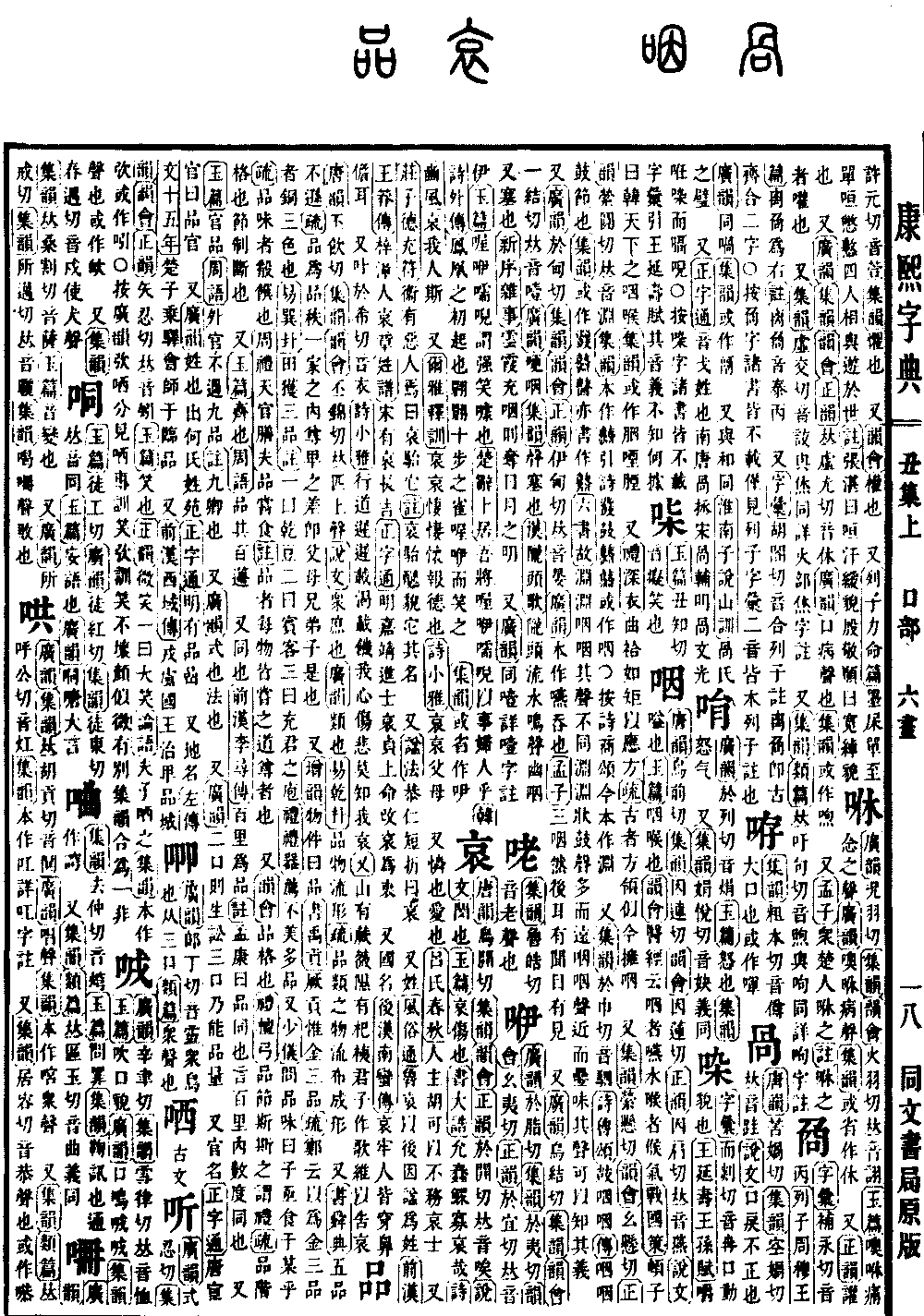
Chou Collection, Upper Volume
Radical: Mouth (kǒu)
Kangxi Strokes: 9
Page 188, Entry 12
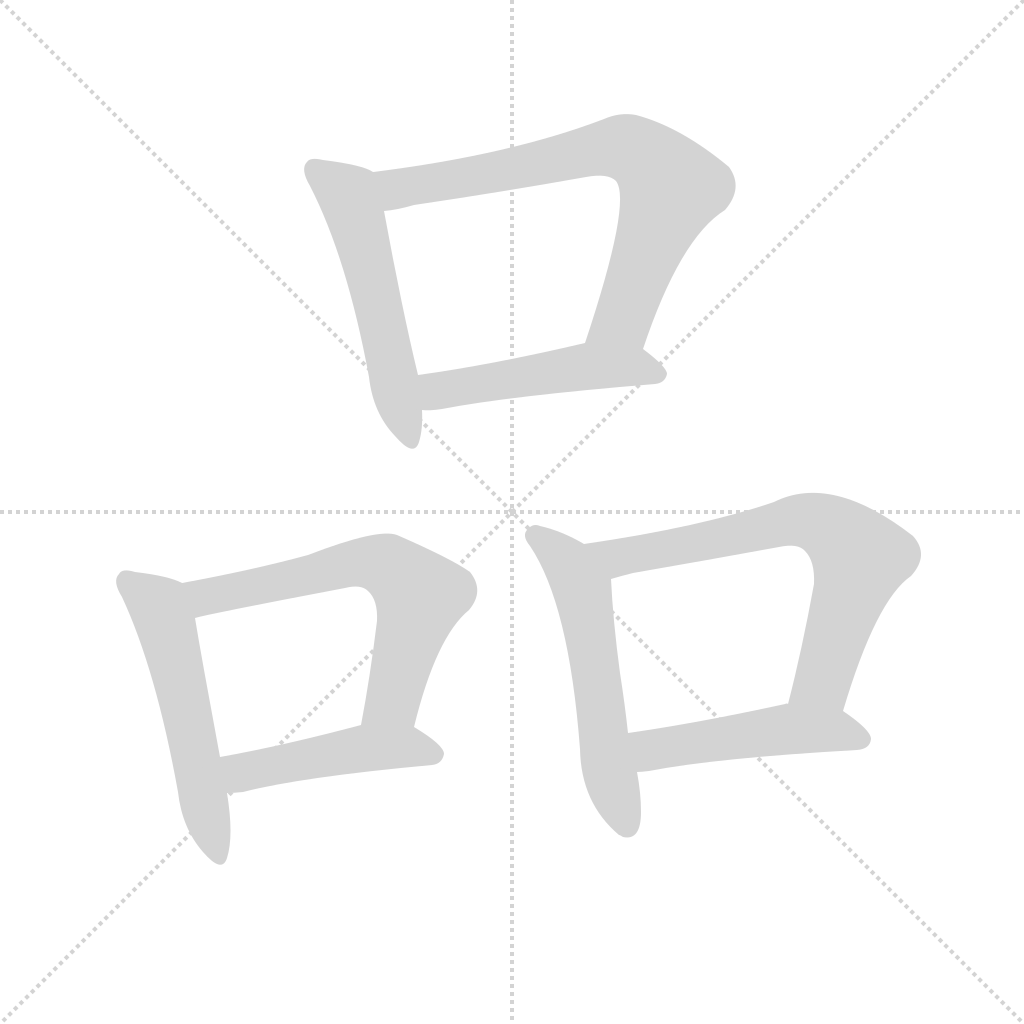
Pronounced pǐn (rising tone)
Shuowen Jiezi (Dictionary of Explanations of Characters): Refers to a multitude of people or things.
Guangyun (Broad Rhymes): Indicates categories.
Book of Changes (Yijing), Hexagram Qian: The myriad things flow into their respective categories and take form.
Commentary: Various things scatter and become physical forms.
Book of Documents (Shujing), Canon of Shun: The five types of ethical relationships are not in harmony.
Commentary: Pin refers to rank and order; the differences in status within a family, namely parents, siblings, and children.
Zengyun (Additional Rhymes): Objects are called pin.
Book of Documents (Shujing), Tribute of Yu: Its tribute consists only of three grades of metal.
Commentary: Zheng Xuan considers the three grades of metal to be the three colors of copper.
Book of Changes (Yijing), Hexagram Xun: Hunting results in three types of game.
Annotation: The first type is for sacrifice, the second is for entertaining guests, and the third is for stocking the ruler's kitchen.
Book of Rites (Liji), Ritual Vessels: Presenting sacrificial offerings does not depend on a multitude of types.
Shao Yi (Lesser Rituals): When asked about the types of food, the reply is: Do you often eat at such-and-such a place?
Commentary: Pinwei refers to the flavors of dishes and food.
Rites of Zhou (Zhouli), Offices of Heaven, Palace Chef: To taste food.
Annotation: Pin means to taste each item; this is a way of showing respect for food.
Yunhui (Collection of Rhymes): Refers to character or quality.
Book of Rites (Liji), Tan Gong: There is a standard of grade and restraint, and only this is called ritual.
Commentary: Pin refers to standards of rank, restraint, and judgment.
Yupian (Jade Chapters): Refers to orderliness.
Discourses of the States (Guoyu): To make the hundreds of bamboo utensils orderly.
Also refers to being the same.
Book of Han (Hanshu), Biography of Li Xun: Within a hundred li, they are of the same grade.
Annotation: Meng Kang says: Pin means the same, indicating that within a hundred li, the standards of measurement are identical.
Yupian (Jade Chapters): Refers to the rank of officials.
Discourses of the States (Guoyu): The officials outside the court do not exceed nine ranks.
Annotation: Refers to the Nine Ministers.
Guangyun (Broad Rhymes): Refers to style or standard.
Guangyun (Broad Rhymes): Two mouths will lead to litigation; only with three mouths can one evaluate and measure.
Also refers to an official title.
Zhengzitong (Correction of Characters): In the Tang dynasty, eunuchs were called pin officials.
Guangyun (Broad Rhymes): A surname. Originates from the Xingyuan (Garden of Surnames) by He Shi.
Zhengzitong (Correction of Characters): In the Ming dynasty, there was a person named Pin Yan.
Also refers to a place name.
Zuo Commentary (Zuozhuan), Sixteenth Year of Duke Wen: The ruler of the Chu state traveled by post-chaise and met at Pin to gather his troops.
Book of Han (Hanshu), Records of the Western Regions: The seat of government of the King of Ronglu was at Pin City.
Textual Research:
Book of Documents (Shujing), Tribute of Yu: Its tribute consists of three grades of metal.
Commentary: Zheng Xuan considers the three grades of metal to be the three colors of copper. Note: In the original text, Zheng Yun has been corrected to Zheng Xuan.
Zuo Commentary (Zuozhuan), Sixteenth Year of Duke Wen: The ruler of Chu traveled by post-chaise. Note: In the original text, the Fifteenth Year has been corrected to the Sixteenth Year, and the character for post-chaise has been corrected to its proper form.