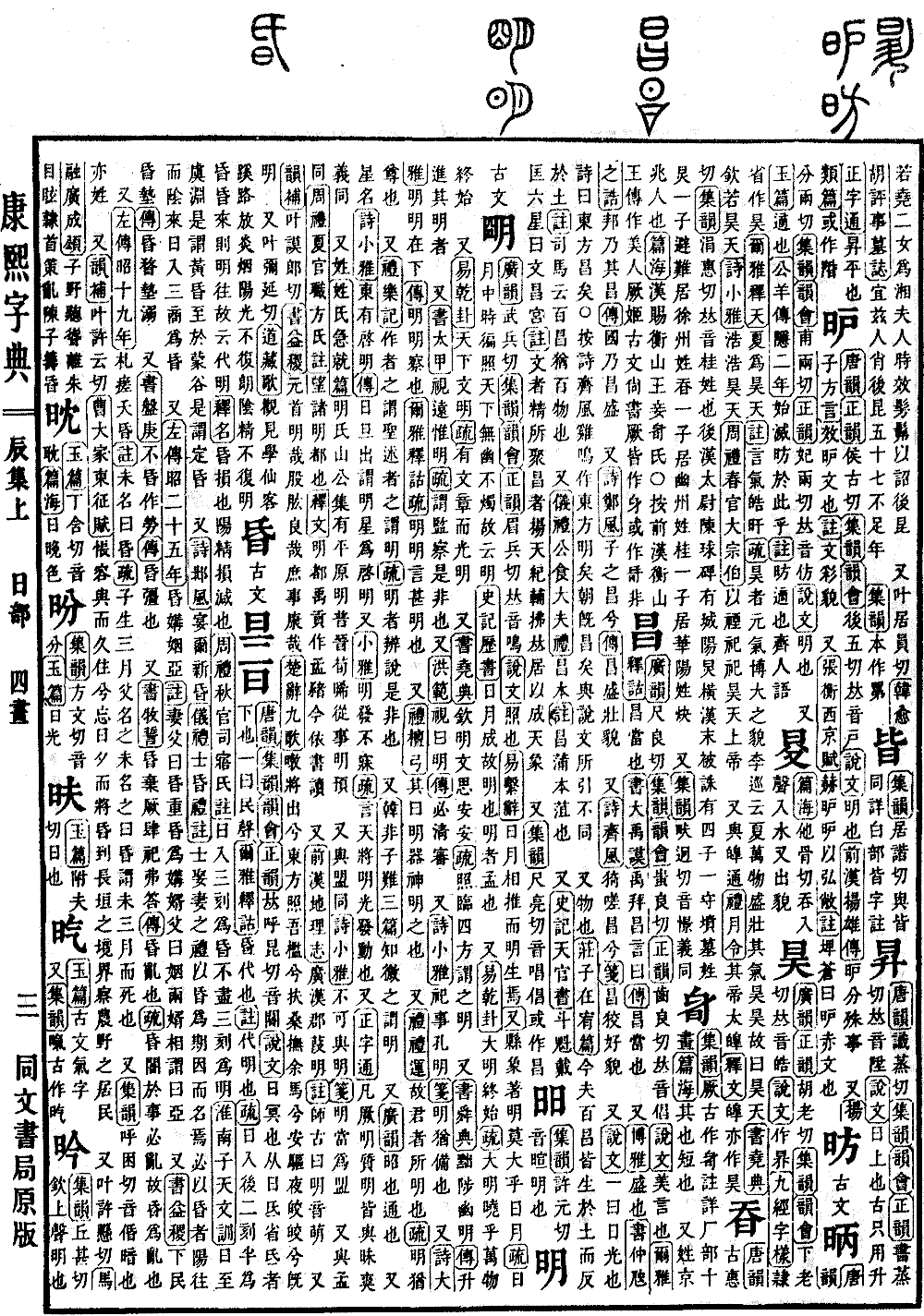
Chen Collection, Upper Volume
Radical: Sun (rì)
Page 491, Entry 12
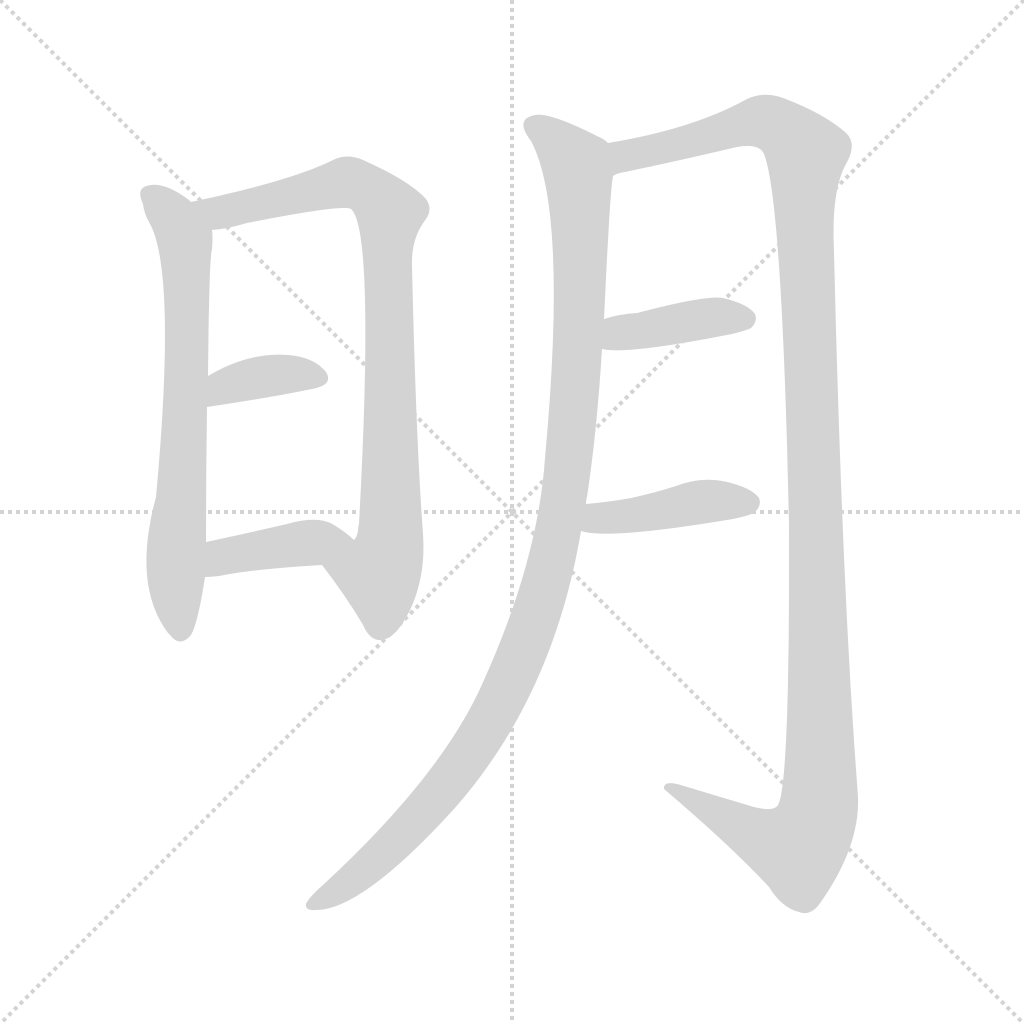
Ancient form written as (míng).
Guangyun (Guangyun) pronounced ming. Jiyun (Jiyun), Yunhui (Yunhui), and Zhengyun (Zhengyun) pronounced ming; rhymes with ming.
Shuowen Jiezi (Shuowen Jiezi) defines it as: to shine upon.
Book of Changes (Yijing), in the Commentary on the Appended Statements (Xici), says: When the sun and moon push and move each other, brightness is produced. It also says: Among all things that hang in the sky and display their brilliance, none are greater than the sun and the moon.
The Commentary (Shu) explains: When the sun and moon reside in the center of the sky, they shine over the entire world, and there is no dark corner left unilluminated; hence it is called bright.
Records of the Grand Historian (Shiji), in the Treatise on the Calendar (Lishu), says: The movement of the sun and moon forms patterns, so it is called bright. The meaning of bright is also beginning or great.
Also, the Book of Changes (Yijing), in the Qian Hexagram, says: Great brilliance pervades both the end and the beginning. The Commentary (Shu) explains: Great brilliance means understanding the principles of the end and beginning of all things.
Also, the Book of Changes (Yijing), in the Qian Hexagram, says: The world is refined and radiant. The Commentary (Shu) explains: To have refinement and patterns while being radiant.
Also, Book of Documents (Shangshu), in the Canon of Yao (Yaodian), says: (Emperor Yao was) reverent, intelligent, refined, and thoughtful, gentle and tolerant. The Commentary (Shu) explains: To shine upon and oversee the four quarters is called being intelligent.
Also, Book of Documents (Shangshu), in the Canon of Shun (Shundian), says: Remove the mediocre officials and promote the intelligent ones. The Commentary (Zhuan) explains: Elevate those who are intelligent.
Also, Book of Documents (Shangshu), in the Counsels of Gao Yao (Taijia), says: Only those who see far are called perceptive. The Commentary (Shu) explains: This refers to supervising and discerning right from wrong.
Also, Book of Documents (Shangshu), in the Great Plan (Hongfan), says: The duty of observation lies in perception. The Commentary (Zhuan) explains: It must be clear and prudent.
Also, Book of Odes (Shijing), in the Xiaoya, says: The sacrificial matters are very complete. The Notes (Jian) explain: Bright is like complete.
Also, Book of Odes (Shijing), in the Daya, says: Intelligent virtue is practiced below. The Commentary (Zhuan) explains: Bright and intelligent means to be perceptive.
The Erya (Erya), in the Commentary on the Explanation of Words (Shi gu shu), explains: The doubled word bright refers to being very perceptive.
Also, Book of Rites (Liji), in the Tan Gong, says: Those things called bright vessels (funerary objects) are treated as if they were vessels for the spirits.
Also, Book of Rites (Liji), in the Liyun, says: Therefore the ruler is respected by the people. The Commentary (Shu) explains: Bright is like respected.
Also, Book of Rites (Liji), in the Yueli, says: Those who create music are called sages, and those who expound upon it are called the enlightened. The Commentary (Shu) explains: An enlightened person is one who can discern and explain right and wrong.
Also, Han Feizi (Hanfeizi), in the Difficulties section, says: To be able to perceive subtle details is called being enlightened.
Also, Guangyun (Guangyun) defines it as: to be manifest, to be well-informed.
It is also the name of a star.
Book of Odes (Shijing), in the Xiaoya, says: In the east, there is the star of dawn. The Commentary (Zhuan) explains: The star called the bright star when the sun is about to rise is called the dawn star.
Also, Book of Odes (Shijing), in the Xiaoya, says: Until the sky is bright, one does not sleep. The Commentary (Shu) explains: This refers to the time when the sky is about to brighten and the light begins to appear.
Also, Zhengzitong (Zhengzitong) says: Whenever expressions like dawn appears or the morning clears are used, the meaning is the same as the break of dawn.
It is also a surname.
The Shixie Jijiepian (Shixie Jijiepian) and the Shanguji (Shanguji) record a person named Ming Pu from Pingyuan; among the subordinates of Xun Xi of the Jin dynasty, there was Ming Yu.
Also used as a variant for alliance (méng).
Book of Odes (Shijing), in the Xiaoya, says: One should not form an alliance with him. The Notes (Jian) state: The word bright here should be read as alliance.
Also used as a variant for great (mèng).
The Zhou Rites (Zhouli), in the Notes to the Office of the Summer Minister, mentions the area of Mengzhu. The Shiwenshu (Shiwenshu) says: Mingdu is written as Mengzhu in the Tribute of Yu (Yugong). Now, one should follow the reading in the Book of Documents (Shangshu).
Also, in the Book of Han (Hanshu), in the Treatise on Geography, there is a place called Jiaming in Guanghan Commandery. The Notes state: Yan Shigu says the word is pronounced meng.
Also, in the Rhyme Supplement (Yunbu), it is a rhyming variant, pronounced mo.
Book of Documents (Shangshu), in the Yi and Ji, chants: Oh, how enlightened the ruler is! How wise the ministers are! Everything is peaceful and healthy!
Songs of Chu (Chuci), in the Nine Songs (Jiuge), chants: The morning sun is about to rise in the east, shining on the hibiscus tree by my railing. Comforting my horse to walk slowly, the night is bright and the sky is already dawn.
Also a rhyming variant, pronounced mi.
The Daozangge (Daozangge) chants: Seeing those guests who study immortality, hot smoke rises on the small path. The sunlight is no longer bright, and the yin energy is no longer clear.