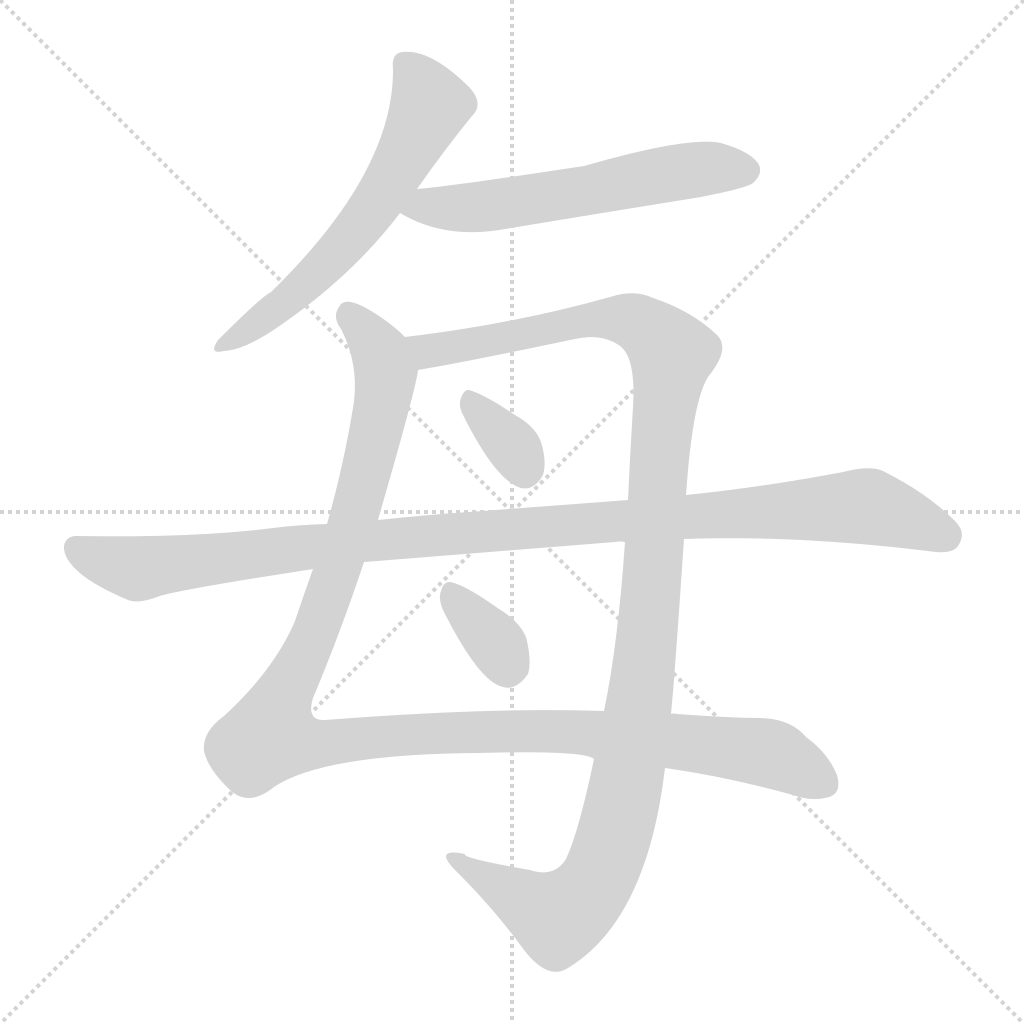
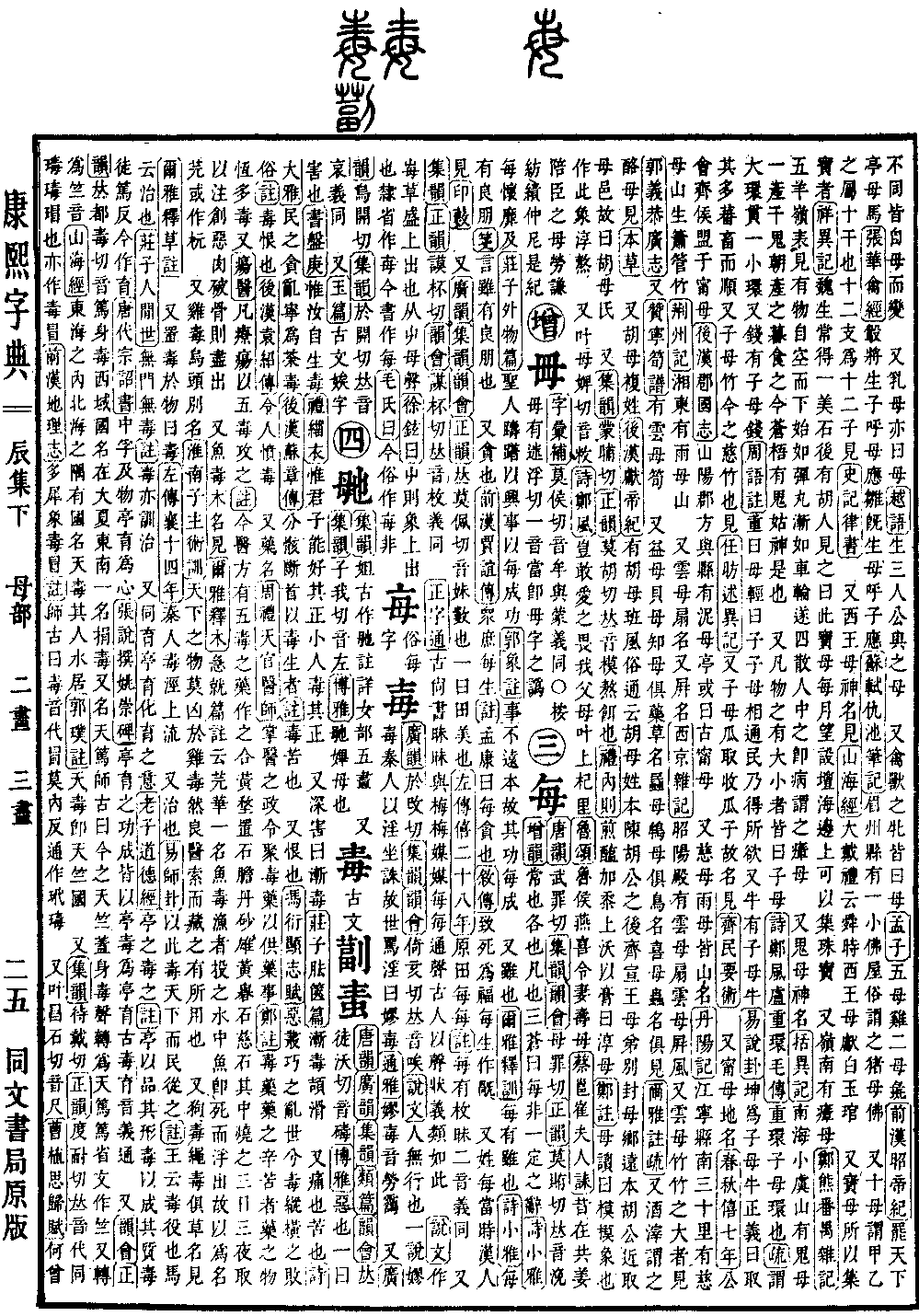
Chen Collection, Lower Volume
Radical: Nothing (wú)
Kangxi Strokes: 7
Page 589, Entry 02
Pronounced mei (falling tone).
Expanded Rhymes (Zengyun): Always, each, generally.
Sancang says: The term mei does not have a fixed definition.
Book of Odes (Shijing): I always yearn but cannot reach him.
Zhuangzi (Waiwu): The sage acts with hesitation, and therefore always succeeds.
Guo Xiang commentary: By not straying from the root in one's actions, achievements are always attained.
Also indicates although.
Erya (Shixun): Mei you means although there is.
Book of Odes (Shijing): Although there are good friends.
Jian commentary: Meaning although there are good friends.
Also indicates to covet.
History of the Former Han (Qian Han Shu), Biography of Jia Yi: The masses always covet life.
Commentary: Meng Kang says mei means to covet.
Xu Zhuan: To risk death is a blessing, to covet life is a disaster.
Also a surname.
Mei Dangshi, a person from the Han dynasty. Found in Yin Sou (Seal Registry).
Pronounced mei (falling tone).
Indicates frequency. One theory suggests it refers to fertile fields.
Zuo Commentary (Zuozhuan), Year 28 of Duke Xi: The original fields are lush and fertile.
Commentary: Mei has the pronunciations of mei and mei, with the same meaning.
Pronounced mei (level tone).
The meaning is the same.
Zhengzitong: In the ancient Book of Documents (Shangshu), the term mei-mei is phonetically interchangeable with mei-mei (as in plum), mei-mei (as in matchmaker), and mei-mei (as in every). The ancients used sound to categorize meaning in this way.
Shuowen Jiezi: Written as, it represents grass and trees growing lushly upwards. The character structure includes the radical for sprout with mu as the phonetic element.
Xu Xuan says: The sprout element represents the appearance of upward growth. In clerical script, it was simplified to the current form of mei.
Mao says: The common modern form is incorrect.