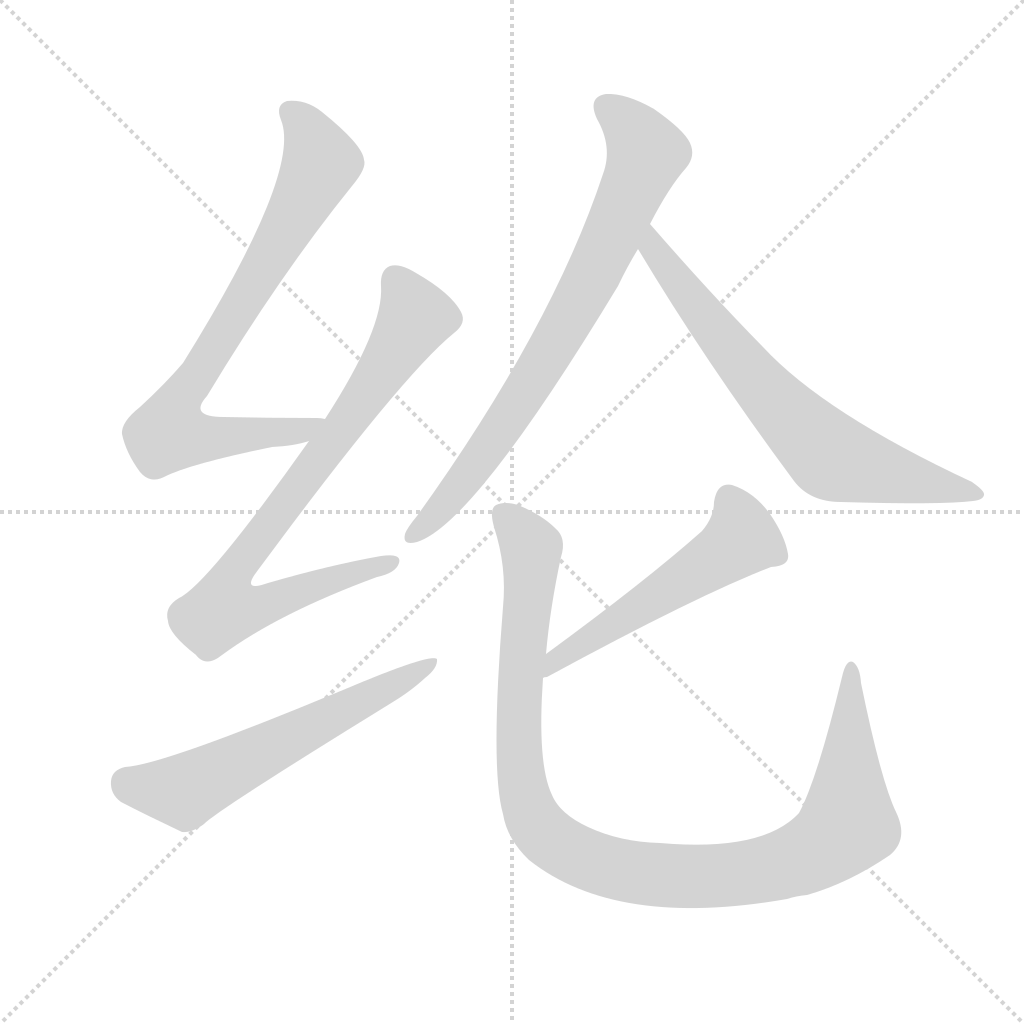
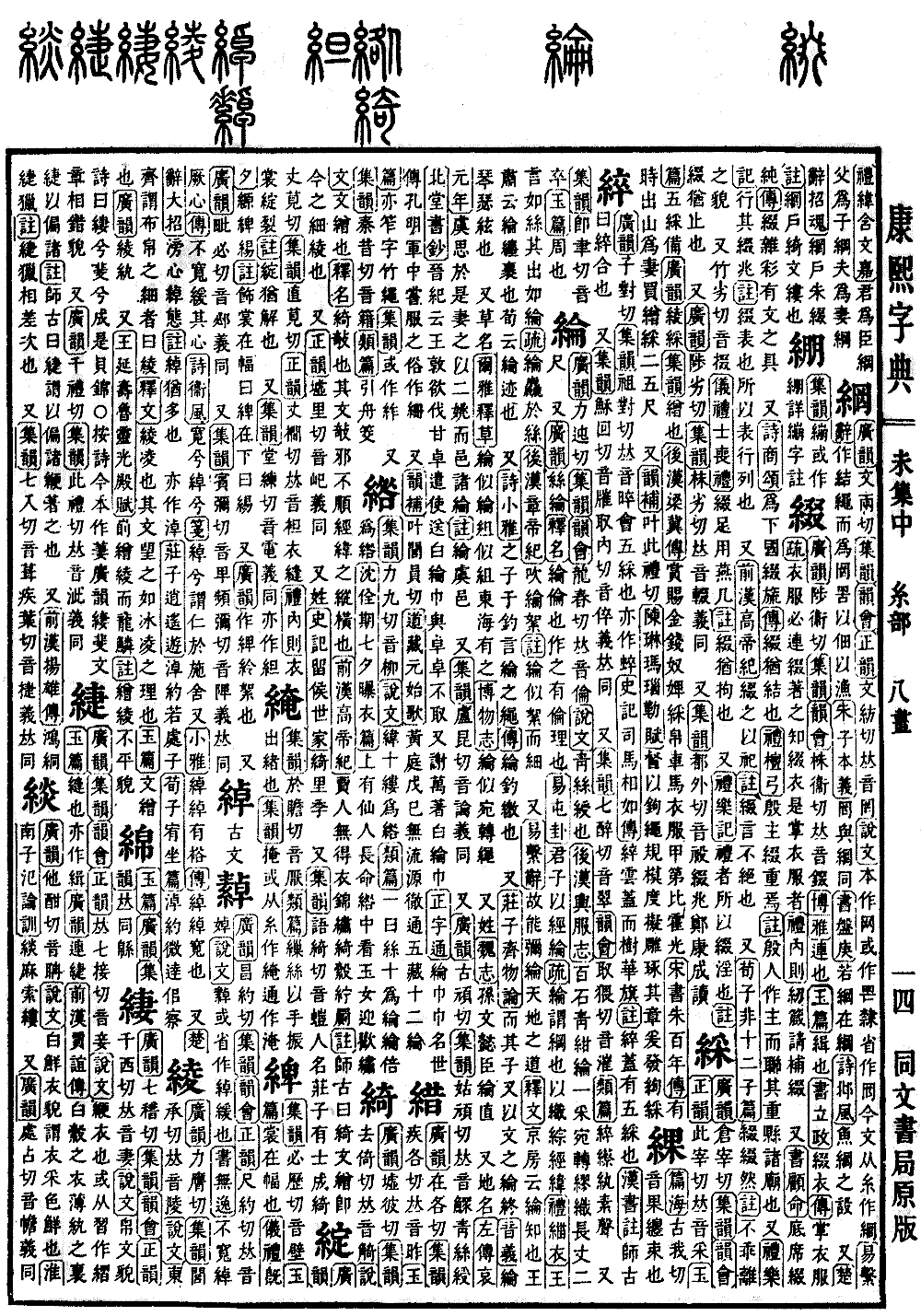
Wei Collection, Middle Volume. Radical: Silk (mì). Kangxi Stroke Count: 14. Page 928, Entry 01.
Guangyun: Pronounced lun. Jiyun and Yunhui: Pronounced lun, sound matches the character for ethical principles.
Shuowen Jiezi defines it as a blue silk sash.
History of the Later Han (Hou Hanshu): Records on Carriages and Attire: Officials with a salary of one hundred shi wore blue-purple silk sashes, a type of colored fabric woven with intricate, intertwining patterns, measuring twelve feet in length.
Additionally, Guangyun refers to silk threads or sashes.
Shiming explains: The term carries the meaning of order, as its production follows a specific, organized method.
Book of Changes (Yijing), Tun Hexagram: The noble person uses this to manage and plan (a metaphor for organizing state affairs).
The Commentary states: The term refers to governing principles, like the organization of warp and weft threads in weaving.
Book of Rites (Liji), Black Robes (Ziyi): The words of a king are as thin as silk, yet when disseminated, they become as thick as these silk cords.
The Commentary states: These cords are thicker than silk.
History of the Later Han (Hou Hanshu), Annals of Emperor Zhang: Mentions blowing on silk fiber.
The Annotation states: This material resembles silk fiber but is finer.
Additionally, the Book of Changes (Yijing), Appended Statements (Xici): Explains how one can encompass the principles of heaven and earth.
The Explanatory Text (Shiwen) records various interpretations: Jing Fang says it means to know. Wang Su says it means to wrap or entangle. Xun Shuang says it means a path or trajectory.
Additionally, the Book of Odes (Shijing), Lesser Odes (Xiaoya): Mentions a person going fishing and attaching the fishing line.
The Commentary states: This refers to a fishing line.
Additionally, the Zhuangzi, Discussion on Making All Things Equal (Qiwulun): Mentions a child finishing with a decorative silk cord.
The Pronunciation and Meaning (Yinyi) notes: This refers to the strings of a zither or lute.
It is also the name of a type of plant.
Erya, Explaining Plants (Shicao): States that this plant resembles the silk cord, while the zu plant resembles a woven ribbon. It is produced in the East Sea region.
The Record of Broad Observations (Bowuzhi) states: The plant resembles an intricately turned cord.
It is also a surname.
Records of the Three Kingdoms (Sanguozhi), History of Wei: Records a subject of Sun Wenyi named Lun Zhi.
It is also a place name.
Zuo Tradition (Zuo Zhuan), First Year of Duke Ai: Records that Yu Si married two women of the Yao clan to him and granted him the territory of Lun as a fief.
The Annotation states: Lun was a walled city of the state of Yu.
Additionally, Jiyun: Pronounced lun, same as the character for discourse. The meaning is the same.
Additionally, Guangyun: Pronounced guan. Jiyun: Pronounced guan. Refers to a blue silk sash.
Beitang Shuchao cites the Jin Annals: Wang Dun wished to suppress Gan Zhuo and sent him a white silk headscarf, but Gan Zhuo did not accept it. It also records that Xie Wan once wore a white silk headscarf.
Zhengzitong explains: A silk headscarf is a type of headwear. Legend says Zhuge Liang wore one while in the army. Commonly written in a variant form.
Additionally, Yunbu: Rhymes with the sound yuan.
Daoist Canon (Daozang), Song of the Primordial Beginning: States that the yellow court has no source of flow, thoroughly connecting the five viscera and the twelve pathways.