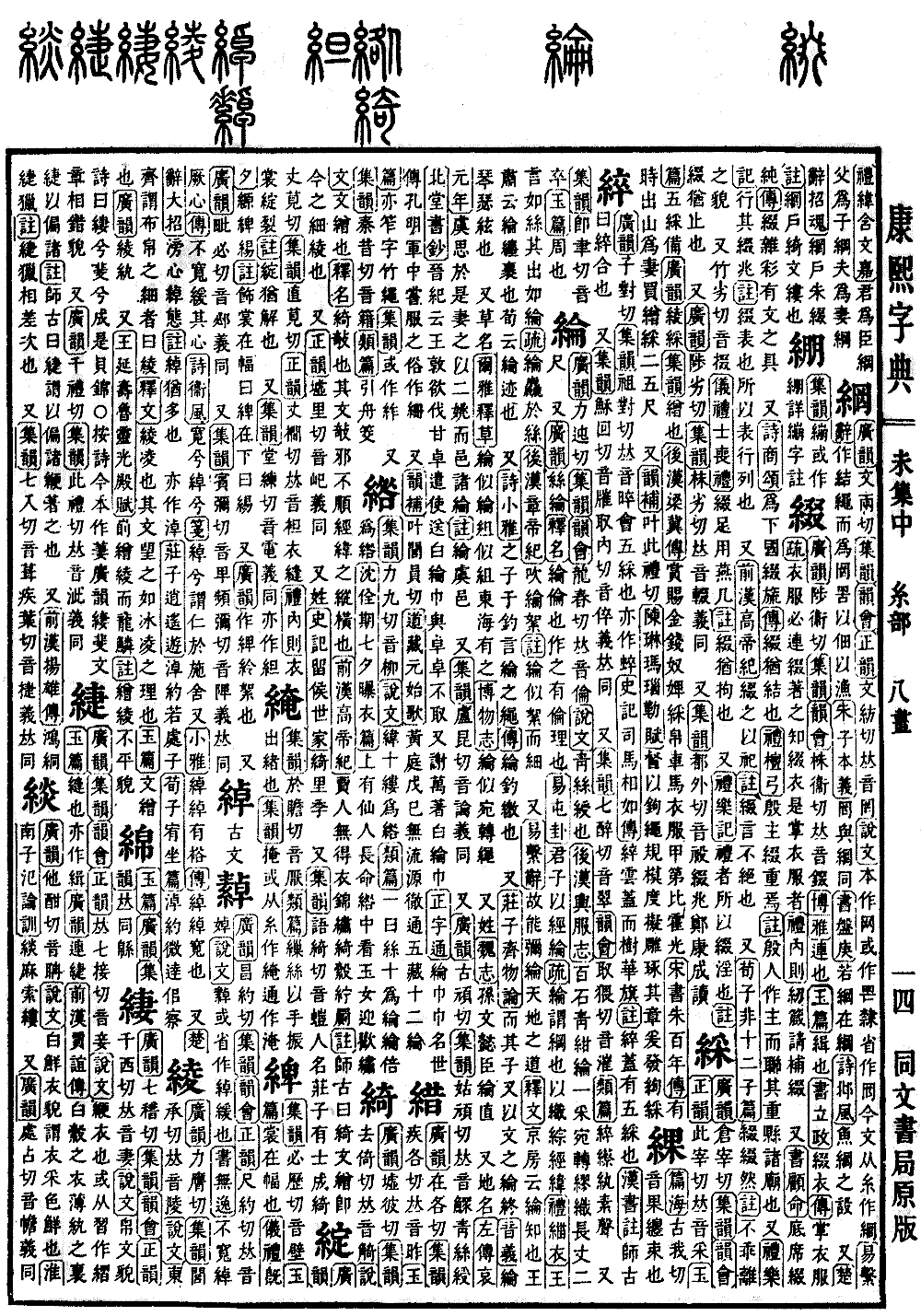
Wei Collection, Middle Volume
Radical: Silk (mì)
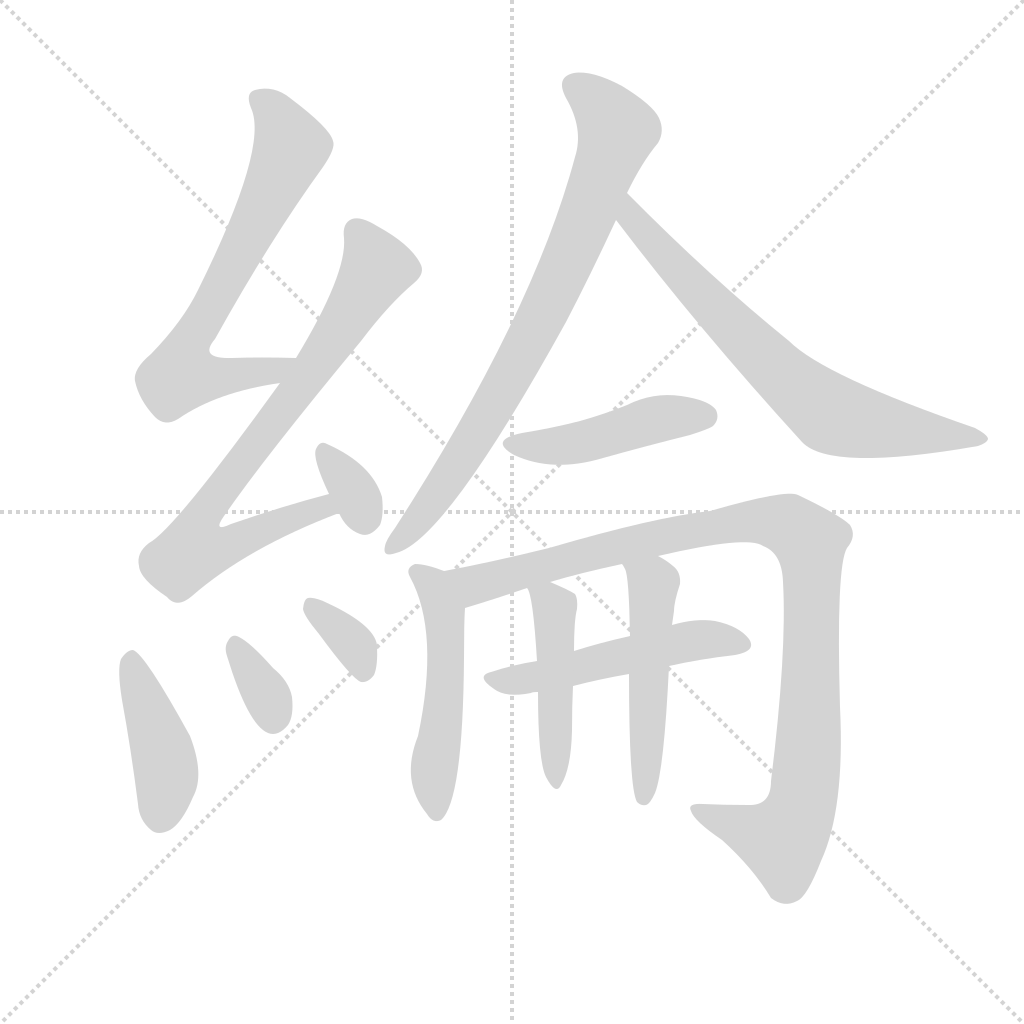
Character: Lun
Kangxi stroke count: 14
Page 928, Entry 07
Pronounced lun.
According to the Book of Diverse Sounds (Guangyun), the Book of Collected Rhymes (Jiyun), and the Rhyme Compilation (Yunhui), the sound is lun.
As defined in the Explanation of Simple and Compound Characters (Shuowen), it refers to a blue silk ribbon.
According to the Treatise on Carriages and Clothing in the History of the Later Han (Hou Hanshu), officials with a salary of one hundred shi wore blue and dark blue ribbons, woven in a winding pattern and measuring twelve feet in length.
Also, according to the Book of Diverse Sounds (Guangyun), it refers to silk threads.
In the Explanation of Names (Shiming), it is stated: Lun means order, signifying that the creation of it follows an orderly principle.
In the Book of Changes (Yijing), Hexagram Tun: The superior man organizes and manages. The commentary notes: Lun means the guiding cords, used to organize the weaving of the warp and weft.
In the Book of Rites (Liji), Ziyi chapter: The king's words are like silk; what he issues is like a thick cord. The commentary notes: Lun is coarser than silk.
In the Annals of Emperor Zhang in the History of the Later Han (Hou Hanshu), it mentions blowing on lun-floss. The commentary notes: Lun resembles floss but is finer.
Also, in the Book of Changes (Yijing), Xici chapter: Therefore it can encompass and organize the way of heaven and earth.
The Interpretation of the Text (Shiwen) cites Jing Fang as saying: Lun means to know. Wang Su says: Lun means to wrap around. Xun says: Lun means traces.
Also, in the Book of Odes (Shijing), Xiaoya section: This man goes fishing; he uses a lun to make a line. The commentary notes: Lun refers to a fishing cord.
Also, in the Zhuangzi, Qiwu Lun chapter: And his son finished it with the lun of a literary composition. The Pronunciation and Meaning (Yinyi) notes: Lun refers to the strings of a zither or lute.
Also, a type of grass.
In the Erya, Explanation of Plants (Shicao): Lun looks like lun, and zu looks like zu. It is found in the East Sea.
The Record of Investigations of Natural Objects (Bowuzhi) states: Lun resembles a winding rope.
Also, a surname.
In the Records of Wei (Weizhi): Sun Wenyi had a subject named Lun Zhi.
Also, a place name.
In the Zuo Commentary (Zuozhuan), first year of Duke Ai: Yu Si gave him two women of the Yao clan as wives and settled him in the city of Lun. The commentary notes: Lun was the city of the Yu state.
Also, according to the Book of Collected Rhymes (Jiyun), pronounced lun. The meaning is the same.
Also, according to the Book of Diverse Sounds (Guangyun), pronounced guan. Refers to a blue silk ribbon.
In the Beitang Shuchao: The Annals of Jin state: Wang Dun wanted to attack Gan Zhuo and sent an envoy to deliver a white silk headband to Zhuo, but Zhuo would not accept it. Also, Xie Wan wore a white silk headband.
The Zhengzitong states: A silk headband is a type of head covering. Tradition holds that Zhuge Liang often wore one in the army. Commonly written as a variant form.
Also, according to the Rhyme Supplement (Yunbu), rhymes with lüanyuan.
In the Daoist Canon (Daozang), Yuanshi Ge: In the yellow court of the central earth, there is no flowing source; it penetrates the five viscera and the twelve lun.