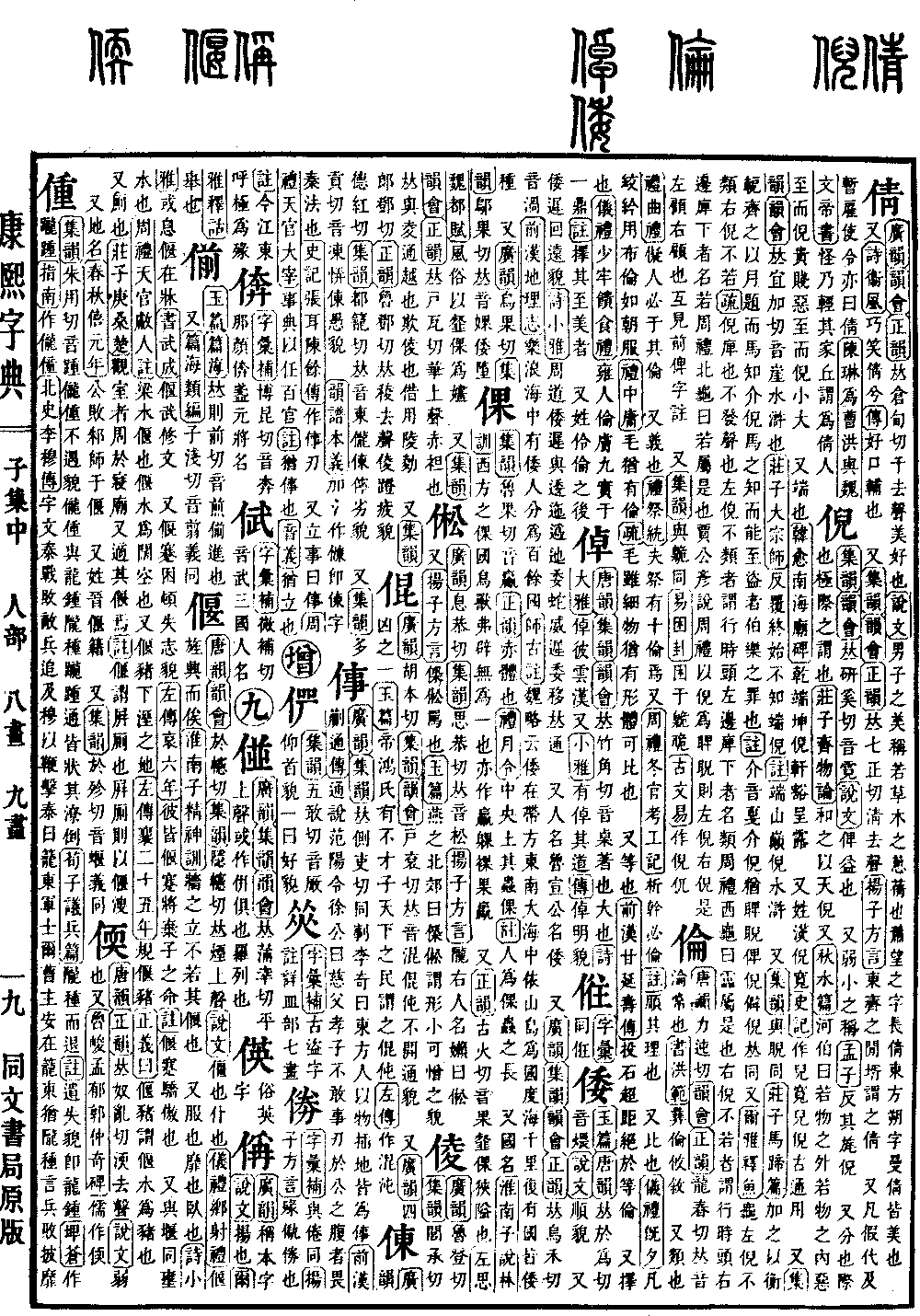
Zi Collection, Middle Volume. Radical: Person (rén). Kangxi stroke count: 10. Page 109, Number 03. According to the Tang Dictionary of Rimes (Tangyun), the pronunciation is a combination of li and zhun. According to the Collected Rimes (Yunhui) and Correct Rimes (Zhengyun), it is a combination of long and chun. The character is pronounced lun. It refers to eternal principles or regularities. "The eternal principles are thus arranged" — Book of Documents (Shangshu). It also refers to category or being of the same kind. "When comparing a person, one must do so with those of the same kind" — Book of Rites (Liji). It also means principle or significance. "In the sacrificial rites, there are ten principles" — Book of Rites. It is also used in the Records of Examination of Crafts (Kaogongji) section of the Rites of Zhou (Zhouli): "When splitting the wood for a bow, one must follow the grain." Commentary: Following its grain. It also means to compare or draw an analogy. "For all bindings and shrouds, use cloth comparable to that of court dress" — Book of Etiquette and Ceremonies (Yili). "Even a hair has something comparable" — Doctrine of the Mean (Zhongyong). Sub-commentary: Although a hair is a minute thing, it still has a form that can be compared. It also refers to rank or peers. "In stone throwing and long jumping, he surpassed all his peers" — History of the Former Han (Qian Hanshu). It also means to select or choose. "The cook selects nine pieces of skin and meat to place in a tripod" — Book of Etiquette and Ceremonies. Commentary: Selecting the best among them. It is also a surname, representing the descendants of Ling Lun.