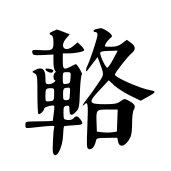
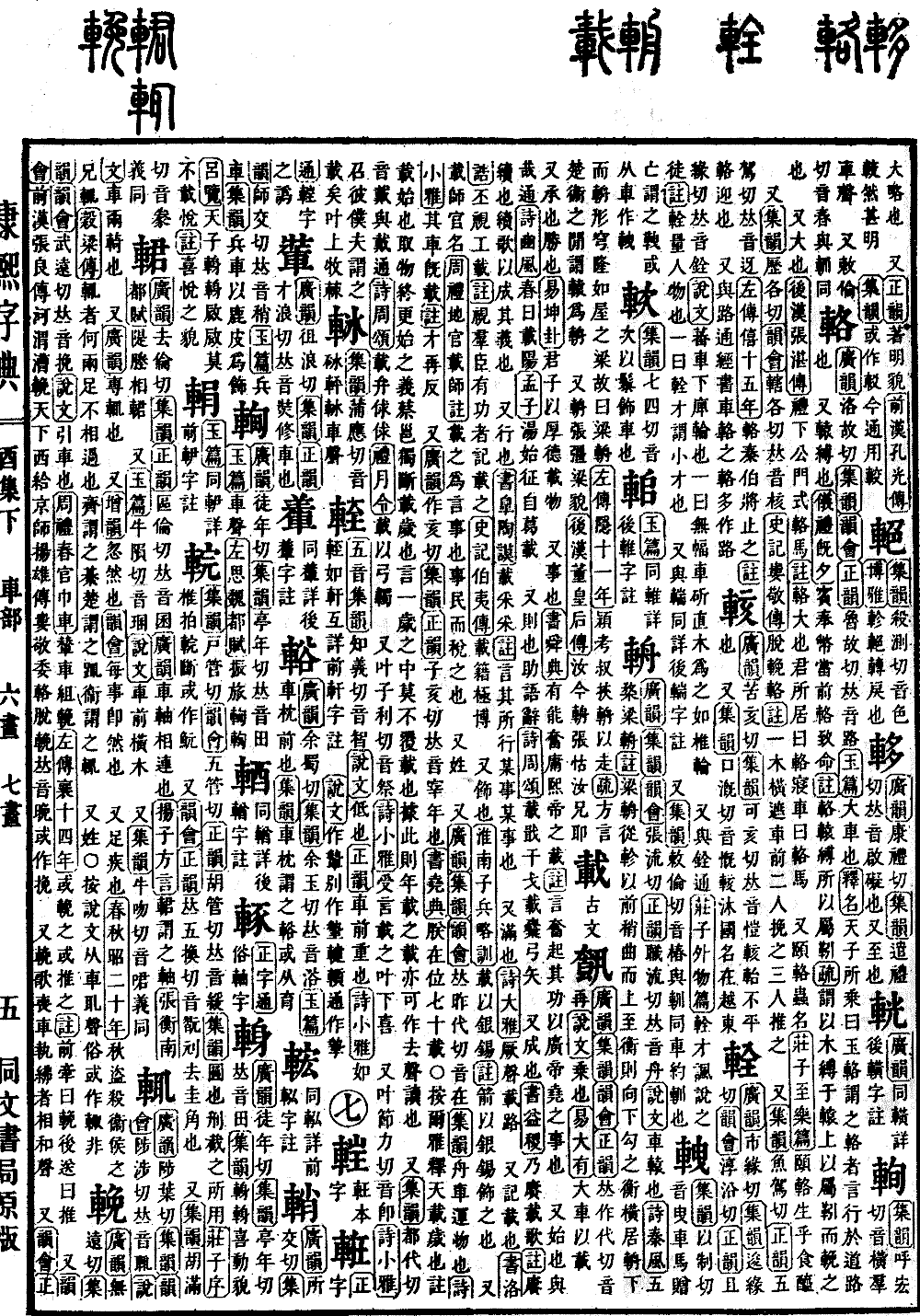
You Collection, Lower Volume
Radical: Carriage (chē)
Kangxi strokes: 13
Page 1243, Entry 05
Guangyun (Dictionary of Rhymes) pronunciation: luo. Jiyun (Compilation of Rhymes), Yunhui (Collection of Rhymes), and Zhengyun (Correct Rhymes) pronunciation: lu. Pronounced lu.
Yupian (Jade Chapters) defines it as a large carriage.
Shiming (Explanation of Names) states: The carriage ridden by the Son of Heaven is called a jade lu. It is called a lu because it travels upon the road.
Also refers to a binding on the carriage shaft.
Yili (Book of Etiquette and Ceremonial): The guest holds the silk offering, stands before the carriage shaft, and conveys the mission.
Annotation: Lu refers to the binding on the shaft used to attach the pulling ropes.
Commentary: Refers to wood bound to the shaft used to connect the pulling ropes to draw the carriage.
Also carries the meaning of big.
Hou Hanshu (Book of the Later Han): One should lean on the crossbar and lower the head when passing the official gate to show respect to the horses of a large carriage.
Annotation: Lu means big. The place where the ruler resides is called a lu, and the carriage used for traveling to the sleeping quarters is called a lu carriage.
Also refers to a type of insect.
Zhuangzi (Master Zhuang), chapter Zhi Le: The insect grows in vinegar.
Also, Jiyun and Yunhui pronunciation: he. Pronounced he.
Shiji (Records of the Grand Historian), Biography of Lou Jing: Lower the horizontal wooden bar of the carriage.
Annotation: A piece of wood placed horizontally in front of the carriage, pulled by two men and pushed by three.
Also, Jiyun and Zhengyun pronunciation: ya. Pronounced ya.
Zuo Zhuan (Commentary of Zuo), 15th Year of Duke Xi: To welcome the Earl of Qin, intending to detain him.
Annotation: Lu means to welcome.
Also interchangeable with the character for road. In the classics, the lu in the term for carriage is often written as the character for road.
Critical Research: In Yili (Book of Etiquette and Ceremonial), regarding the guest holding offerings and standing before the shaft to convey a mission, the annotation says the shaft binding is for attaching pulling ropes, and the commentary explains it as wood bound to the shaft to attach the ropes for pulling. The character for pulling rope has been corrected to the standard form. In the Hou Hanshu (Book of the Later Han), regarding the ritual of lowering the head at the official gate and leaning on the crossbar for the carriage horses, the annotation notes that the term means big, and the residence of the ruler and the carriage of the sleeping quarters are designated accordingly. The term has been corrected to refer to the carriage crossbar and carriage frame.