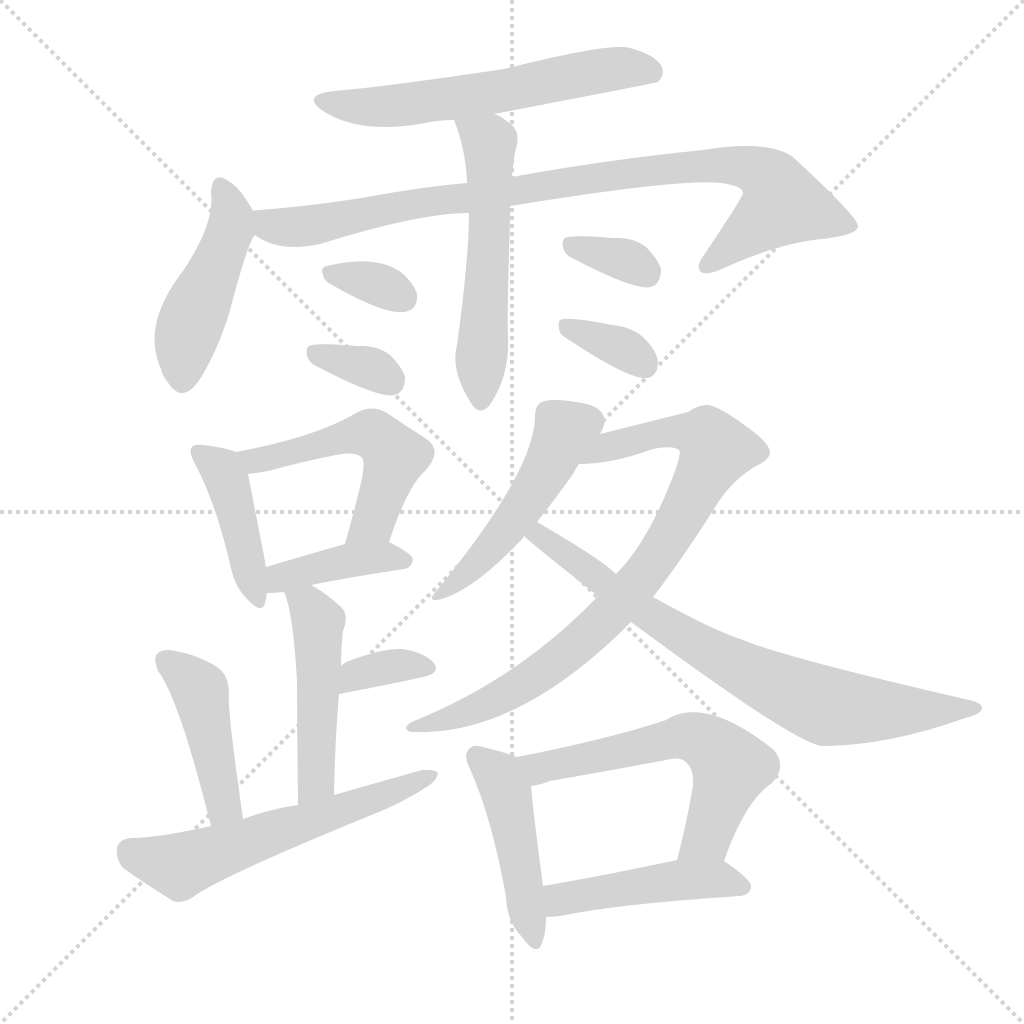
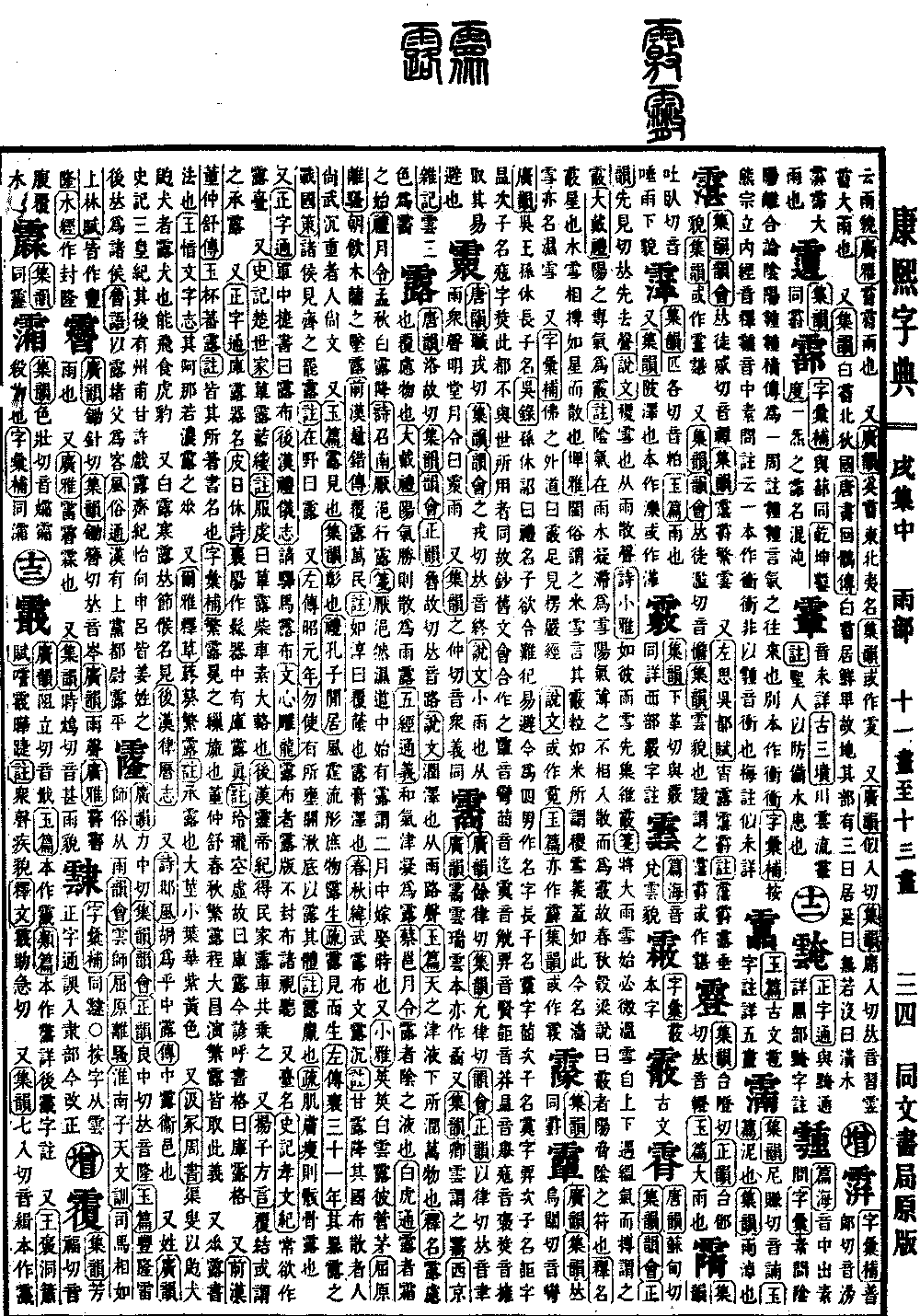
Xu Collection, Middle Volume
Radical: Rain (yǔ)
Kangxi Strokes: 20
Page 1378, Entry 22
Tang Rhymes (Tangyun): Pronounced luo. Collected Rhymes (Jiyun), Rhyme Compendium (Yunhui), and Orthodox Rhymes (Zhengyun): Pronounced lu, with the same reading as the character for road.
Analytical Dictionary of Characters (Shuowen Jiezi): Defined as the meaning of moistening. The character structure is formed by the radical for rain and the phonetic for road.
Jade Chapters (Yupian): Defined as the liquid essence of the heavens, which descends to moisten and nourish all things.
Explanations of Names (Shiming): Defined as the character for dew having the sense of consideration, representing something that covers and moistens objects.
Book of Confucian Rites by Dai the Elder (Da Dai Liji): Records: When the solar energy (yang) is flourishing, it radiates to become rain and dew.
General Principles of the Five Classics (Wujing Tongyi): Defined as the condensation of harmonious energy into liquid essence, which is dew.
Cai Yong's Monthly Ordinances (Cai Yong Yue Ling): Defined as dew being the liquid form of shadow energy (yin).
White Tiger Hall Discussions (Baihu Tong): Defined as dew being the beginning of frost.
Book of Rites (Liji), Monthly Ordinances: Records: In the first month of autumn, white dew descends.
Book of Odes (Shijing), Odes of Zhao: Contains the line, "Soaking and wet is the dew on the road." Zheng Xuan's commentary explains: The road is damp and dew has begun to form; this refers to the marriage season in the second month of the lunar calendar.
Also, Book of Odes (Shijing), Odes of Xiao Ya: Contains the line, "Bright and brilliant are the white clouds, drenching the cogon grass."
Qu Yuan, Songs of the South (Lisao): Contains the line, "In the morning I drink the fallen dew of the magnolia."
History of the Former Han (Qian Hanshu), Biography of Chao Cuo: Contains the expression "covering and moistening the ten thousand people." Commentary: Ru Chun explains: Covering means to shelter. Moistening means to bestow grace.
Apocryphal Texts of the Spring and Autumn Annals (Chunqiu Wei): Records: Military dew is scattered; scholarly dew is deep. Commentary: If sweet dew descends on a state and is scattered, the people of that state value martial strength; if it is heavy and thick, the people value scholarly virtue.
Also, Jade Chapters (Yupian): Defined as having the meaning of appearing.
Collected Rhymes (Jiyun): Defined as the meaning of manifesting.
Book of Rites (Liji), Master Kong's Idle Living: Contains the line, "Wind and thunder flow and take shape, and the myriad things are revealed and grow." Kong Yingda's sub-commentary explains: To be revealed and to grow.
Zuo Tradition (Zuo Zhuan), 31st Year of Duke Xiang: Contains the line, "Exposing them to the elements."
Stratagems of the Warring States (Zhanguoce): Contains the line, "The feudal lords saw that Qi was exhausted and exposed." Commentary: Being in the open field is called "lu" (exposure).
Also, Zuo Tradition (Zuo Zhuan), 1st Year of Duke Zhao: Contains the line, "Do not let it be blocked or stagnate, so as to expose the body." Commentary: Exposure here means thin or emaciated. Kong Yingda's sub-commentary explains: If the skin and muscles are emaciated, then the bones are revealed.
Also, Correct Character Compendium (Zhengzitong): Records: Military victory reports are called "lu-bu" (manifest banners).
History of the Later Han (Hou Hanshu), Treatise on Ritual: Contains the record, "Requesting relay horses to carry a manifest banner."
The Literary Mind and the Carving of Dragons (Wenxin Diaolong): Explains the term "lu-bu": It is a document sent without a seal, openly announced for everyone to see and hear.
Also refers to the name of a terrace.
Records of the Grand Historian (Shiji), Basic Annals of Emperor Xiaowen: Records: Once wanted to build a Dew Terrace.
Also, Records of the Grand Historian (Shiji), House of Chu: Contains the phrase "wearing rough clothes and driving a rustic cart." Commentary: Fu Qian explains: "Bi-lu" refers to a cart made of brushwood, a simple vehicle without decoration.
History of the Later Han (Hou Hanshu), Annals of Emperor Ling: Records: Obtained rustic carts from the common people to ride in together.
Also, Yang Xiong's Dialects (Fangyan): Records: A style of knotted hair is called "holding the dew" in some regions.
Also, Correct Character Compendium (Zhengzitong): Records: "Ku-lu" is the name of a type of object.
Pei Rixiu's Poetry: Contains the line, "Xiangyang produces lacquered ware, containing true ku-lu." Commentary: Because the object is hollow and exquisite, it is called "ku-lu." Today, common parlance calls bookshelves "ku-lu shelves."
Also, History of the Former Han (Qian Hanshu), Biography of Dong Zhongshu: Mentions "Jade Cup and Lush Dew." Commentary: Both are titles of books he authored.
Character Collection Supplement (Zihui Bu): Explains: "Fan-lu" refers to the jade strings hanging from the imperial crown. Dong Zhongshu's Luxuriant Gems of the Spring and Autumn (Chunqiu Fanlu) and Cheng Dachang's Elucidation of the Luxuriant Gems (Yan Fanlu) both take their names from this.
Also, "lu" is a type of calligraphy brushwork.
Wang Yin's Records of Writing (Wenzhizhi): Records: That flowing, graceful style is like heavy dew.
Also, Er Ya, Explanations of Grasses: Records: "Zhong-kui" is also called "fan-lu." Commentary: This is the same as "holding the dew," having thick stems, small leaves, and purple-yellow flowers.
Also, Bamboo Annals (Jizhu Zhoushu): Records: The tribe of Qu Sou offered a dog as tribute. This dog is a "dew dog." It can fly and eats tigers and leopards.
Also, "White Dew" and "Cold Dew" are names of solar terms. Found in History of the Later Han (Hou Hanshu), Treatise on Calendars and Laws.
Also, Book of Odes (Shijing), Odes of Bei: Contains the line, "Why am I in the middle of the dew?" Mao's commentary explains: "Middle of the Dew" is the name of a city in the state of Wei.
Also a surname.
Broad Rhymes (Guangyun): Records: The Records of the Grand Historian, Annals of the Three Sovereigns, says that among his descendants were the states of Zhou, Fu, Gan, Xu, Xi, Lu, Qi, Ji, Yi, Xiang, Shen, and Lü; all were descendants of the Jiang clan who became feudal lords.
Discourses of the States (Guoyu), Lu Discourses: Records: Used Lu Du-fu as a guest minister.
Customs and Traditions (Fengsutong): Records: In the Han dynasty, there was an Assistant Commandant of Shangdang named Lu Ping.