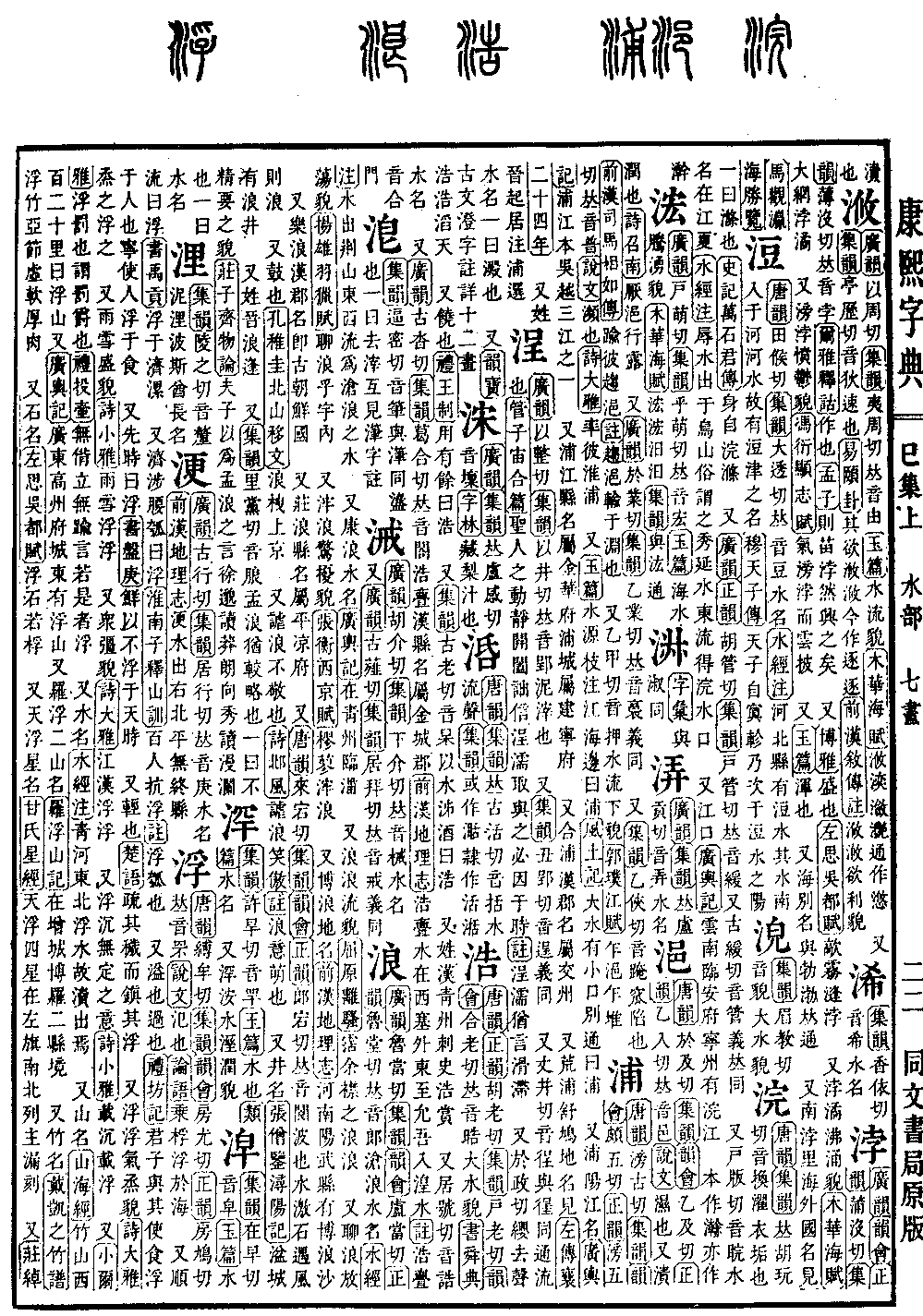
Si Collection, Upper Volume
Radical: Water (shuǐ)
Kangxi Strokes: 11
Page 624, Entry 18
Pronounced láng. Canglang, the name of a river. Commentary on the Water Classic (Shuijing Zhu): The water flows out from Jing Mountain, flowing east and west to become the Canglang River.
Also, Kanglang, the name of a river. Expanded Record of the World (Guangyuji): Located in Linzi, Qingzhou.
Also, langlang, the appearance of flowing. Chu Ci (Laisao): The tears wetting my lapels flow unceasingly.
Also, liaolang, the appearance of being unrestrained. Yang Xiong (Yulie Fu): Rambling unrestrainedly between heaven and earth.
Also, shuolang, the appearance of being agitated. Zhang Heng (Xijing Fu): Plants and trees intermingling and swaying in agitation.
Also, Bolang, a place name. History of the Former Han (Qianhan Dili Zhi): Bolangsha is located in Yangwu County, Henan.
Also, Lelang, the name of a commandery during the Han Dynasty, which refers to the ancient state of Korea.
Also, Zhuanglang, the name of a county belonging to Pingliang Prefecture.
Also pronounced làng. Waves. Water striking rocks when encountering wind creates waves.
Also, to stir or incite. Kong Zhigui (Beishan Yiwen): Recklessly rowing toward the capital.
Also, to be lewd or unrestrained, lacking decorum. Book of Odes (Shijing), Beifeng: Playing and laughing in an unrestrained manner. Commentary: Lang refers to the stirring of the heart.
Also, the name of a well. Zhang Sengjian (Xunyang Ji): There is a Lang Well in Penchen.
Also, a surname. There was a Lang Feng in the Jin Dynasty.
Also pronounced lǎng. Menglang, meaning generally or loosely. One interpretation is that it signifies something imprecise or inconsequential. Zhuangzi (Qiwulun): The master considers them to be rough and inappropriate remarks. Xu Miao reads it as manglang, and Xiang Xiu reads it as manlan.