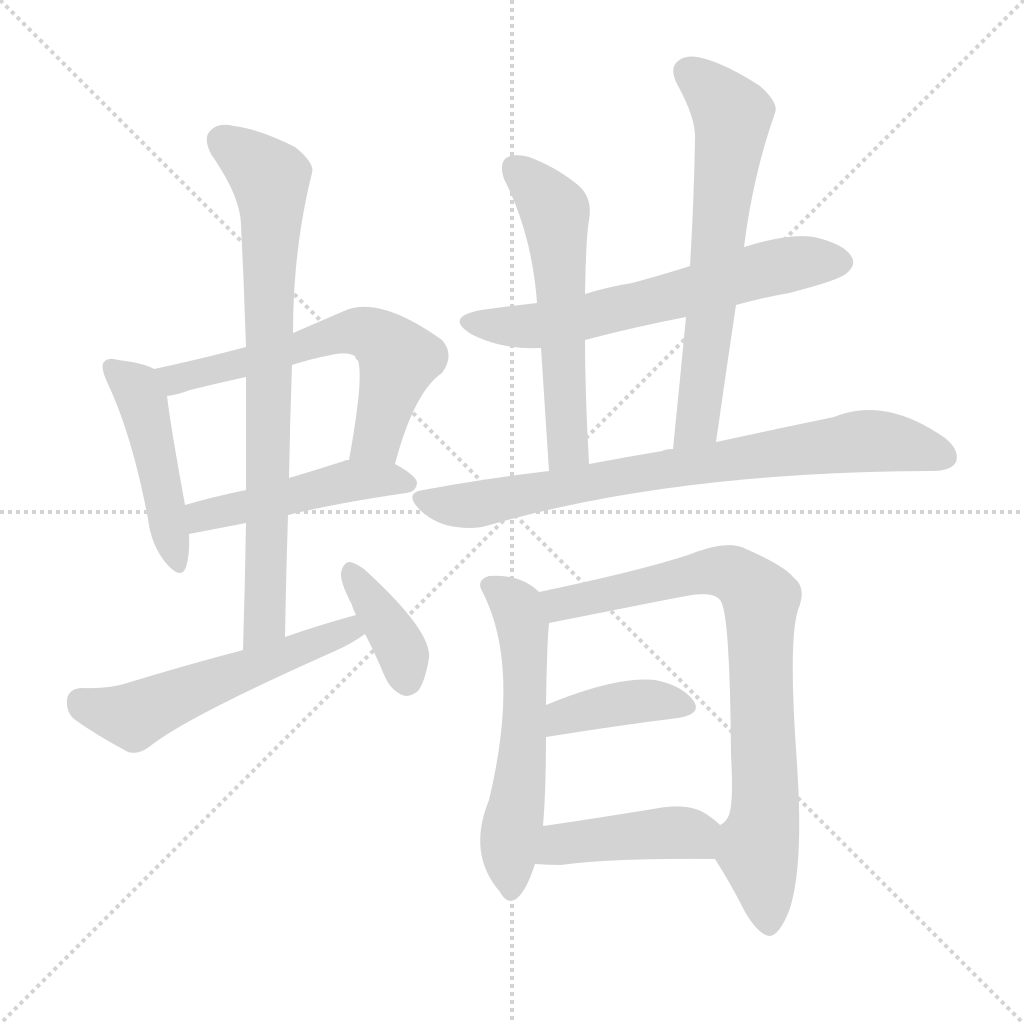
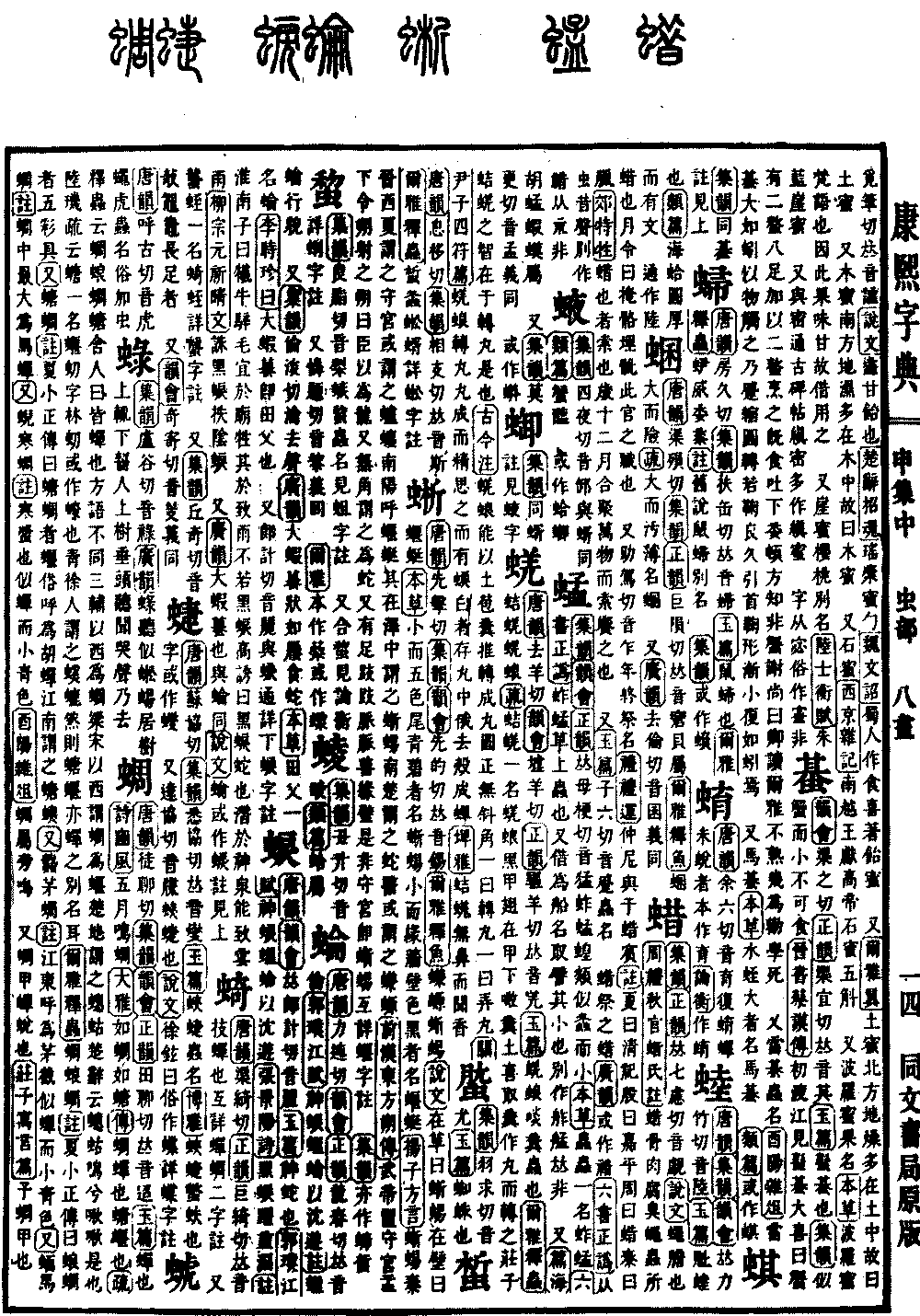
Shen Collection, Middle Volume. Radical: Insect (chóng). Kangxi strokes: 21. Page 1086, Entry 07.
Jiyun and Zhengyun: Pronounced qu.
Shuowen Jiezi (Shuowen): The larva of a housefly.
Book of Rites: Office of Autumn (Zhouli Qiuguan), Commentary on the Wax Official: The term refers to the place where decaying flesh and bone rot and become foul, acting as a host for fly larvae. The Monthly Ordinances (Yueling) states that burying exposed skeletal remains is the duty of this official.
Also pronounced zha. Refers to a year-end sacrificial ceremony.
Book of Rites (Liji), Evolution of Rites (Liyun): Confucius once participated in the wax sacrifice as a guest.
Commentary: The Xia dynasty called this the clear sacrifice (qingsi), the Yin dynasty called it the auspicious peace (jiaping), the Zhou dynasty called it wax, and the Qin dynasty called it la.
Book of Rites (Liji), Suburb Special Sacrifices (Jiaotesheng): Wax implies a seeking. Every twelfth month, all things are gathered to petition the spirits to consume the offerings.
Also Yupian: Pronounced cu. The name of an insect. Refers to the wax of the wax sacrifice.
Guangyun: Sometimes written as a variant.
Liushu Zhenge: Formed from the radical for insect and the phonetic component for the past (xi). Another written form using the spirit radical is incorrect.
Textual verification: Shuowen Jiezi: The larva of a housefly. Corrected in accordance with the original text, changing the erroneous character to the correct one.
La (wax):
Tangyun: Pronounced la.
Jiyun and Yunhui: Pronounced la.
Yupian: The residue of honey.
Lu Dian: Honeybees brewing honey must necessarily draw water from low-lying areas and inject it into the wax comb before honey can be formed. Thus, it is called wax, as it is the foundation of honey.
Compendium of Materia Medica (Bencao): Insect white wax.
Li Shizhen: The wax tree is evergreen; in the fifth month, it blooms with white flowers and forms clusters of fruit. There is an insect, similar in size to a louse, that crawls along the branches, drinks the sap, and spits out saliva. Peeling off this residue and refining it creates wax. There is also beeswax, produced within honey. Furthermore, there is water wax, whose leaves resemble those of an elm, as well as the sweet chinkapin tree; both can harbor insects to produce wax.
Book of Jin (Jinshu), Biography of Ruan Fu: Ruan Fu was naturally fond of wooden clogs. Someone came to visit him and saw him applying wax to his clogs. He remarked: How many pairs of wooden clogs can a person wear in one lifetime?
Biography of Shi Chong: Shi Chong lived an extravagant and wasteful life, using wax as fuel instead of firewood.
History of the Southern Dynasties (Nanshi), Biography of Wang Sengqian: In his youth, he cast a wax phoenix using candle drippings.
Also wax plum (lamei), the name of a flower.
Su Shi: Honeybees collect nectar to make yellow wax, and making flowers out of yellow wax is the same principle.
Also wax-beak (lazui), the name of a bird.
Compendium of Materia Medica (Bencao): The sanghu, also known as the wax-beak sparrow; its beak sometimes congeals into a yellow color like wax.
Guangyun: Commonly written as a variant.