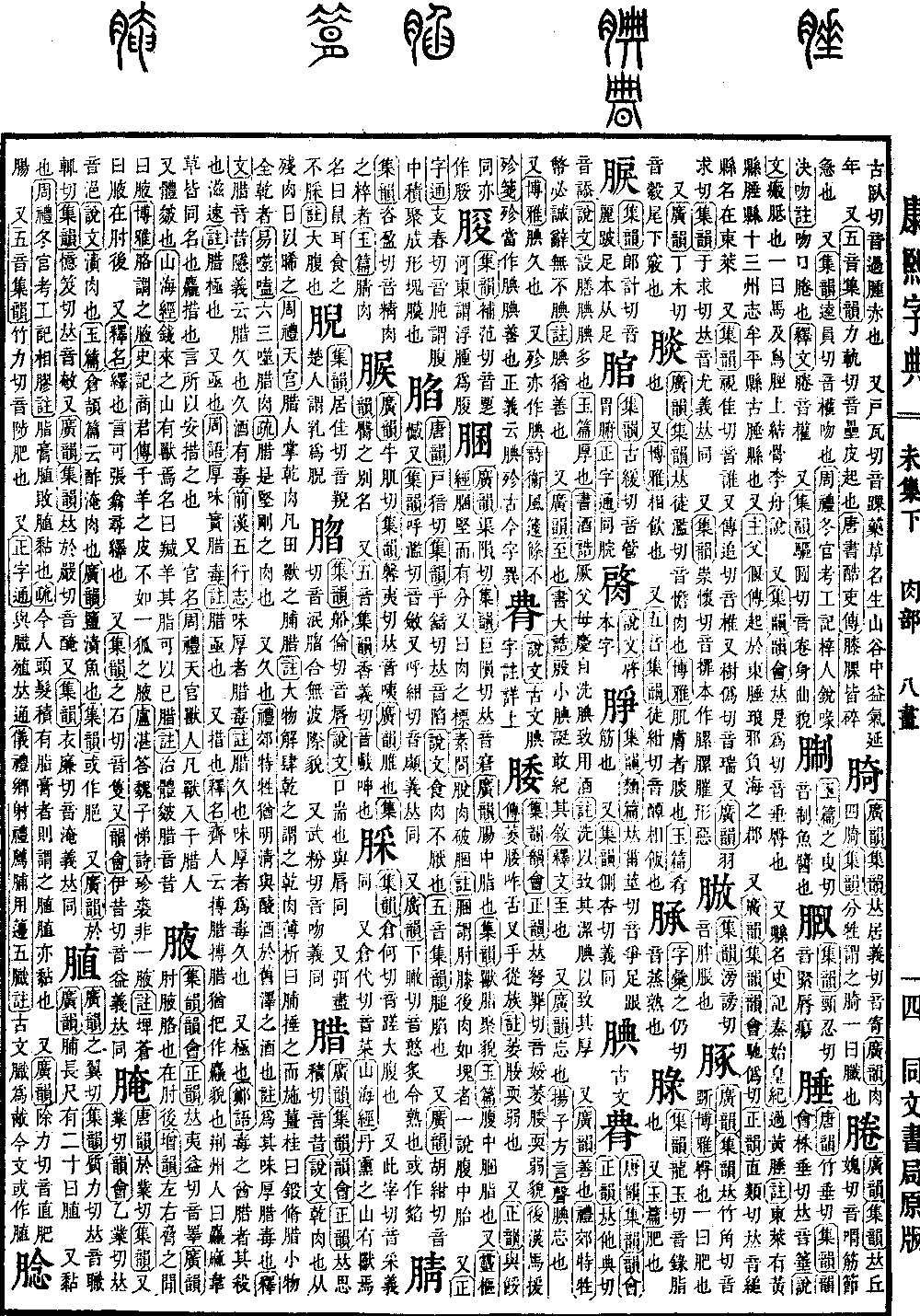
Wei Collection, Lower Volume
Radical: Meat (ròu)
Kangxi stroke count: 21
Page 986, Entry 01
Pronounced la.
According to the Explaining Graphs and Analyzing Characters (Shuowen Jiezi), it refers to the day of the third Xu day after the winter solstice, when a sacrifice is made to the hundred spirits. In the Book of Rites (Liji), Monthly Ordinances (Yueling), it states: In the first month of winter, perform the la sacrifice to the ancestors and the five household spirits. The commentary explains: This is what the Rites of Zhou (Zhouli) calls the zha sacrifice. In the History of the Former Han (Qianhan Shu), Annals of Emperor Wu, it states: Sacrifice to the spirits of the doors and thresholds, with rites similar to the la sacrifice. The commentary states: La refers to the sacrifice to the hundred spirits after the winter solstice.
In the Biography of Chen Sheng, it mentions the la month, when Chen Sheng arrived in Ruyin. The commentary by Zhang Yan states: The la month of the Qin dynasty corresponds to the ninth month of the Xia calendar. Chen Zan states: It is the month of Jianchou, the twelfth month of the Xia calendar.
According to the Zhengzitong, the Comprehensive Treatise on Customs (Fengsu Tong) and Cai Yong's Decisive Discourses (Duduan) state: During the Xia dynasty, it was called qingsi, during the Yin dynasty it was called jiaping, during the Zhou dynasty it was called zha, and during the Han dynasty it was called la. Another view, based on the Monthly Ordinances, suggests that performing the la sacrifice to ancestors and the five household spirits in the first month of winter has existed since ancient times and did not begin in the Han dynasty.
Zheng Xuan's commentary on the Monthly Ordinances states: La is what the Rites of Zhou calls zha. He was unaware that the la sacrifice is for ancestors and the zha sacrifice is for the hundred spirits; these two rites are distinct, and it is an error for Zheng Xuan to conflate them.
Jin dynasty scholar Zhang Liang argued: La signifies the intersection of time, and it is appropriate to perform sacrifices when the old year meets the new. Folk tradition calls the day after the la sacrifice the beginning of the year; the custom of celebrating the New Year since the Qin and Han dynasties stems from these ancient practices.
Daoist texts state there are five types of la: the first day of the first month is the celestial la, the fifth day of the fifth month is the terrestrial la, the seventh day of the seventh month is the moral la, the twelfth day of the tenth month is the people's annual la, and the formal la day in the twelfth month is the royal la.
According to the Guangya, la also means to seek or to demand. It also refers to the blade of a sword. The Rites of Zhou (Zhouli), Winter Officials (Dongguan Kaogongji), states: The Tao maker produces swords, with the widest part of the blade being two and a half inches. The commentary explains: La refers to the two edges of the sword. The sub-commentary explains: Two edges refers to both sides of the sword having sharp blades.
According to the Zhengzitong, Zhenla is the name of a southern barbarian state.
Pronounced lie. The meaning is the same.