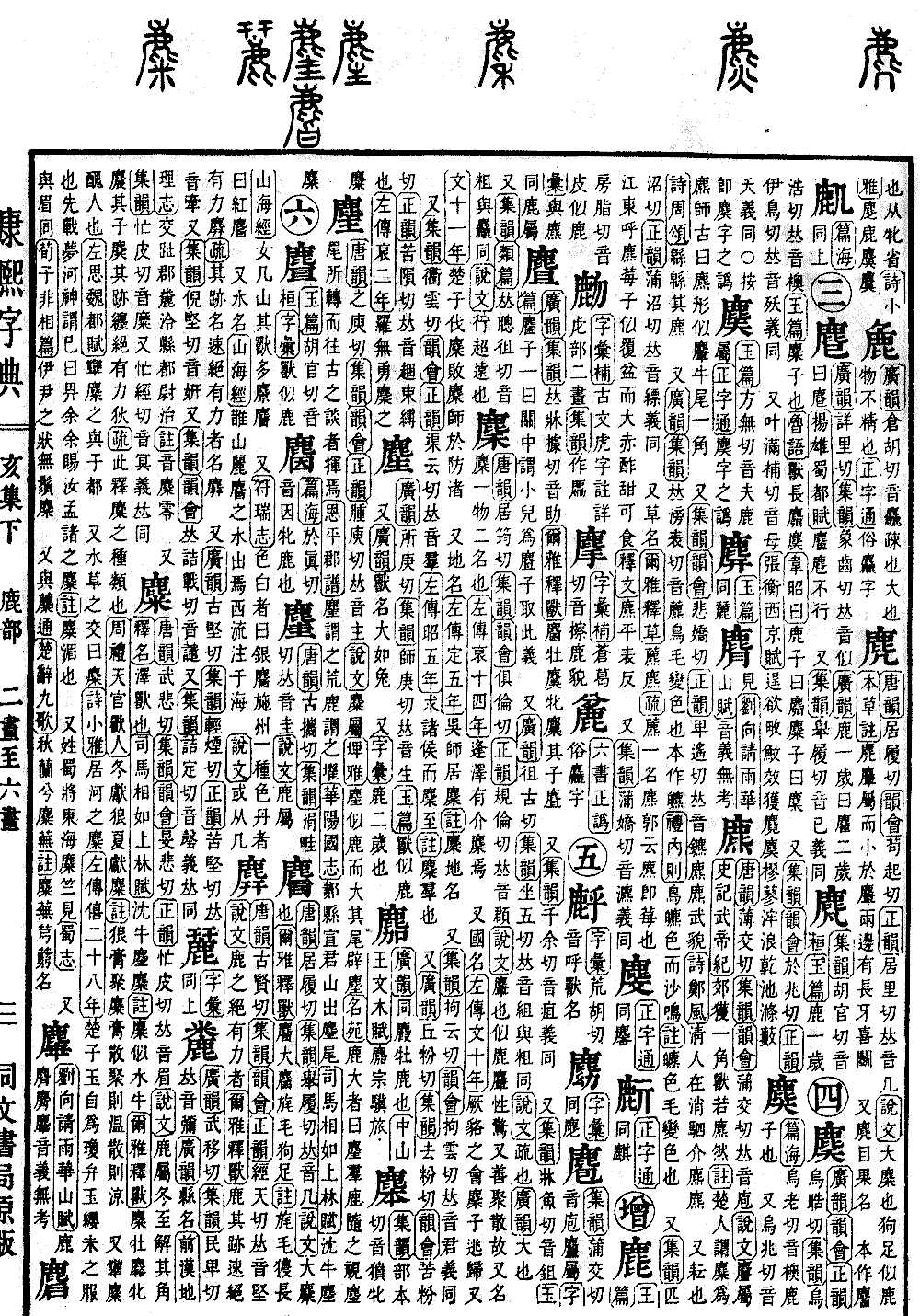
Hai Collection, Lower Volume
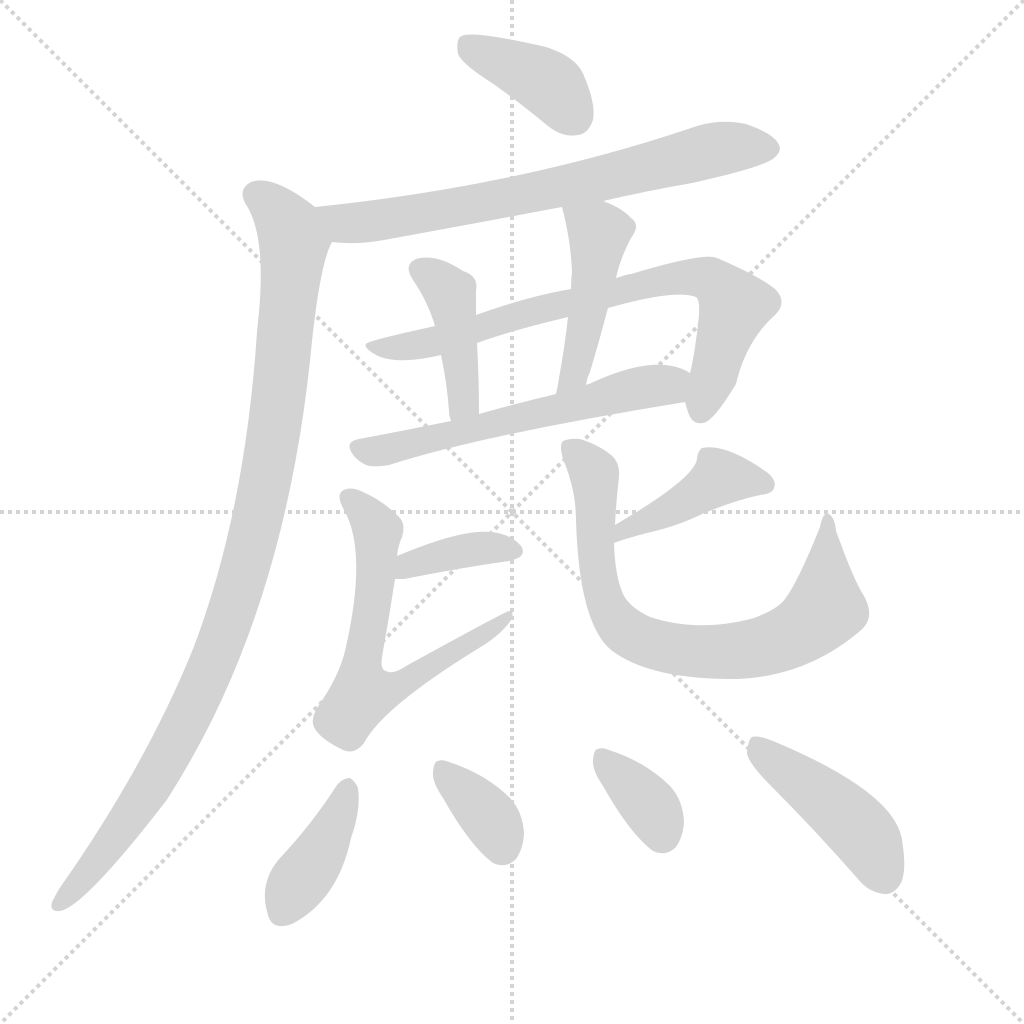
Radical: Deer (lù)
Kangxi Strokes: 15
Page 1509, Entry 11
Pronounced pao.
According to the Explanation of Writing (Shuowen), it is a type of deer.
In the Records of the Grand Historian (Shiji), Biography of Emperor Wu: At the suburb of Yong, a one-horned animal was captured, resembling a pao.
Commentary: The people of Chu call the milu deer a pao.
Citation of the Erya: A large deer is a pao. It has an ox tail and one horn.
Also pronounced biao.
Pao pao refers to a martial appearance.
In the Book of Odes (Shijing), Odes of Zheng: The men of Qing are in Xiao, with four armored horses looking martial (pao pao).
Also means to weed.
In the Book of Odes (Shijing), Odes of Zhou: Continuous is the weeding.
Also pronounced piao.
Refers to the changing color of bird feathers. Originally written as biao.
In the Book of Rites (Liji), Inner Chapters: When the bird's feathers change color and it makes a screeching sound.
Commentary: Changing color means the feathers are discolored.
Also pronounced piao.
Meaning is the same.
Also a plant name.
In the Erya, Explaining Plants: Piao pao.
Commentary: Piao is also named pao. Guo Pu states: The pao is the raspberry. People in Jiangdong call it the pao berry, which resembles a raspberry but is larger, deep red, sour and sweet, and edible.
Explanation of Text: Piao, pronounced piao.
Also pronounced biao.
Meaning is the same.
Textual research:
In the Records of the Grand Historian (Shiji), Biography of Emperor Wu: At the suburb, a one-horned animal was captured, resembling a pao.
Commentary: The people of Chu call the milu deer a pao. Yan Shigu stated the pao resembles a muntjac.
Note: There is a missing character for Yong after suburb. Yan Shigu’s comment is not from the original Shiji commentary. According to the original text, the character for Yong has been added after suburb, and the seven characters regarding Yan Shigu have been replaced by the citation of the Erya regarding the large deer.