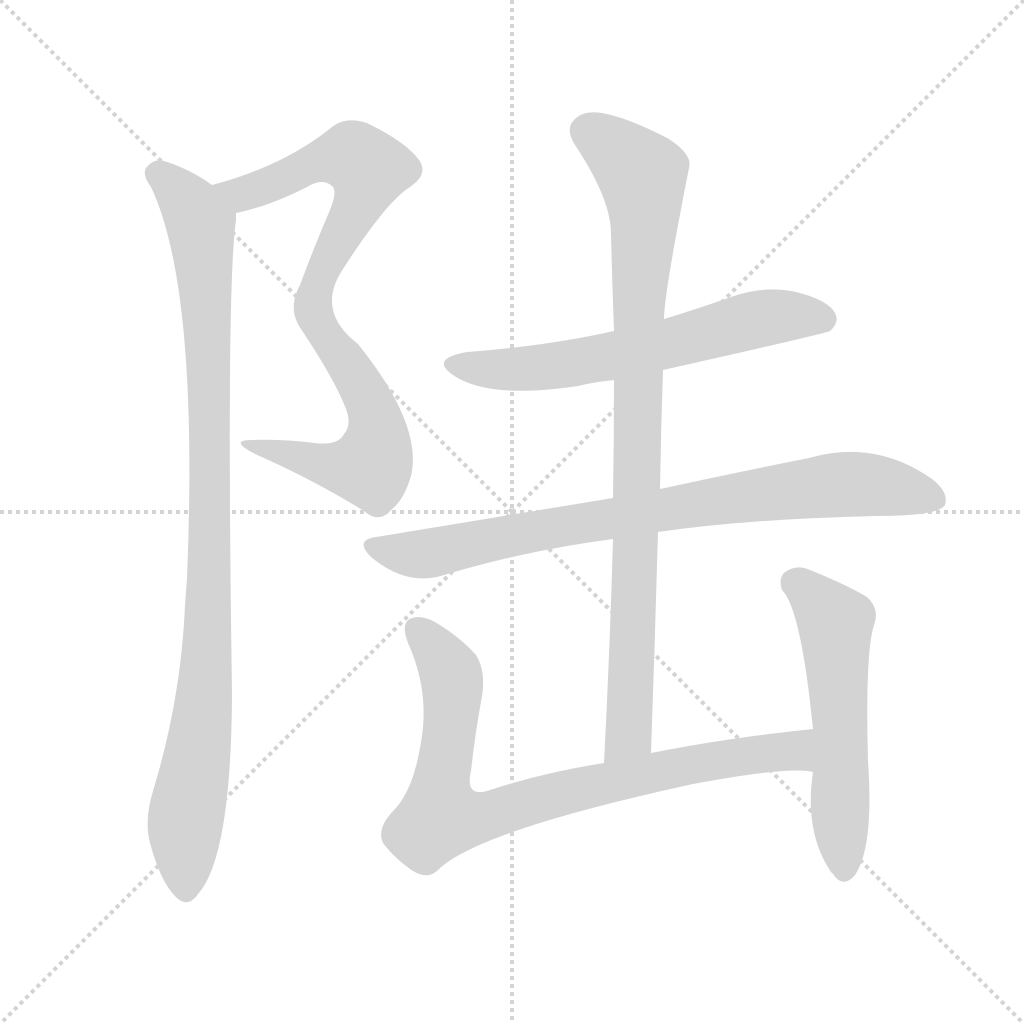
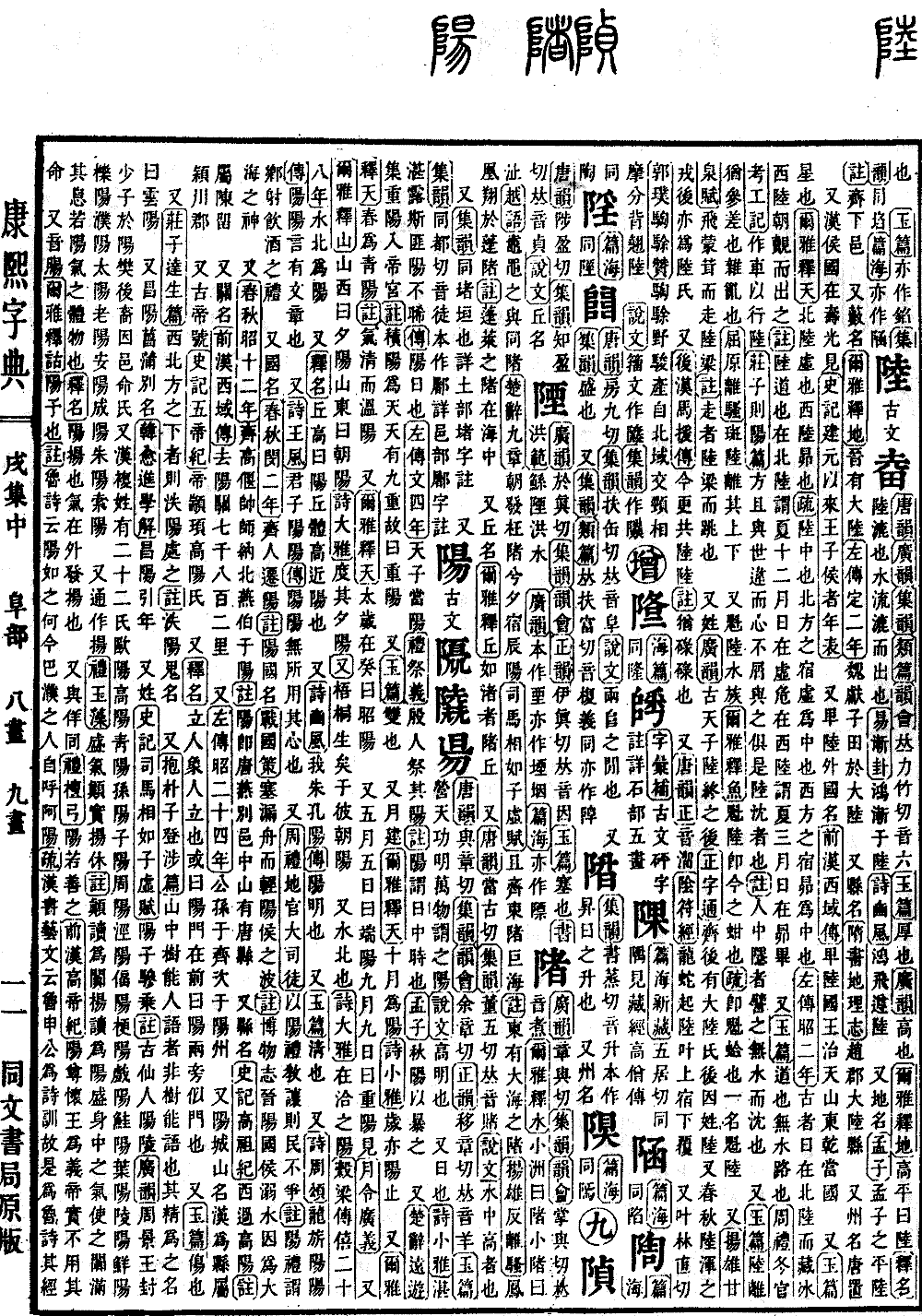
Xu Collection, Middle Volume. Radical: Mound (fu). Lu; Kangxi stroke count: 16; Page 1355.
Ancient form. Tang Rhymes (Tangyun), Broad Rhymes (Guangyun), Collected Rhymes (Jiyun), Classified Chapters (Leipian), and Rhyme Assembly (Yunhui) all state the pronunciation is derived from the initial of li and the final of zhu, sounding like liu.
Jade Chapters (Yupian) defines it as thick. Broad Rhymes defines it as high. Erya (Erya) in its section on the earth states that high and level ground is called lu. Explaining Names (Shiming) states that lu means to drain or filter, referring to water flowing out and leaving dry land. "The wild geese gradually reach the high plateau" — Book of Changes (Yijing). "The wild geese fly along the land" — Book of Odes (Shijing).
Also a place name. "Mencius went to Pinglu" — Mencius (Mengzi). Note: A minor town in the state of Qi.
Also the name of a marsh. Erya states that the state of Jin has Dalu. "Wei Xianzi hunted at Dalu" — Zuo Commentary (Zuozhuan), second year of Duke Ding.
Also a county name. Dalu County in Zhao Prefecture — Book of Sui (Suishu).
Also a prefecture name, established during the Tang dynasty.
Also a Han dynasty marquisate located in Shouguang. See the Chronological Table of Marquisates since the Jianyuan Era in the Records of the Grand Historian (Shiji).
Also the name of a foreign state. In the Records of the Western Regions in the Book of Han (Hanshu), the King of Lu ruled from the Qiandang region in the Tianshan Mountains.
Jade Chapters also defines it as a star. Erya in its section on the heavens states that the northern lu is the Xu mansion and the western lu is the Mao mansion. Commentary: Lu means middle. Among the northern asterisms, Xu is the center; among the western asterisms, Mao is the center. Zuo Commentary, second year of Duke Zhao: "In ancient times, when the sun was in the northern lu, ice was stored; when it was in the western lu at dawn, the ice was brought out." Note: Lu means path. In the northern lu refers to the twelfth month of the Xia calendar when the sun is in the Xu and Wei mansions. In the western lu refers to the third month of the Xia calendar when the sun is in the Mao and Bi mansions.
Jade Chapters also defines it as a path or a road without water. Record of Trades (Kaogongji) in the Rites of Zhou (Zhouli): "Constructing carriages to travel by land." Zhuangzi (Zhuangzi): "One who is at odds with the world and does not deign to go along with it is one who sinks on dry land." Note: Refers to a hermit living among common people, likened to one who sinks where there is no water.
Jade Chapters also uses the term luli to mean uneven, variegated, or scattered. "Their dappled colors flash and flicker up and down" — On Encountering Sorrow (Lisao).
Also kuilu, an aquatic creature. Erya in its section on fish states that kuilu is the modern blood clam. Commentary: It is the bloody clam, also called kuilu.
Yang Xiong's Rhapsody on the Ganquan Palace (Ganquan Fu): "Flying through tangled vegetation and jumping across the land." Note: The term refers to jumping or leaping across land.
Also a surname. Broad Rhymes states it is from the descendants of the ancient emperor Lu Zhong. Correcting Character Forms (Zhengzitong) states the state of Qi had a Dalu clan, which later used the surname Lu. Also the Luhun nomads of the Spring and Autumn period later adopted the Lu surname.
Also used in the Biography of Ma Yuan in the Book of the Later Han (Houhanshu): "Now we are just ordinary together." Note: Similar to the term lulu, meaning mediocre or ordinary.
Also pronounced as liu in Correcting Tang Rhymes. "Dragons and snakes rise from the land" — Scripture of the Hidden Accord (Yinfujing). It rhymes with the preceding and following lines.
Also used as a rhyming word pronounced as lu. Guo Pu's Praise of the Taotu: "The Taotu is a wild steed, born in the northern regions. They rub necks together and turn their backs to leap."
The character is written in the Zhou dynasty style in Seal Script (Shuowen). Collected Rhymes notes it is written in a variant form. It was originally written with the mound radical, or sometimes found identical to the Zhou dynasty style character for lu.